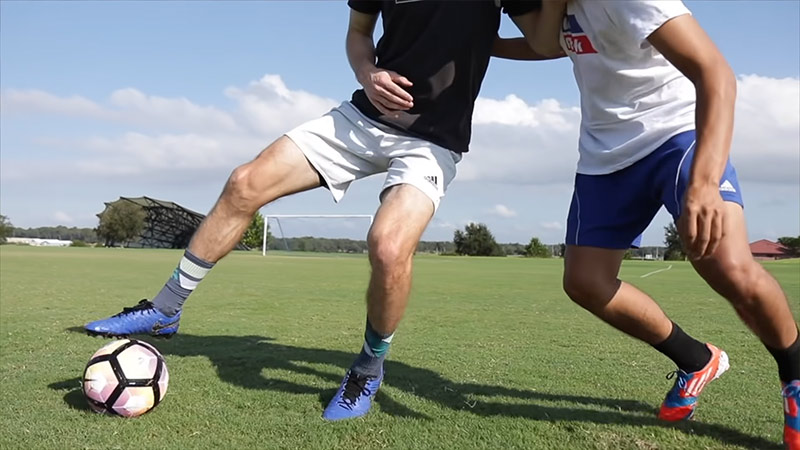
In the fast-paced world of global soccer, the boundary between tactical physicality and a whistle-blowing foul is often razor-thin.
While many newcomers label it a non-contact sport, experienced players know that winning the ball requires a sophisticated use of the body. One of the most frequently asked questions by athletes and fans alike is: Is pushing allowed in soccer?
Navigating the intricate Laws of the Game requires more than just speed; it demands an understanding of how to leverage physical presence without violating IFAB standards. This guide analyzes the nuances of legal contact, illegal pushes, and refereeing criteria.
Understanding the Fundamental Rules of Contact
In high-performance soccer, physicality is an essential component of the game’s strategic landscape. However, the term “pushing” carries a specific negative connotation within the officiating framework.
Generally, pushing is not allowed in soccer and is strictly classified as a foul. The primary goal of the referee is to ensure that no player gains an unfair advantage through the use of force that displaces or endangers an opponent.
The Mechanics of an Illegal Push
An illegal push occurs when a player uses specific body parts to exert force on an opponent. According to the standard regulations, using hands, arms, or elbows to shove or displace an opponent is a foul.
This displacement is the key factor; if a player’s momentum is halted or redirected because of an extension of the arms, the official is likely to blow the whistle.
Consequences for Illegal Physicality
When a referee determines that a push has occurred, the immediate result is a direct free kick for the opposing team. This penalty shifts the momentum of the game and can be devastating if the foul occurs near the goal.
Furthermore, if the illegal push occurs within the offending player’s own penalty area, it results in a penalty kick, which is a high-probability scoring opportunity for the opposition.
The Strategic Application of Legal Physicality
While the literal act of pushing with the hands is prohibited, the game allows for significant physical contact through sophisticated body positioning and “fair charges”.
This distinction is what separates elite defenders from those who frequently concede fouls. Understanding how to use your frame without crossing the line into a violation is a hallmark of world-class play.
Mastering the Fair Charge
The most common form of legal contact is the “shoulder-to-shoulder” challenge. This maneuver is generally permitted under very specific circumstances:
- Competing for the Ball: Both players must be actively attempting to play the ball rather than simply trying to knock the opponent over.
- Playing Distance: The contact must occur while the ball is within playing distance of both participants.
- Body Positioning: The arms must be kept down against the body, and the force must be delivered through the shoulder rather than the hands or elbows.
The Art of Defensive Shielding
Shielding is another legal tactic where a player uses their body as a barrier to protect the ball from an opponent.
A player in possession of the ball may legally “shield” the ball, provided they do not use their hands or arms to actively push the opponent away. This requires a strong lower body and a low center of gravity.
As long as the player is focused on maintaining possession and keeping their body between the defender and the ball, the contact is considered a natural part of the game.
How Referees Categorize Physical Misconduct
Officiating is not merely about identifying contact; it is about evaluating the intensity and intent behind that contact. Referees utilize a three-tier system defined by the International Football Association Board (IFAB) to judge physical interactions on the pitch.
| Criteria | Definition | Disciplinary Action |
|---|---|---|
| Careless | A simple lack of attention, consideration, or precaution when making a challenge. | Direct Free Kick (Foul only). |
| Reckless | Acting with complete disregard for the danger to, or consequences for, an opponent. | Direct Free Kick and a Yellow Card. |
| Excessive Force | Exceeding the necessary use of force and endangering the safety of an opponent. | Direct Free Kick and a Red Card. |
The Role of Discretion in Modern Officiating
The legality of contact often depends on the body part used and the referee’s discretion regarding force. This subjective element is why players must adapt to the “temperature” of a match.
Some officials allow a more physical game, while others may whistle for even minor instances of “careless” contact to maintain control of the environment.
Identifying the Line Between Careless and Reckless
The transition from a simple foul to a cardable offense usually involves the speed of the player and the extension of the limbs.
If a player enters a challenge with their elbows up or at a high rate of speed that prevents them from stopping, a referee may deem the action “reckless”. This is particularly true in “fifty-fifty” balls where both players are sprinting toward a central point.
The “Endangering Safety” Standard
Excessive force is the most serious category and is reserved for actions that the referee believes could cause injury.
This includes pushes that send a player into the advertisement boards or challenges where the force used is far beyond what is required to win the ball.
In these cases, the integrity of the sport and the safety of the athletes take precedence over the flow of the game.
Tactical Advantages of Masterful Physical Play
Dominating the physical aspect of soccer is not about being the strongest person on the field; it is about using physics and timing to your advantage.
Players who understand that “is pushing allowed in soccer” is a question of technique rather than brute strength often find themselves winning more duels and maintaining higher possession percentages.
Lowering the Center of Gravity
To win a shoulder-to-shoulder challenge without fouling, a player should aim to get slightly lower than their opponent.
By driving through the legs and making contact with the shoulder while keeping the arms tucked, a player can displace an opponent legally.
This uses the opponent’s own momentum against them, making the challenge look like a natural collision rather than an intentional shove.
Anticipating the Official’s Perspective
Professional athletes are taught to look at the ball, not the player, during a challenge. If a referee sees a player looking at their opponent while extending their arms, a foul is almost certain.
However, if the player is focused on the ball and the contact occurs as a byproduct of a legitimate tackle or shield, the official is much more likely to let play continue.
Enhancing Your Game: Practical Drills and Tips
To internalize these rules, players should focus on drills that emphasize body positioning over arm usage.
Practice sessions should include “king of the ring” scenarios where players must shield the ball from multiple defenders without using their hands. This builds the necessary core strength and balance to compete at a high level.
Developing the “No-Hands” Habit
During training, players should consciously focus on keeping their hands down. A common mistake is to reach out when losing balance, which often leads to a “careless” or “reckless” push.
By training the body to find balance through the core and feet, players reduce the risk of conceding unnecessary free kicks in dangerous areas.
The Importance of Playing Distance
Always ensure you are within “playing distance” of the ball before initiating contact. If you challenge an opponent who is far away from the ball, even a shoulder-to-shoulder bump will likely be called as an obstruction or an illegal charge.
The ball is the “legalizing” factor in any physical interaction on the soccer field.
Frequently Asked Questions About Soccer Contact
Can you push with two hands?
No. Using two hands to push an opponent is almost always called as a foul. It is seen as a deliberate act of displacement rather than a tactical challenge for the ball.
This is especially true in the air, where a two-handed shove can cause a player to lose their balance and land dangerously.
Is a “gentle” push allowed?
While “careless” contact is the lowest tier of foul, it is still a foul. Even a gentle push that displaces an opponent can result in a direct free kick.
The only “gentle” contact that is generally permitted is the incidental touching that occurs when two players are running side-by-side or competing for space during a corner kick.
What happens if both players are pushing?
If two players are equally engaged in physical contact—such as mutual shirt-pulling or jostling—referees often allow play to continue, assuming neither player has gained an unfair advantage.
However, if one player’s actions become “reckless” or involve “excessive force,” the referee will intervene and penalize the primary aggressor.
Mastering Legal Contact: A Strategic Blueprint for Physical Success
Navigating the physical demands of soccer requires a deep understanding of the IFAB Laws of the Game.
While the simple answer to “is pushing allowed in soccer” is no, the reality is a nuanced landscape where body positioning and fair charging are essential tools for any elite athlete.
By focusing on legal shoulder-to-shoulder contact, maintaining playing distance, and mastering the art of shielding, players can dominate their opponents without risking disciplinary action.
Success on the pitch is found at the intersection of strength, timing, and an unwavering commitment to the rules of the game.
Always remember that the goal is to win the ball, not just to move the opponent. When you prioritize the ball and respect the safety of your fellow athletes, you embody the true spirit of the beautiful game.