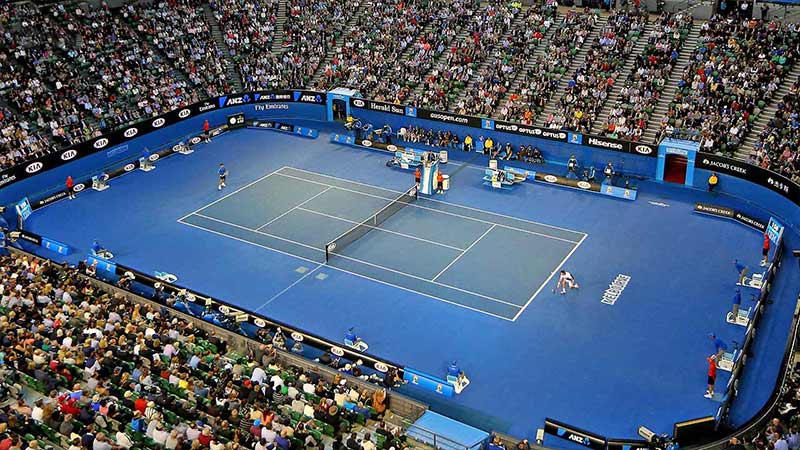
In its most rigorous definition, a Grand Slam refers to the accomplishment of winning all four major championships—the championships of Australia, France, Britain (Wimbledon), and the United States—within a single calendar season. The term was borrowed from the card game contract bridge, where it denotes winning every possible trick.
While the modern era often uses “Grand Slam” to refer to an individual tournament (e.g., “She won a Grand Slam today”), purists and governing bodies like the International Tennis Federation (ITF) maintain that the “true” Grand Slam is the calendar-year sweep.
The Variants of Excellence
To distinguish between various tiers of greatness, the sport recognizes several specific designations:
- The Calendar-Year Grand Slam: Winning all four titles in one discipline between January and September.
- The Non-Calendar-Year Grand Slam: Holding all four major titles simultaneously, but across two different calendar years (e.g., winning the US Open in Year 1 and the remaining three in Year 2).
- The Career Grand Slam: Winning each of the four majors at any point during a professional career.
- The Golden Slam: An elite milestone achieved by winning all four majors plus an Olympic or Paralympic gold medal in a single year—a feat famously pioneered by Steffi Graf in 1988.
The Four Pillars: Analyzing the Majors
Each of the four Grand Slam tournaments offers a unique challenge, testing a player’s ability to adapt to different climates, surfaces, and traditions. These events are overseen by the ITF and provide the highest ranking points and prize money in the sport.
1. The Australian Open: The “Happy Slam”
Held annually in January at Melbourne Park, the Australian Open is the first major of the calendar year.
- Surface: Hard court (currently using GreenSet).
- Identity: Known for its innovation, it was the first major to feature indoor play with retractable roofs and the first to utilize “Hawk-Eye Live” electronic line calling.
- Scale: In 2024, it set a record for the highest attendance of any Grand Slam, with over 1,020,000 spectators.
2. The French Open (Roland Garros): The Test of Endurance
Staged in Paris between late May and early June, the French Open is the only major played on red clay.
- The Challenge: Clay courts slow down the ball and produce a high bounce, making it widely considered the most physically demanding tournament in the world.
- History: Originally a closed event for French club members starting in 1891, it opened to international competitors and achieved major status in 1925.
3. Wimbledon: The Cathedral of Tennis
As the oldest tennis tournament in the world (founded in 1877), Wimbledon is the sport’s most prestigious event.
- Surface: The only major still played on grass, the game’s original surface.
- Traditions: Players must adhere to a strict all-white attire code and are referred to as “Gentlemen” and “Ladies”. It remains a bastion of tradition, including the royal box and the requirement to bow or curtsy to the monarch or Prince of Wales.
4. The US Open: The Electric Finale
The final major of the year takes place at the USTA Billie Jean King National Tennis Center in New York.
- Surface: Hard court.
- Innovation: The US Open has pioneered several sport-wide changes, including night matches under floodlights (1975), equal prize money for men and women (1975), and the introduction of the tiebreak system (1970).
- Scale: It houses Arthur Ashe Stadium, the largest tennis stadium in the world with a capacity of 23,771.
The Immortals: Who Has Achieved the Grand Slam?
Achieving a calendar-year Grand Slam is so difficult that only five singles players have ever accomplished it.
Singles Grand Slam Winners
- Don Budge (1938): The first player to sweep all four majors in one year.
- Maureen Connolly (1953): The first woman to achieve the feat.
- Rod Laver (1962 & 1969): The only player to achieve the Grand Slam twice, once as an amateur and once in the Open Era.
- Margaret Court (1970): Secured the sweep in the early years of the Open Era.
- Steffi Graf (1988): Not only won the Grand Slam but added an Olympic Gold to complete the first-ever Golden Slam.
Doubles and Mixed Doubles Excellence
The feat is equally rare in other disciplines. Frank Sedgman and Ken McGregor achieved the doubles Grand Slam in 1951. In mixed doubles, Margaret Court and Ken Fletcher completed the sweep in 1963.
More recently, wheelchair stars Diede de Groot and Dylan Alcott have dominated their fields, completing calendar-year Grand Slams in both singles and doubles.
The Evolution of the Game: Amateurism to the Open Era
The history of the Grand Slam is divided by the landmark year of 1968. Prior to this, the majors were restricted to amateur players.
The “Shamateurism” Era
In the mid-20th century, top players were forbidden from earning prize money. This led to “shamateurism,” where players received secret, under-the-table payments to remain in the amateur circuit rather than joining professional tours.
Many legends, like Ken Rosewall and Rod Laver, were excluded from the Grand Slams during their peak years because they had turned professional.
1968: The Birth of Open Tennis
The pressure to modernize finally broke the amateur-professional divide. The 1968 French Open was the first Grand Slam of the “Open Era,” allowing all players to compete regardless of their status.
This transition unified the sport and paved the way for the multi-million dollar prize pools seen today, such as the A$ 111.5 million total purse for the 2026 Australian Open.
Advanced Concepts in Tennis Mastery
Beyond the standard Grand Slam, elite players chase specialized milestones that demonstrate surface versatility and historical longevity.
The Career Grand Slam
Winning all four majors over a career is a hallmark of the all-time greats. In the men’s game, icons like Andre Agassi, Roger Federer, Rafael Nadal, and Novak Djokovic have reached this milestone.
On the women’s side, Chris Evert, Martina Navratilova, Serena Williams, and Maria Sharapova are among the few who have conquered every surface.
The Channel Slam
Considered one of the most difficult feats, the Channel Slam involves winning the French Open and Wimbledon in the same year.
This requires a player to transition from the slow, sliding clay of Paris to the fast, low-skidding grass of London in just a few weeks—a massive physical and tactical shift.
The Surface Slam
Since 1978, when the US Open moved to hard courts, it has been possible to achieve a Surface Slam—winning majors on clay, grass, and hard courts in a single year. This serves as the ultimate proof of a player’s tactical range.
The Boxed Set
The rarest of all collections is the “Boxed Set”—winning the singles, doubles, and mixed doubles titles at every one of the four majors. Only three women have ever achieved this: Doris Hart, Margaret Court, and Martina Navratilova.
Strategic Insights: Why These Titles Matter
For players, the Grand Slams are the primary drivers of legacy and financial value. For fans and sponsors, they represent the pinnacle of sports broadcasting and engagement.
Ranking Power
Grand Slams offer 2,000 ranking points to the winner, far more than any other tournament on the ATP or WTA tours.
Media Reach
These events command global television audiences and record-breaking digital engagement, such as the US Open’s extensive social media presence and broadcast reach on networks like ESPN and Sky Sports.
Technological Leadership
From the introduction of retractable roofs at the Australian Open to the pioneering of electronic line calling at the US Open, the Grand Slams are where the future of sports technology is tested and implemented.
Enhanced FAQ: Dominating the Knowledge Graph
Who has won the most Grand Slam singles titles?
While the “Grand Slam” refers to the four-in-one-year feat, the record for most individual major titles is a separate battle for history. Legends like Novak Djokovic and Serena Williams have set the modern benchmark for career titles.
Is the “Golden Slam” harder than the Grand Slam?
Yes. A Golden Slam can only be attempted once every four years during an Olympic season. Winning all four majors and the Olympic Gold Medal in a single year has only been achieved by Steffi Graf (1988) in singles, and Diede de Groot and Dylan Alcott in wheelchair tennis.
What happens if a player wins all four majors, but not in the same year?
This is called a Non-calendar-year Grand Slam. Novak Djokovic achieved this in 2015–2016, and Serena Williams did it twice (the “Serena Slam” in 2002–03 and 2014–15).
Conclusion: The Eternal Pursuit
The Grand Slam remains the “Holy Grail” of tennis because it demands perfection across an entire year. It requires a player to be a master of the clay, the grass, and the hard court, while maintaining peak physical and mental form from January to September.
As the sport continues to evolve with faster courts and new technologies, the challenge of the Grand Slam stands as a timeless testament to human resilience and sporting excellence.