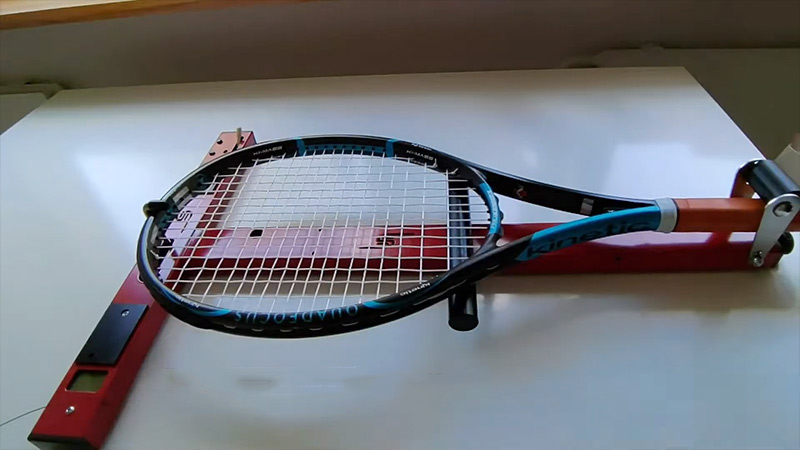
In the landscape of professional tennis, the technical nuances of equipment can be the deciding factor between peak performance and physical injury.
One of the most persistent technical debates among competitive players and stringers involves the relationship between string tension and the structural integrity of the racquet. Specifically, does increasing string tension actually increase racquet stiffness?
To answer this with the precision required for high-level play, we must differentiate between the physical properties of the carbon fiber frame and the mechanical response of the string bed.
Understanding the Constants: Frame Rigidity and the RA Scale
The physical frame of a racquet is a static entity once it leaves the factory floor. Its stiffness—often referred to as its “rigidity”—is a fundamental property of the materials used in its construction, such as high-modulus graphite, basalt, or aramid fibers.
Racquet stiffness is defined as the rigidity of the physical frame itself. This property is commonly quantified using an RA scale, a standard measurement that indicates how much a frame deforms under a specific load. It is a critical distinction to make: string tension does not alter the physical property of the frame’s stiffness.
Whether you string a racquet at 30 pounds or 70 pounds, the frame’s structural resistance to bending remains constant. The carbon layup and geometry of the hoop and throat are set in stone. However, the perception of stiffness changes dramatically based on the tension of the string bed.
The Variable: String Bed Stiffness
While the frame is static, the string bed is dynamic. This is where the confusion between tension and stiffness typically arises. String bed stiffness refers to how rigid the grid of strings feels during contact with the ball.
When a technician pulls more tension on a stringing machine—for instance, increasing the load from 50 to 60 pounds—they are making that specific grid more rigid. This is a temporary mechanical state.
Over hours of play, strings lose tension, and the string bed stiffness decreases, even though the frame’s RA rating remains the same.
The Trampoline Analogy: Elasticity vs. Rigidity
To visualize how this affects your game, it is helpful to think of the strings as a trampoline.
- Low Tension (40–50 lbs): At these lower tensions, the strings retain a high degree of elasticity. Upon impact, the strings stretch easily, acting like a loose trampoline that catapults the ball back across the net. This “trampoline effect” provides a softer feel and significantly more power with less effort from the player.
- High Tension (55–65 lbs): Conversely, high tension creates a tight, rigid surface. These strings are already stretched near their limit, meaning they have very little “give” left when the ball hits them. They stretch less, which fundamentally changes the ball’s exit characteristics.
Performance Implications: Power vs. Control
The decision to increase tension is rarely about making the racquet “stiffer” in a structural sense, but rather about managing the ball’s dwell time on the strings.
High Tension and the Quest for Control
When you play with a rigid string bed, the ball spends less time in contact with the strings. This reduction in dwell time translates to increased control.
Because the string bed does not deform as much, the ball does not “sink” into the racquet, meaning its trajectory is determined more by the angle of the racquet face and less by the elastic snap-back of the strings. The trade-off, however, is a substantial loss in power.
Low Tension and the Generation of Power
Lower tensions maximize the dwell time. As the ball sinks into the strings, it stores potential energy that is then released as kinetic energy.
While this provides effortless depth, it can make the racquet feel “mushy” or unpredictable for players with high swing speeds who require pinpoint accuracy.
The Physiological Cost: Shock Absorption and Joint Health
Beyond the scoreline, the interplay between frame rigidity and string tension has profound implications for a player’s physical longevity. The primary function of a string bed during impact is to act as a shock absorber.
A stiffer string bed deflects less upon impact. When the strings do not move, the energy of the ball hitting the racquet has nowhere to go but into the frame and, subsequently, into the player’s arm. This lack of shock absorption is the leading contributor to equipment-related injuries.
The “Stiff-Stiff” Trap
The most dangerous equipment configuration for a tennis player is the pairing of a high-RA frame with high string tension.
- Frame Threshold: Any racquet with an RA rating above 67 is considered very stiff.
- The Risk: Pairing such a rigid frame with high string tension (e.g., 60+ lbs) is a common mistake among amateurs.
This combination creates a setup that offers almost no energy dampening. The result is a high-frequency vibration that travels through the handle and into the tendons of the elbow. Over time, this leads to joint fatigue and chronic conditions like tennis elbow.
Strategic Customization: Optimizing Your Setup
To achieve a professional-grade setup, you must balance your frame’s inherent properties with your stringing choices.
- If you use a stiff frame (RA 68+): Consider dropping your tension into the low 50s or high 40s. This allows the string bed to compensate for the frame’s lack of flex, protecting your arm while still providing the power associated with a rigid frame.
- If you use a flexible frame (RA 60-64): You have more room to experiment with higher tensions. Since the frame itself will bend and absorb some of the impact, a tighter string bed can provide the control you need without making the overall experience feel too harsh on the joints.
Frequently Asked Questions
Does a racquet lose stiffness over time?
Yes, but this is due to “frame fatigue”—the breakdown of carbon fibers over thousands of impacts—not because of the string tension. The frame’s physical rigidity will eventually decrease, making it feel “dead,” but this is independent of your tension settings.
Will my racquet break if I string it too tightly?
Modern high-quality frames are engineered to withstand significant tension. However, exceeding the manufacturer’s recommended tension range can put undue stress on the “shoulders” of the racquet hoop, potentially leading to warping or structural failure if the frame already has micro-fractures.
How often should I restring to maintain the right stiffness?
Because string bed stiffness is a variable that decreases as the strings lose their “elastic memory,” you should restring whenever you feel a loss of control or a “launchy” feel. A common rule of thumb is to restring as many times per year as you play per week.
Conclusion: Engineering Your Game
Understanding that string tension does not change the physical frame is the first step toward a more sophisticated approach to the game.
By acknowledging that tension only increases the string bed stiffness, you can make data-driven decisions that enhance your ball control, maximize your power, and—most importantly—shield your arm from the damaging effects of impact shock.
In the modern game, the most effective tool is not necessarily the stiffest one, but the one that is calibrated to your physical needs and your tactical style.
Choose your tension not just for the points you want to win, but for the years of tennis you want to play.