In the world of high-performance athletics, the margin between a championship-winning shot and an unforced error often comes down to the precision of one’s equipment.
For many emerging players and enthusiasts, a recurring question dominates the initial stages of gear selection: Do tennis rackets come in specific left-handed or right-handed versions?
The answer is fundamental to the design of the sport’s modern equipment. Every standard tennis racket manufactured today is built with a symmetrical, octagonal handle.
This engineering choice ensures that a single racket is a universal tool, adaptable to any player regardless of their dominant hand.
While many other sports—such as golf or baseball—require hand-specific equipment, tennis relies on the versatility of the handle to accommodate the diverse biomechanics of its global player base.
This guide explores the engineering behind the tennis racket, the nuances of grip customization for left-handed players, and the critical importance of sizing in achieving peak performance on the court.
The Architecture of Symmetry: Understanding the Octagonal Handle
To understand why a specific “lefty” racket does not exist, one must examine the geometry of the handle. The handle of a tennis racket is not a simple cylinder; it is a meticulously designed octagon.
This eight-sided structure serves a specific mechanical purpose. The bevels of the octagon provide tactile feedback to the player, allowing them to identify their grip position (such as Eastern, Continental, or Western) without looking at the racket.
Because the octagon is perfectly symmetrical, the “beveled” feedback is identical whether you approach the handle from the left side or the right.
This symmetry allows for a seamless transition between various strokes. Players adjust their hand placement for different shots, such as moving from a forehand to a backhand, simply by rotating the handle within their palm.
For a left-handed player, this rotation follows the same mechanical principles as it does for a right-handed player, just mirrored in direction.
The Left-Handed Experience: Adapting Standard Equipment
While the hardware itself is universal, the application can vary slightly based on handedness. Left-handed players utilize a “handshake grip” on the symmetrical handle, just as right-handed players do.
The primary difference lies in the direction of rotation and the specific ergonomics of grip maintenance.
The Role of Factory Wraps
When a racket leaves the manufacturing floor, the base grip—the permanent cushioning attached directly to the handle—is typically wound in a right-handed direction. This is a standard industry practice based on the statistical majority of players.
However, it is important to note that this factory winding direction rarely affects play or performance. The structural integrity of the grip remains the same, and the tactile feel is consistent across the symmetrical bevels.
Advanced Customization: The Overgrip
The area where left-handed players often choose to deviate from standard “out-of-the-box” setups is in the application of overgrips.
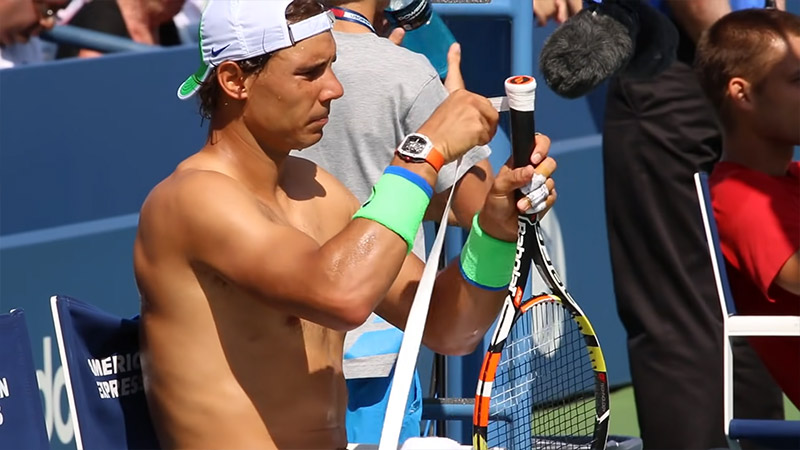
Overgrips are the thin, temporary, and often “tacky” tapes added over the main base grip to improve sweat absorption and friction.
Many left-handed players prefer to wrap these overgrips in a left-handed, or counter-clockwise, direction. This subtle adjustment allows the edges of the tape to align more naturally with how a lefty’s fingers wrap around the handle.
By winding counter-clockwise, the player ensures that the pressure of their palm and fingers “locks” the tape into place during a swing, rather than potentially pushing against the seams of the wrap.
This level of customization is the only area where “handedness” truly enters the conversation of racket preparation.
Grip Sizing: The True Measure of Performance
If handedness is a non-issue in racket selection, what is the most important factor for a player’s comfort and control? The answer is grip size. While a racket’s frame might be universal, the thickness of its handle—the grip size—is highly specific to the individual.
Standard Industry Sizing
Adult tennis rackets are produced in a standardized range of sizes to accommodate different hand dimensions. These typically range from size 0, which measures 4 inches in circumference, up to size 5, which measures 4 5/8 inches.
Finding the correct size is not a matter of preference but a matter of biomechanics. In the current market:
- Size 2 (4 1/4″) is the most common choice for female players.
- Size 3 (4 3/8″) is the standard for most male players.
However, these are merely averages. A player’s height or general hand size should dictate the choice, not their gender or skill level.
The Index Finger Test: Evaluating Your Fit
Determining the correct grip size is a straightforward process that can be performed without professional equipment. This is known as the “Index Finger Test.”
To perform this check, hold the tennis racket in your dominant hand using a standard “handshake” or Eastern forehand grip. Once you have a firm hold, attempt to place the index finger of your other hand into the gap between your fingertips and your palm.
- The Perfect Fit: If your index finger fits snugly into that space, the grip size is likely ideal for your hand. This allows for the perfect balance between stability and range of motion.
- The “Too Small” Scenario: If there is not enough room to fit your index finger, the grip is too small.
- The “Too Large” Scenario: If there is significant extra space around your index finger, the grip is too large.
The Risks of Improper Grip Sizing
Ignoring the results of the index finger test can lead to significant issues on the court, ranging from poor performance to physical injury.
The Dangers of a Grip That Is Too Small
When a handle is too small for a player’s hand, they lack the surface area required to keep the racket stable during high-speed impacts. As a result, the racket will often twist in the hand upon contact with the ball.
To compensate for this twisting, players frequently over-tighten their muscles, leading to premature fatigue and an increased risk of developing “tennis elbow” (lateral epicondylitis).
The Dangers of a Grip That Is Too Large
Conversely, a grip that is too large prevents the hand from fully closing around the handle. This restriction significantly reduces wrist flexibility.
In modern tennis, where “snap” and topspin are essential components of a powerful serve and baseline game, a lack of wrist mobility can stifle a player’s development and limit the variety of shots they can execute effectively.
Optimizing Your Equipment: A Summary for All Players
The beauty of tennis equipment lies in its universal accessibility. Whether you are a left-handed player looking for your first racket or a right-handed veteran refining your gear, the focus should remain on the following principles:
- Embrace Symmetry: Understand that any high-quality racket on the market is designed for you. The octagonal handle is a masterpiece of neutral engineering.
- Master the Wrap: If you are left-handed, consider learning to wrap your own overgrips in a counter-clockwise direction to enhance the “locked-in” feel of your handle.
- Prioritize Size: Use the index finger test to ensure your handle circumference is correct. Don’t settle for a size that causes twisting or limits your wrist’s range of motion.
- Listen to Your Body: If you feel excessive strain in your forearm or notice the racket shifting during volleys, re-evaluate your grip size immediately.
By shifting the focus from “handedness” to “fit,” players can ensure that their equipment acts as a true extension of their arm.
In a sport defined by seconds and millimeters, having a racket that fits perfectly in your hand—regardless of which hand that is—makes all the difference.
Frequently Asked Questions
Do professional left-handed players use special rackets?
No. Professional players like Rafael Nadal use the same symmetrical frames available to the public. Their customization comes in the form of weight, balance, and specific overgrip wrapping techniques, not the structural handedness of the handle.
Can I change the grip size of a racket I already own?
While you cannot easily “shrink” a handle, you can increase the size. Adding an overgrip typically increases the handle size by about half a size (1/16th of an inch). For more permanent changes, heat-shrink sleeves can be applied to the handle.
How often should I replace my overgrip?
This depends on how much you sweat and how often you play. However, once the grip loses its “tackiness” or begins to show signs of wear, it should be replaced to ensure the racket doesn’t slip during play.
Is there a difference in racket length for different hands?
No. Racket length is standardized (usually 27 inches for adults) and remains the same for all players.
Final Thoughts
Tennis is a sport of inclusivity and technical mastery. The fact that the industry has coalesced around a symmetrical, octagonal handle design is a testament to the efficiency of the sport’s equipment.
By understanding the mechanics of the “handshake grip” and the vital importance of proper sizing, you can step onto the court with the confidence that your racket is perfectly calibrated for your game. Don’t look for a “lefty” racket—look for the right fit.