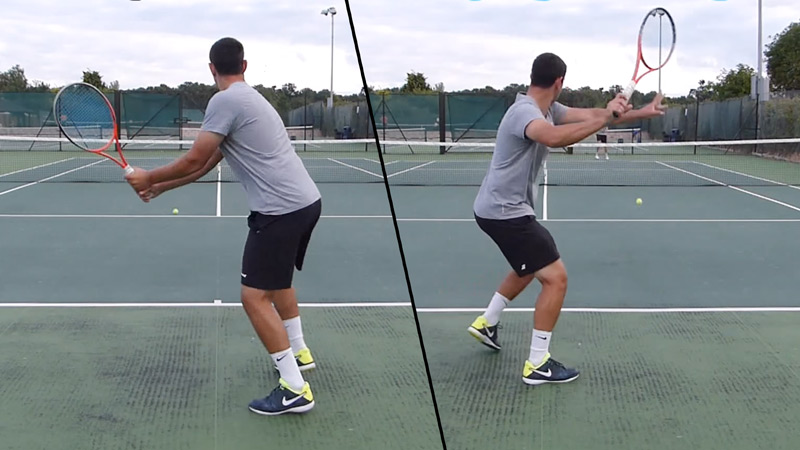
In the heat of a high-stakes rally, you find yourself pulled wide to your backhand side. You are at full stretch, the ball is dipping, and a standard one-handed slice or a cramped two-hander feels like a losing proposition.
In that split second, a thought flashes through your mind: Can I just move the racket to my other hand?
For most players, this feels like “cheating” or a move reserved for backyard games. However, the reality of the court is far more flexible.
You are legally allowed to switch the racket between your hands at any point during a tennis match, including mid-rally.
Whether you are seeking a way to bypass a weak wing, recovering from a career-threatening injury, or simply looking for a tactical advantage that throws your opponent off balance, hand switching is a legitimate—though rare—strategic choice.
This comprehensive guide will explore the regulatory landscape, the biomechanical benefits, and the rigorous training required to join the ranks of the sport’s most versatile players.
The Legal Landscape: What the Rulebook Actually Says
Before diving into the “how,” we must solidify the “can.” Many recreational players believe that hand switching is restricted to exhibitions or “trick” shots, but the International Tennis Federation (ITF) rules are remarkably clear on the matter.
The “One-Racket” Rule
While you have complete freedom to move your racket from your right hand to your left hand mid-point, there are two non-negotiable boundaries you must respect:
- Single Racket Limit: You may only use one racket per point. You cannot hold a racket in each hand or switch to a fresh racket until the point is concluded.
- No Mid-Strike Switches: You cannot be in the process of switching hands while actually striking the ball. The racket must be firmly in your hand (or hands) at the moment of impact.
Beyond these points, there are no restrictions on how often you switch or which hand you use to serve, volley, or smash. You could, theoretically, hit every single ball with a different hand if your coordination allowed it.
Tactical Motivation: Why Trade the Backhand for Two Forehands?
If it is legal, why isn’t everyone doing it? The answer lies in the extreme difficulty of the transition, but for those who succeed, the rewards are transformative.
1. Bypassing the “Survive, Not Thrive” Backhand
For the vast majority of club-level players, the backhand is a defensive liability—a shot designed to keep the ball in play rather than end the point. By developing a “two-forehand” game, you effectively remove the weakest link in your repertoire.
- Wider Angles: A forehand generally allows for a more aggressive “flick” of the wrist, creating cross-court angles that are difficult to replicate with a traditional backhand.
- Heavy Topspin: Most players find it easier to generate heavy, dipping topspin on the forehand wing, which can push opponents deeper behind the baseline.
2. Enhanced Reach in Scramble Situations
Even if you don’t commit to a full-time ambidextrous style, the “emergency switch” can be a lifesaver.
High-level players like Michael Chang were known to flip the racket to their non-dominant hand when stretched wide just to flick a desperate winner or a deep lob back into play.
3. The Psychological Surprise Factor
Tennis is a game of patterns. Opponents spend the first few games “mapping” your weaknesses, usually targeting your backhand during pressure moments.
A sudden, confident forehand winner from your “backhand” side can completely disrupt an opponent’s rhythm and mental game.
The Injury Lifeline: Saving Your Tennis Career
Perhaps the most compelling reason to consider the switch isn’t tactical—it’s medical. Chronic conditions such as Tennis Elbow (Lateral Epicondylitis), rotator cuff tears, or wrist tendonitis can effectively end a player’s time on the court if they rely solely on their dominant arm.
The 80–90% Recovery Rule
The data from players who have been forced to switch hands due to injury is surprisingly optimistic. Many players who commit to “starting over” as a lefty (or righty) are able to climb back to 80–90% of their original skill level within 12 to 24 months.
- Neural Carryover: As an experienced player, you already possess the “tennis IQ”—you understand court positioning, ball flight, and tactical patterns.
- Breaking Bad Habits: Starting fresh with your non-dominant hand offers a unique opportunity to learn proper mechanics from scratch, often bypassing the technical flaws that caused the injury in your dominant arm in the first place.
For someone facing a lifetime on the sidelines, “dropping the ego” and learning to play with the other arm is a small price to pay to stay in the game.
Case Studies: The Pros Who Broke the Mold
While the professional tour is dominated by single-handed specialists, a handful of innovators have proved that ambidexterity can survive at the highest levels.
- Yevgeniya Kulikovskaya (WTA Top 100): A true anomaly in the modern game, Kulikovskaya hit forehands off both wings, famously lacking a backhand entirely.
- Rafael Nadal: Though naturally right-handed, Nadal was famously encouraged by his coach, Toni Nadal, to play left-handed to gain a tactical advantage. While he doesn’t switch hands mid-point, he represents the pinnacle of “trained” non-dominance.
- Nicolas Rosenzweig (ATP): Reaching a ranking of approximately #700, Rosenzweig utilized a double-forehand approach. Some observers noted his use of a specialized “two-handled” racket to facilitate faster grip changes.
- Teo Davidov: A standout junior player who has gone viral for his ability to serve and rally with both hands with equal proficiency.
The Reality Check: Why Switching is a “Hard Road”
We must be objective: if switching hands were easy, the backhand would be extinct. There are significant hurdles that require months of dedicated training to overcome.
1. The Transition Speed Problem
The faster the ball comes at you, the less time you have to change your grip and move the racket. At the professional level, where ball speeds exceed 80-90 mph in rallies, the split-second required to swap hands is often too slow to handle aggressive pace. You risk being caught “mid-switch,” leading to framed shots or total misses.
2. The “Weak Link” Serve
Relearning the serve is widely considered the most difficult aspect of the ambidextrous transition. The coordination required for the toss, the rhythmic loading of the legs, and the “overhead throwing motion” is incredibly complex for the non-dominant brain.
Many players who switch wings for groundstrokes still choose a “hybrid” style—serving with their original dominant hand while rallying with two forehands.
3. Peer Resistance and Ego
When you begin training your non-dominant side, you will initially play like a beginner again. This can be frustrating for players who are used to a high level of competition.
As some veteran players note, your peers may be reluctant to practice with you while you are “learning to crawl” again on your off-hand.
The Neural Roadmap: How to Train Your “Other” Brain
If you are committed to the switch, you cannot limit your training to the court. You are essentially rewiring your motor cortex.
1: Daily Life Integration
To build the necessary hand-eye coordination, you must force your non-dominant hand to work during mundane tasks.
- The “Brush and Stir” Method: Use your off-hand to brush your teeth, stir coffee, open doors, and use a computer mouse.
- The “Dog Catch”: Playing simple games of catch with a tennis ball or a pet helps build the “tracking” ability required for a clean strike.
2: Mirror and Visualization Drills
Your dominant hand is your best coach. Mirror training involves standing in front of a full-length mirror and mimicking the mechanics of your strong forehand with your weak hand. This creates a “blueprint” in the brain for the new motion.
3: The “Bilateral Transfer” Advantage
Fascinatingly, research suggests that training your non-dominant hand can actually improve the technique of your dominant hand.
This phenomenon, known as bilateral transfer, suggests that the neural gains made on one side of the body can “leak” over to the other, making you a more coordinated athlete overall.
4: Structured On-Court Repetition
- Ball Machine Grills: Remove the pressure of a live opponent. Use a ball machine to provide a consistent feed, allowing you to “groove” the new stroke without judgment.
- Video Feedback: Seeing yourself on camera is vital. Often, what “feels” like a full follow-through is actually a cramped motion. Comparing your two forehands on video will highlight the mechanical gaps you need to close.
Enhanced FAQ: Your Ambidextrous Questions Answered
Is it legal to serve with one hand and then switch for the rally?
Yes. Many “hybrid” players do exactly this. They maintain their powerful, dominant serve to start the point but then switch to a two-forehand system once the ball is in play to protect an injury or exploit a tactical gap.
Can I use a racket with two handles?
Yes. Rackets like the “Battistone” or “Natural Tennis” rackets feature two separate grips. These are fully legal for tournament play and are designed specifically to eliminate the “transition time” issue by allowing both hands to remain on the racket in a ready position.
Will switching hands cause injury to my “new” arm?
There is a risk. If your injury was caused by poor technique (like “leading with the elbow”), you are likely to replicate that mistake on the other side unless you receive proper coaching.
However, if the injury was purely an overuse issue, the switch provides the necessary rest for your original arm to heal.
How long does it take to become competitive?
For an experienced player (3.5 to 4.5 level), it typically takes 6 to 12 months of dedicated practice to reach a “functional” recreational level (3.0) with the non-dominant hand.
Conclusion: Evolution Over Tradition
Tennis coaching is often rooted in “the way things have always been done.” Most coaches will discourage you from switching hands, viewing it as a distraction from perfecting traditional strokes. However, the sport is ultimately about problem-solving.
If a weak backhand is preventing you from winning matches, or if a “cranky elbow” is threatening to take you off the court forever, then the traditional rules of coaching no longer apply.
Embracing the ambidextrous edge is about more than just a “trick shot”—it is about extending your playing life and finding a version of the game that works for your body.
The road to a two-forehand game is long, awkward, and occasionally frustrating. But for the player willing to “flip the script” (and the racket), the reward is a game with no weaknesses and a tactical flexibility that very few opponents will ever be prepared to face.