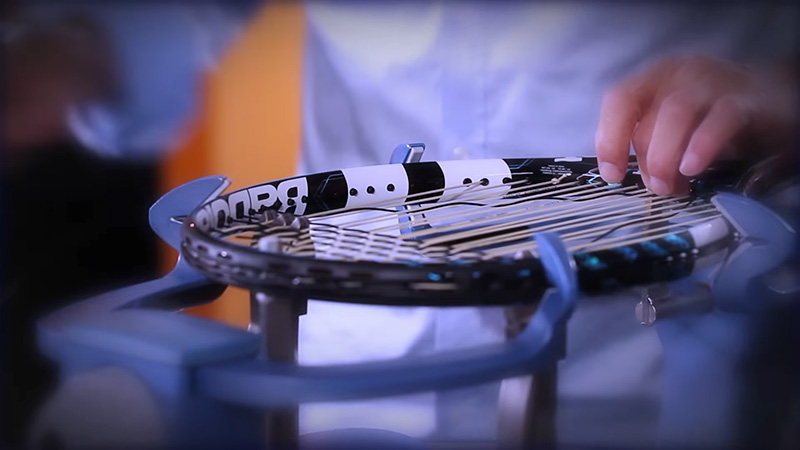
In the modern era of professional tennis, the equipment used is no longer a simple tool; it is a highly calibrated instrument. Among the variables a player can control, string tension stands as one of the most critical factors in determining the outcome of a match.
Deciding whether to utilize a high-tension setup is a strategic choice that balances the desire for surgical precision against the physical demands of power generation and injury prevention.
The Fundamental Physics: The Trampoline Effect
To understand why tension matters, one must first understand the physics of the string bed. The interaction between the ball and the racket is often referred to as the “trampoline effect”. This analogy provides a clear visual for how energy is stored and returned during a shot.
The Loose Trampoline (40–50 lbs)
A lower tension acts like a loose trampoline. When the ball strikes the strings, they deform deeply, absorbing energy and then snapping back to propel the ball forward with significant “free power”.
This setup is ideal for players who want the equipment to do the heavy lifting regarding depth and pace.
The Tight Trampoline (55–65 lbs)
Conversely, tight strings function like a stiff trampoline. The surface is firm and provides very little “give” or stretch. Because the strings do not stretch as much, the “spring” effect is significantly reduced.
Consequently, the ball does not receive an effortless boost in speed from the string bed itself. Instead, the surface provides a predictable bounce, ensuring the ball travels exactly toward the intended target.
The Precision Advantage: Why Tight Strings Rule the Baseline
For many competitive players, the primary motivation for tightening their strings is the pursuit of maximum control and precision.
In a game where a single inch can determine whether a ball is a winner or an unforced error, the predictability of high tension is invaluable.
Enhanced Accuracy
When strings are pulled to a higher tension, they become stiffer and exhibit less movement during the moment of impact. This lack of displacement means the string bed remains a flat, consistent plane.
For the player, this translates to heightened accuracy. You can aim for the lines with a higher degree of confidence, knowing that the racket will not produce an unexpected launch angle caused by shifting strings.
The Predictability Factor
High tension removes the “wildcard” element of the string bed. Because the bounce is so predictable, advanced players can calibrate their swings with extreme detail.
This is particularly beneficial for those who have already mastered the mechanics of a fast swing and are looking to refine their placement rather than increase their power.
The Power Equation: Trading Ease for Effort
While the control offered by tight strings is a significant benefit, it comes at a clear cost: reduced power. This trade-off is the central challenge for any player considering a high-tension setup.
Because the strings do not provide the “spring” effect found in looser setups, the player must supply their own energy to every shot. To hit the ball deep into the opponent’s court, you must swing harder and faster.
The Biomechanical Cost: Impact and Injury Risks
One of the most critical considerations for any tennis player is the impact of their equipment on their physical health. String tension is not just a performance metric; it is a health metric.
Vibration and Shock Transfer
Tight strings are inherently less forgiving. They absorb fewer vibrations when the ball hits the racket. Instead of the strings soaking up the energy of the impact, that energy—in the form of a shockwave—is transferred directly through the racket frame and into the player’s wrist and elbow.
The Risk of Tennis Elbow
This increased shock transfer significantly elevates the risk of repetitive strain injuries, most notably tennis elbow. For players who already experience joint sensitivity or have a history of arm pain, high tension can be a dangerous choice.
The stiffness of the string bed requires the tendons and muscles of the forearm to work harder to stabilize the joint against the force of the incoming ball.
The Spin Paradox: Dwell Time and Grip
Spin is a cornerstone of the modern game, allowing players to hit the ball with high clearance over the net while still keeping it within the lines. However, high string tension can actually hinder a player’s ability to generate heavy topspin.
The physics behind this involves “dwell time”—the amount of time the ball remains in contact with the strings. Because tight strings are so stiff, the ball spends less time on the racket face.
This reduced contact time decreases the racket’s ability to “grip” or “pocket” the ball. Without that momentary grip, it becomes much more difficult to brush up the back of the ball and create the rotation necessary for heavy spin.
Durability and Economic Considerations
From a practical standpoint, tight strings offer one distinct advantage for the frequent player: longevity.
Because tight strings move less upon impact, there is less friction between the vertical (main) and horizontal (cross) strings. This reduction in “sawing” action means that the strings are less likely to fray or snap prematurely.
For players who find themselves breaking strings every few days, increasing the tension slightly can be a cost-effective way to extend the life of their equipment.
Defining the Ideal Candidate: Who Should Tighten Up?
High tension is not a “one size fits all” solution. Based on the mechanical and physical profiles discussed, tight strings are best suited for a specific type of player:
- The Advanced Attacker: Players who already possess fast, aggressive swings and need the strings to act as a “governor” to keep their power in check.
- The Depth-Control Specialist: Players who find themselves consistently hitting the ball past the baseline and need more precision to keep the ball in play.
- The Injury-Free Athlete: Only players who currently do not have any arm, wrist, or elbow pain should consider a very tight setup.
- The Frequent String-Breaker: Those looking to reduce the frequency of string replacements by minimizing string movement.
Professional Guidance: Finding Your Equilibrium
Choosing the right tension is an iterative process. Most experts suggest starting in the middle of your racket’s recommended tension range (usually printed on the frame) and adjusting by 2–3 pounds at a time.
- If your balls are landing short: your tension may be too high. Dropping the tension will give you more “free power” and depth.
- If you are hitting long: Your tension may be too low. Tightening the strings will increase your control and help you find the court.
Enhanced FAQ: Technical Deep Dive
Q: Does string tension change over time?
Yes. All strings begin to lose tension the moment they are pulled off the stringing machine. This is known as “tension creep.” Professional players often have their rackets restrung for every single match to ensure the tension remains at their exact preferred level.
Q: How do tight strings affect the “sweet spot”?
A tighter string bed generally results in a smaller, more concentrated sweet spot. While this provides incredible feedback and precision when the ball is hit perfectly, it is much less forgiving on off-center hits compared to a looser setup.
Q: Are certain string materials better for high tension?
Generally, polyester strings are already quite stiff, so high tension with polyester can be extremely taxing on the arm. Natural gut or multifilament strings are softer and can often be strung at higher tensions while remaining relatively comfortable.
Conclusion: A Tool for Mastery
Tight tennis strings are an exceptional tool for the player who has reached a level of technical mastery where control and precision are the only things missing from their game.
By transforming the racket face into a firm, predictable surface, a player can dictate play with surgical accuracy.
However, this performance comes with a physical requirement. The player must be prepared to provide their own power and must possess the physical resilience to handle the increased shock to the arm.
Before tightening your strings, evaluate your swing speed, your injury history, and your strategic goals. When used correctly, the right tension isn’t just a setting—it’s a competitive advantage.