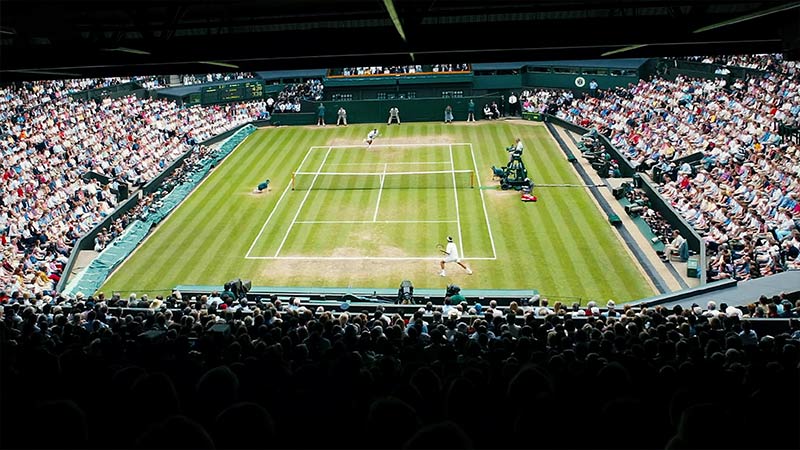
The green courts of the tennis world are often viewed as the ultimate cathedral of the sport. For spectators and players alike, the sight of a perfectly manicured lawn evokes a sense of prestige and history that no other surface can replicate.
However, a common question arises among enthusiasts and club members: Are these courts actually made of real grass?
The answer is complex, as the term “grass court” now encompasses two distinct technologies: natural turf and synthetic systems.
Understanding the differences between these surfaces is essential for facility managers, professional athletes, and recreational players who want to understand how the ground beneath their feet dictates the rhythm of the game.
The Botanical Reality: Natural Grass Courts
When you watch the world’s most prestigious tournaments, you are indeed looking at living, breathing organisms.
Natural grass courts are comprised of real, living grass—typically a specific variety known as perennial ryegrass—which is grown over a meticulously prepared soil base.
The Science of Perennial Ryegrass
Professional venues do not use standard backyard turf. The selection of perennial ryegrass is intentional; it is chosen for its durability, its ability to withstand the friction of sudden lateral movements, and its capacity to be mown to extremely low heights without dying.
At elite levels, such as the Championships at Wimbledon, the grass is maintained at a precise height of 8 mm. This height is critical because it balances the health of the plant with the requirements of a high-performance athletic surface.
Playability and the “Skid” Factor
The defining characteristic of natural grass is its speed. It remains the fastest surface in the sport of tennis. Because the blades of grass are slick and the soil base provides a firm yet yielding foundation, the ball does not “grip” the surface as it would on clay or hard courts.
Instead, the ball skids and stays very low, which fundamentally alters the strategy of the match. This environment rewards aggressive, fast-paced play, making the “serve-and-volley” technique a dominant strategy on this terrain.
The Burden of Maintenance
The prestige of natural turf comes at a high cost. These courts require intense daily care, involving a specialized team of groundskeepers who manage irrigation, mowing, and soil nutrition. Furthermore, natural grass is fragile under pressure.
Constant foot traffic from players quickly wears away the living tissue, often leaving brown dirt patches near the baselines by the end of a two-week tournament.
Because of this sensitivity and the high cost of upkeep, natural grass is largely reserved for the professional tour and a small number of exclusive private clubs.
The Engineering of the Game: Synthetic Grass Courts
For the vast majority of players worldwide, the experience of a “grass” court comes in the form of an engineered solution.
Artificial grass courts are synthetic carpets designed to mimic the aesthetic and some of the playability of natural turf without the biological fragility.
Composition and Construction
Synthetic courts are made of plastic fibers woven into a heavy-duty backing. To ensure the “blades” remain upright and to provide the necessary weight to keep the carpet in place, these courts are usually filled with sand.
This sand infill acts as a stabilizer, allowing players to slide slightly while maintaining enough traction for explosive movements.
Performance Metrics
While synthetic turf is designed to look like its natural counterpart, it performs differently. These courts offer a similar soft feel underfoot, which is often preferred by older players or those with joint concerns, but the ball physics are distinct.
Synthetic surfaces are generally slower and more predictable than natural grass, and the ball tends to bounce higher. This makes the game more accessible for recreational players who may find the low, unpredictable skid of natural grass too difficult to manage.
Durability and All-Weather Utility
The primary driver for the adoption of synthetic grass is its resilience. These surfaces are highly durable and do not suffer from the “die-back” or thinning seen in living turf.
Most importantly for club owners, synthetic courts can be used in the rain or immediately following a downpour, whereas natural grass becomes a slipping hazard when even slightly damp. This utility is why synthetic grass is the standard for local recreational clubs and training facilities.
Comparing the Two: A Strategic Breakdown
| Feature | Natural Grass | Synthetic Grass |
|---|---|---|
| Material | Living Perennial Ryegrass | Plastic Fibers & Sand |
| Ball Speed | Extremely Fast | Moderate |
| Bounce Height | Low & Skidding | Higher & Predictable |
| Durability | Low (wears to dirt) | High (weather-resistant) |
| Primary User | Professionals / Elite Clubs | Local / Recreational Clubs |
The Strategic Shift: How Surface Choice Changes Play
The choice between natural and synthetic grass is not merely an aesthetic one; it dictates the physical demands on the athlete.
- Natural Grass Strategy: Players must stay low to the ground and have exceptional reaction times. Points are usually shorter because the surface favors the server. Footwork must be precise, as the thinning grass throughout a tournament can lead to “bad bounces” as the ball hits patches of uneven soil.
- Synthetic Grass Strategy: This surface encourages longer rallies. Because the bounce is more consistent and the ball travels more slowly, players have more time to set up their shots. It is an ideal surface for baseline players who rely on consistency and endurance rather than raw power.
Maintenance and Sustainability: The Hidden Costs
From a facility management perspective, the “Real vs. Synthetic” debate is often decided by the budget. A natural grass court is a year-round commitment.
Even during the off-season, the soil must be aerated, fertilized, and protected from pests. If the drainage system fails, the entire court may need to be excavated and replanted.
In contrast, synthetic turf requires minimal intervention. Occasional brushing to redistribute the sand infill and the removal of organic debris (like leaves) are usually sufficient to keep the court in peak condition for a decade or more.
For organizations looking for a high return on investment and maximum “uptime” for their members, the synthetic option is almost always the superior choice.
Frequently Asked Questions
Why isn’t every tournament played on natural grass?
The level of specialized labor and the lack of durability make natural grass impractical for most venues. A natural grass court can only handle a few hours of play per day before the plants are irreparably damaged, whereas hard courts or synthetic courts can be used 24/7.
Is synthetic grass better for your knees?
Generally, yes. Both natural and synthetic grass are “softer” than hard courts (acrylic over concrete). However, synthetic grass with a sand infill provides a consistent cushion that absorbs impact, making it a favorite for recreational players looking to minimize joint strain.
Does natural grass change during a match?
Yes. As the sun dries out the surface or as players scuff the turf, the friction levels change. This “living” aspect of the court is part of what makes professional grass-court tennis so challenging; the court you start on in the first set may feel different by the fifth.
Can you slide on grass as you do on clay?
On natural grass, sliding is dangerous and can lead to significant injury or damage to the turf. On synthetic grass, the sand infill allows for a controlled slide, though it is not as fluid as the sliding seen on a red clay court.
Conclusion: The Future of the Green Court
The allure of the grass court remains a cornerstone of tennis culture. Whether it is the living perennial ryegrass of a professional stadium or the durable synthetic fibers of a local club, the green surface represents a connection to the sport’s elegant history.
For the professional, the natural grass court is a test of speed and nerves. For the recreational player, the synthetic court is a reliable, comfortable, and accessible way to enjoy the game.
As technology in both agronomy and textile engineering continues to advance, the gap between the “real” and the “engineered” will continue to narrow, ensuring that the “Green Cathedral” remains a fixture of the sport for generations to come.