In the long and storied history of Major League Baseball, the World Series serves as the ultimate proving ground. For over a century, the best of the American League and the National League have squared off to determine who reigns supreme.
While many of these series stretch to a grueling six or seven games, there is a special category of victory that stands above the rest for its sheer decisiveness: the sweep.
A World Series sweep is the ultimate statement of dominance, a moment when one team proves so superior that its opponent cannot manage even a single victory on the game’s biggest stage.
But how common is this feat? As it turns out, the “clean sweep” is one of the rarest achievements in professional sports.
The Statistical Landscape: 21 Moments of Perfection
Since the inception of the modern World Series in 1903, the Fall Classic has been played over 115 times. Despite the hundreds of games played in October, there have been only 21 sweeps in World Series history.
A sweep is officially defined as a series where one team defeats another 4-0. In a sport defined by its daily grind and the “any given Sunday” (or in this case, any given Tuesday) mentality, winning four consecutive games against a pennant-winning opponent is a monumental task.
The rarity of this event—occurring in less than 20% of all World Series played—highlights just how difficult it is to maintain peak performance under the highest pressure for four straight nights.
The Battle of the Leagues: American League Dominance
When looking at the breakdown of these 21 sweeps, a clear pattern of league dominance emerges. The American League (AL) has historically been the more dominant force in these lopsided victories.
Of the 21 recorded sweeps, the American League holds 13 of these victories, while the National League (NL) has secured only eight.
This disparity speaks to various eras of MLB history where the American League, often led by powerhouse dynasties, maintained a stranglehold on the championship.
While the National League has seen its fair share of legends, they have struggled to match the AL’s record for finishing off opponents in the minimum number of games.
The Pinstripe Standard: The New York Yankees’ Record
No discussion of World Series dominance is complete without mentioning the New York Yankees. The Bronx Bombers are not just the team with the most titles; they are also the undisputed masters of the sweep.
The New York Yankees hold the record for the most World Series sweeps, having swept their opponents a staggering eight times.
This means that nearly 40% of all sweeps in the history of the sport have been conducted by a single franchise.
From the “Murderers’ Row” era to the Joe DiMaggio years and into the late-90s dynasty, the Yankees have made a habit of entering the World Series and leaving no doubt about who the better team was.
Their eight sweeps represent a level of consistency and “killer instinct” that no other team in baseball history has been able to replicate.
The Giants’ Legacy: Second Only to the Best
While the Yankees sit alone at the top, the New York/San Francisco Giants have also carved out a significant place in the history of dominance. The Giants follow the Yankees with the second-most sweeps in history, having achieved the feat three times.
The Giants’ history of sweeps spans over a century, reflecting their status as a cornerstone franchise of the National League.
Whether playing at the Polo Grounds in New York or AT&T Park in San Francisco, the Giants have demonstrated an ability to completely shut down their opponents in the Fall Classic across different eras of the game.
The Origins of the Sweep: 1907 and the “Clean” 4-0
The history of the World Series sweep has a few nuances that are often overlooked. The very first instance of a team winning a series without a loss occurred in 1907, when the Chicago Cubs defeated the Detroit Tigers.
However, this is not considered a “clean” 4-0 sweep in the traditional modern sense, as one of the games in the 1907 series ended in a tie.
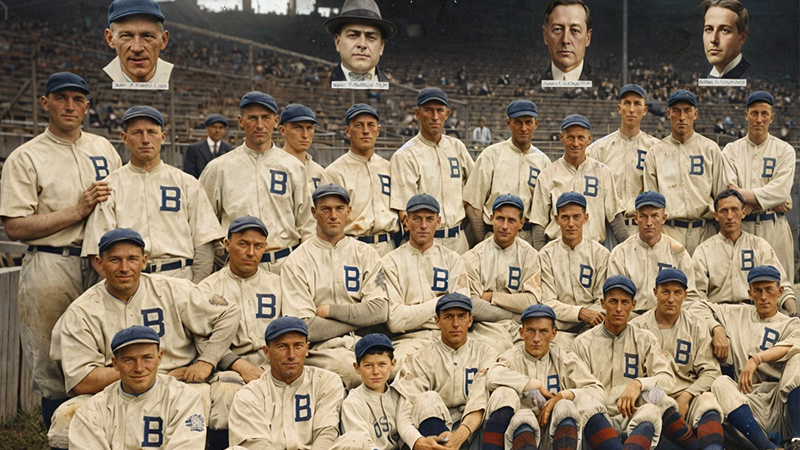
It wasn’t until 1914 that the baseball world witnessed its first “clean” 4-0 sweep, where one team won four consecutive games without any ties or interruptions.
This 1914 victory set the standard for what we now recognize as the ultimate postseason achievement: four games, four wins, zero losses.
The Modern Era: A Vanishing Phenomenon?
Interestingly, the frequency of World Series sweeps has shifted over time. While the mid-20th century saw several periods of dominance, sweeps have become notably less frequent in recent decades.
The parity of the modern game, influenced by free agency, expanded playoffs, and advanced scouting, has made it increasingly difficult for one team to steamroll another in the championship. The data reflects this shift: since the year 2000, only four sweeps have occurred:
- 2004: The Boston Red Sox (breaking their 86-year curse).
- 2005: The Chicago White Sox.
- 2007: The Boston Red Sox (their second sweep of the decade).
- 2012: The San Francisco Giants.
This lack of frequency makes each modern sweep all the more impressive. In an era where every team has access to elite data and world-class bullpens, winning four straight games against a league champion is an anomaly.
The Last of a Dying Breed: The 2012 San Francisco Giants
For fans wondering when they last saw a team hoisted the trophy after a mere four games, you have to look back over a decade.
The San Francisco Giants defeated the Detroit Tigers in 2012, marking the most recent 4-game sweep in World Series history.
Led by a dominant pitching staff and timely hitting, the 2012 Giants dismantled a Tigers team that featured future Hall of Famers and Triple Crown winners. Since that October night in Detroit, every World Series has gone at least five games.
This 12-year drought is one of the longer stretches in baseball history without a sweep, further emphasizing that we are currently living in an era of high competitiveness where teams are rarely able to walk away with a “clean” victory.
Conclusion: The Prestige of the Sweep
The World Series sweep remains the “gold standard” of championship victories. With only 21 occurrences since 1903, it is a rare gem in the crown of Major League Baseball.
Whether it is the American League’s 13-8 lead over the National League, or the New York Yankees’ incredible eight sweeps, the history of the 4-0 victory is a history of the greatest teams to ever take the field.
As we look toward future postseasons, the question remains: When will we see the 22nd sweep? Given the trend of the last two decades, it may be a long wait.
But when it happens, it will cement that team’s place among the elite few who didn’t just win the World Series—they owned it.