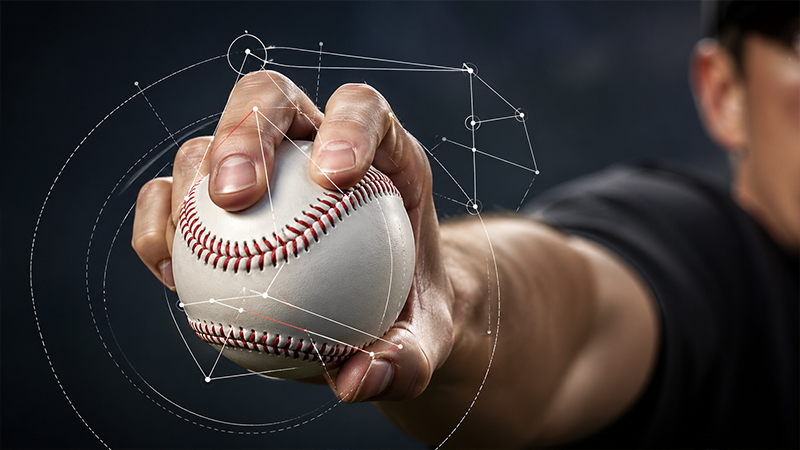
In the high-stakes environment of professional baseball, where a single millimeter of bat-to-ball variance distinguishes a home run from a pop-fly, the foundation of every swing begins in the palms.
Despite the complexity of modern launch-angle analytics and high-speed motion capture, the most critical variable often remains the most overlooked: the geometry of the grip.
For decades, a fundamental rift has existed between traditional instructional pedagogy and the actual mechanics employed by elite hitters in Major League Baseball (MLB).
I have synthesized traditional insights with modern mechanical data to provide a definitive analysis of the two primary grip architectures: The Knocking Knuckles (Door Knocker) and The Box Grip.
The Biomechanics of the Foundation
The grip serves as the exclusive interface between the athlete’s kinetic energy and the tool of the trade. It dictates the bat path, the timing of the “rollover,” and the degree of wrist mobility throughout the zone.
When we discuss “geometry” in the grip, we are specifically addressing the alignment of the metacarpophalangeal (MP) joints—the knuckles—and how their orientation shifts the leverage of the forearms and shoulders.
Choosing a grip is not merely a matter of comfort; it is a strategic decision that prioritizes either precision and contact or leverage and power.
The Traditional Standard: The “Knocking Knuckles” Method
Often referred to as the “Door Knocker” grip, this method is the cornerstone of traditional youth and collegiate instruction.
1. The Geometric Setup
The athlete aligns the middle knuckles (the ones used to knock on a door) of both the top and bottom hands in a straight vertical line.
2. Precision and Path Control
The primary advantage of the Knocking Knuckles grip is the promotion of a direct swing path. By aligning the hands in this manner, the hitter naturally discourages “looping,” a common mechanical flaw where the barrel of the bat dips below the hands early in the swing.
From a biomechanical perspective, this alignment encourages the hands to work in a more unified, “palm-up, palm-down” orientation through the contact zone.
This maximizes the hitter’s ability to maintain a short, compact path to the ball, making it an exceptional choice for contact-oriented hitters who prioritize high Batting Average on Balls In Play (BABIP) and a low strikeout rate.
3. Strategic Application
- Target Persona: Slap hitters, high-contact “lead-off” profiles, and youth players struggling with barrel control.
- Key Benefit: Superior bat control and a minimized “loop” in the swing.
The Modern Power Lever: The “Box Grip”
As the game has shifted toward a “power-first” philosophy, many elite athletes have moved away from traditional knuckle alignment in favor of what is known as the Box Grip.
1. The Geometric Setup
In a Box Grip, the athlete aligns the middle knuckles of the top hand with the top knuckles (those closest to the fingernails) of the bottom hand. This creates a slight offset, rotating the hands away from each other.
2. Levered Power and Shoulder Stability
The Box Grip is strategically designed to maximize leverage. By rotating the top hand slightly, the hitter allows for better lead elbow alignment to the pitch, which facilitates a more aggressive “turn” through the ball.
One of the most significant advantages of this geometry is its effect on the upper body: it helps power hitters keep their shoulders level throughout the rotation.
This stability prevents the “dipping” of the back shoulder, allowing the athlete to stay on a plane that matches the downward angle of elite-level pitching.
3. Preventing Early Rollover
A critical issue for many hitters is “rolling over” the wrists too early, which results in weak ground balls to the pull side.
The Box Grip provides a mechanical buffer against this, helping the hitter stay “through” the ball longer and ensuring the rear arm gets into a stronger, more forceful position at the point of impact.
Analyzing the Performance Impact: Power vs. Control
The following matrix illustrates the performance trade-offs:
| Feature | Knocking Knuckles | Box Grip |
|---|---|---|
| Primary Goal | Contact and Precision | Power and Leverage |
| Bat Path | Direct and Compact | On-Plane and Forceful |
| Risk Factor | Potential loss of leverage | Risk of “Strongman” rigidity |
| MLB Adoption | Traditional/Specific Roles | High among Power Hitters |
| Shoulder Alignment | Neutral | Optimized Leveling |
The Professional Reality: What the Data Shows
While traditional coaches often mandate the “Knocking Knuckles” grip as a non-negotiable rule, modern observation of MLB players reveals a different story. Many professionals utilize a modified or “box-like” grip specifically to enhance their bat speed.
The “Strongman” Trap
However, there is a limit to the rotation. If a hitter over-rotates the top hand too far, they fall into the “Strongman” grip trap. This creates excessive tension in the forearms, which restricts fluidity and wrist mobility.
A rigid grip is a slow grip. Elite performance requires a balance between the strength of the Box Grip and the flexibility required to “whip” the bat through the zone.
Finding the “Happy Medium”
Professional hitting coaches increasingly advocate for a “Happy Medium” approach. Instead of adhering to a rigid geometric rule, the athlete should find a position that sits between the two extremes.
The ultimate diagnostic for a world-class grip is comfort and mobility. The ideal grip is one that:
- Feels natural in the palms rather than the fingers or deep in the hands.
- Allows for maximum wrist movement to adjust to different pitch locations.
- Prevents the early “rollover” while maintaining the ability to “flick” the barrel for late timing adjustments.
Frequently Asked Questions (FAQ)
Q: Should I force my youth player to use Knocking Knuckles?
A: While it is a great teaching tool to prevent “looping,” forcing a rigid grip can lead to tension. If the player is struggling with bat control, Knocking Knuckles is a great fix; if they are naturally strong and find a Box Grip more comfortable, let them evolve into it.
Q: Does the Box Grip cause more ground balls?
A: Actually, the Box Grip can prevent weak ground balls by delaying the “rollover” of the wrists, allowing the hitter to drive the ball deeper into the outfield.
Q: How do I know if my grip is too tight?
A: If you feel tension in your forearms before the swing begins, you are likely using a “Strongman” grip. Your hands should be loose—like holding an egg—until the moment of impact.
Strategic Conclusion: The Grip is a Tool, Not a Rule
In the pursuit of an elite swing, the grip must be viewed as a dynamic tool. The Knocking Knuckles method offers a masterclass in path precision and control.
Conversely, the Box Grip provides the geometric leverage required to compete in the modern era of high-velocity, high-power baseball.
By understanding the trade-off between shoulder leveling, elbow alignment, and wrist mobility, hitters can customize their geometry to dominate the strike zone.