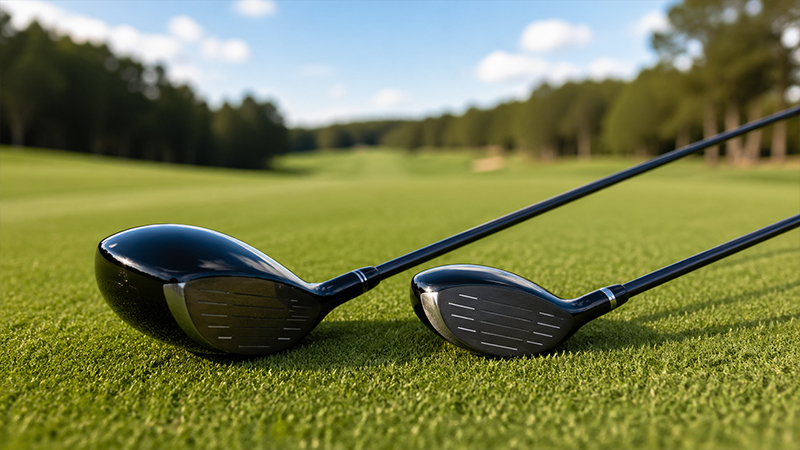
In the world of golf, the battle between distance and accuracy is often won or lost in the specs of your equipment.
While golfers spend thousands of dollars on the latest clubhead technology, the shaft length is frequently the unsung hero—or villain—of their scorecard.
Specifically, the relationship between driver and 3-wood shaft lengths represents the fundamental trade-off of the game: the pursuit of maximum speed versus the necessity of consistent contact.
Understanding the technical nuances of these two clubs is not just for professional fitters; it is essential knowledge for any player looking to optimize their bag for lower scores.
The Standard Specs: Breaking Down the Industry Benchmarks
To understand how to optimize your setup, you must first understand the “standard” measurements found in most retail golf shops.
While these numbers can vary slightly by manufacturer, the industry has gravitated toward specific lengths designed to suit the average golfer.
- The Driver Standard: Modern drivers typically measure between 45 and 46 inches in length. It is very common for “off-the-rack” drivers to be set at a standard of 45.5 inches.
- The 3-Wood Standard: By contrast, 3-wood shafts are significantly shorter, generally falling between 42.5 and 43.5 inches. The industry benchmark for a 3-wood is traditionally 43 inches.
This creates a gap of approximately 2 inches between your longest club and your most versatile fairway wood.
While two inches might seem negligible in other contexts, in a golf swing, it completely alters the physics of the club’s arc and the golfer’s ability to control the clubhead.
The Physics of the Arc: Why Longer Isn’t Always Better
The primary reason drivers are built longer than 3-woods is pure physics: leverage and speed. A longer shaft creates a wider swing arc.
As the arc widens, the clubhead has more time and distance to accelerate, which increases clubhead speed at the point of impact. This increased speed is the engine behind the massive distance gaps seen between a driver and a fairway wood.
However, this distance comes at a steep price. The longer the shaft, the further the clubhead sits from the golfer’s body.
This distance makes it significantly harder to manage and strike the ball consistently on the center of the face.
Because a 3-wood shaft is shorter, it allows the golfer to feel more “connected” to the club, leading to improved control and accuracy.
For many amateur golfers, the extra distance gained from a 46-inch driver is often negated by the frequency of off-center hits that result in lost balls or difficult recovery shots.
The Modern Fitting Trend: Why Pros are Going Shorter
Despite the industry trend of pushing drivers to 45.5 or even 46 inches to market “explosive distance,” many professional golfers and high-end club fitters are moving in the opposite direction. There is a growing movement toward the 44.5-inch driver.
By shaving an inch off the standard driver length, players often find a “sweet spot” where they retain most of their clubhead speed but dramatically increase their smash factor (efficiency of energy transfer).
A properly fitted 44.5-inch driver can often lead to more total distance than a 46-inch driver because the player hits the center of the face more frequently.
Interchangeability: The “Mini-Driver” Experiment
A popular experiment among club enthusiasts is the “Short Driver” build, which involves taking a 3-wood shaft and placing it into a driver head.
Because driver heads are generally designed for longer shafts, putting a 3-wood shaft into one typically results in a finished club length of approximately 43.25 inches.
The benefits of this setup include:
- Enhanced Controllability: The club feels much more like a fairway wood, giving the golfer more confidence to “swing away” without fearing a massive slice or hook.
- A Lighter Feel: Initially, the shorter shaft can make the club feel lighter and easier to swing.
The Trade-offs and Technical Hurdles: This modification is not as simple as “plug and play.” Because driver heads are lighter than 3-wood heads, putting a shorter 3-wood shaft into a driver head can throw off the balance and swing weight. To make this setup functional, you will likely need to add weight to the driver head (via lead tape or adjustable weights) to ensure the club doesn’t feel “dead” or too light during the swing.
The Technical Nuance: Tipping and Shaft Stiffness
One of the most overlooked aspects of the driver vs. 3-wood debate is shaft stiffness, specifically regarding a process called “tipping.”
A 3-wood head is naturally heavier than a driver head to help launch the ball off the turf. To compensate for this extra weight, 3-wood shafts are often “tipped”—meaning a portion is cut from the bottom (the tip) before the head is installed. This process makes the shaft stiffer than a standard driver shaft.
If you simply cut a driver shaft down to 3-wood length without accounting for tipping, the shaft may play “softer” than intended, leading to inconsistent launch angles and spin rates.
Conversely, a 3-wood shaft is built to handle that heavier head, ensuring the club remains stable through impact.
Conclusion: How to Choose Your Ideal Length
When deciding between sticking with standard lengths or experimenting with shorter builds, consider your primary goal on the tee box.
If you are a high-level ball striker looking for every possible yard, the standard 45.5-inch driver offers the highest ceiling for distance.
However, if you find yourself struggling to find the fairway, a shorter driver (44.5 inches) or even a 3-wood length shaft in your driver head might be the key to more consistent scoring.
The 2-inch difference between a driver and a 3-wood is the boundary between maximum power and maximum precision. Finding where you belong on that spectrum is the first step toward mastering your long game.