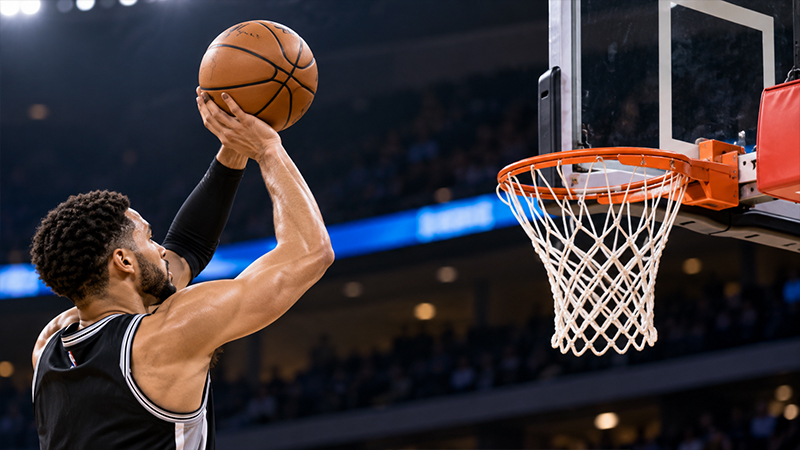
In the early stages of basketball development, the small white rectangle above the rim is treated as a sacred target.
Coaches emphasize that hitting “the box” is the most reliable way to ensure the ball falls downward into the cylinder.
However, as players transition from youth leagues to the professional hardwood of the NBA, this fundamental tool largely disappears from the offensive arsenal.
The professional game has pivoted toward a standardized “swish-first” philosophy. While legends like Tim Duncan built a Hall of Fame career on the backboard’s reliability, the modern era treats the glass as an emergency backup rather than a primary strategy.
This analysis explores the biomechanical, psychological, and statistical reasons why the world’s best shooters have largely abandoned the backboard.
Technical Comparison: The Swish vs. The Bank Shot
To understand the shift, we must first analyze the fundamental differences in shot execution. Professional players prioritize repeatability above all else.
| Feature | The Swish (Direct Rim Aim) | The Bank Shot (Backboard Aim) |
|---|---|---|
| Primary Target | The center of the rim or the back of the cylinder. | The specific point on the glass, usually the rectangle corners. |
| Variables Involved | Distance, arc, and lateral alignment. | Distance, arc, lateral alignment, ball spin, and backboard elasticity. |
| Consistency | The target is identical from every 15-foot spot on the floor. | The target point on the glass changes based on the shooter’s angle. |
| Margin of Error | Allows for “lucky rolls” off the rim if the aim is slightly off. | Missed calculations often result in the ball flying off with no chance of recovery. |
| Ideal Entry Angle | High arc (49 to 55 degrees) increases the effective size of the rim. | Requires a flatter trajectory to “push” the ball through the rim via the glass. |
Biomechanics and the Physics of Standardization
The primary reason NBA players avoid the backboard for jump shots is the need for mechanical standardization. A professional shooter wants their 10-foot or 15-foot shot to feel the same regardless of where they are on the court.
The Variable of the Angle
When a player aims for a swish, a 15-foot shot from the baseline is essentially the same motion as a 15-foot shot from the top of the key. The rim is a stationary target in 3D space.
Conversely, the bank shot requires a “mental calculation” of the angle. If you move three feet to the left, the point on the backboard you must hit to score changes significantly.
| Shot Location | Swish Difficulty | Bank Difficulty | Reasoning |
|---|---|---|---|
| Baseline | High | Impossible | No backboard access behind the rim. |
| Wing/Elbow | Standard | Medium | Ideal for banking, but requires precise angular velocity. |
| Top of Key | Standard | High | Very narrow window for successful bank shots. |
The Physics of the “Bounce”
NBA backboards are engineered to be highly elastic and “bouncy”. This introduces a level of unpredictability that elite players find detrimental to their rhythm. Banking a shot requires accounting for:
- Ball Spin: Backspin helps the ball “die” on the glass and drop.
- Velocity: A ball thrown too hard will fly off the rim; one thrown too soft won’t reach.
- Backboard Material: Professional glass behaves differently from wood or fiberglass found on local playgrounds.
The Modern Era: Why Distance Kills the Bank Shot
The modern NBA is defined by the three-point revolution. This shift in court geometry has made the bank shot physically impractical for the majority of offensive possessions.
| Factor | Impact on Banking | Statistical Reality |
|---|---|---|
| Increased Distance | Bank shots are largely ineffective from beyond the paint. | The further the shooter is from the glass, the harder it is to control the bounce. |
| Shooting Arc | High-arc shots have a higher probability of scoring. | Bank shots typically require a flatter trajectory, which reduces the margin for error from distance. |
| Defensive Pressure | Taller defenders make low-trajectory bank shots easier to block. | Modern defenders prioritize closing out on shooters, forcing them into high-arc releases. |
While a study noted that using the backboard could potentially increase free-throw efficiency by up to 20%, players still refuse to adopt the practice. The reason is rooted in muscle memory. If a player banks their free throws but swishes their jump shots, they are forced to maintain two entirely different shooting motions, which can “play with their stroke” and ruin their overall consistency.
The Cultural and Aesthetic Shift
Beyond physics and statistics, there is a powerful cultural component to the decline of the bank shot. Former San Antonio Spurs coach Gregg Popovich has famously noted that players often abandon the glass because it is not considered “visually cooler” or as aesthetically pleasing as a “swish”.
Aesthetics vs. Efficiency
| Perception | The Swish | The Bank Shot |
|---|---|---|
| Visual Appeal | Considered the “cleanest” way to score; highly satisfying. | Often viewed as “old school,” “unskilled,” or accidental. |
| Player Perception | Signals elite touch and precision. | Signals a reliance on “the box” rather than pure skill. |
| Social Media Impact | “Swish” highlights are more viral. | Bank shots are rarely featured in highlight reels unless they are game-winners. |
This “style factor” cannot be ignored in an era where player branding and individual flair are central to the professional experience.
Even though players like Dwyane Wade and Tim Duncan proved that the bank shot is an elite mid-range weapon, the younger generation of players—who grew up idolizing distance shooters like Stephen Curry—prioritize the “pure” shot over the “calculated” bank.
When the Bank is Still Open: Strategic Exceptions
Despite its general decline, the backboard remains a critical tool in specific high-leverage scenarios. Professional players utilize the glass in three primary areas:
- Layups and Finishers: At the rim, the backboard is still the primary target for the majority of layups and reverse finishes.
- Floaters and Soft Touches: Players like Anthony Edwards and Blake Griffin use the glass to “soften” the angle of entry on difficult runners in the lane.
- Shooting Over Taller Defenders: The bank shot allows shorter players to shoot “through” the rim by aiming higher on the glass, making it harder for a shot-blocker to reach the ball at its apex.
Comprehensive FAQ: Understanding the Backboard Paradox
| Question | Expert Insight |
|---|---|
| Is it illegal to bank a free throw? | No. It is perfectly legal. Players like DeAndre Jordan have successfully banked in free throws during the playoffs. |
| Does banking actually increase accuracy? | Some studies suggest a 20% increase in free-throw efficiency, but professionals find it harder to maintain the necessary rhythm and mental calculation. |
| Why did Tim Duncan use it so often? | Duncan utilized the glass to “soften” his mid-range shots, giving him a higher margin of error on the low block. |
| Is the backboard too “bouncy” in the NBA? | Yes. NBA backboards are designed for maximum rebound energy, requiring incredible “touch” and precise spin to bank consistently. |
| Why don’t kids just learn to swish? | For younger/weaker players, it is easier to aim for the rectangle because they lack the strength to consistently get the ball over the rim with high arc. |
Conclusion: A Vanishing Art Form
The decline of the bank shot in the NBA is a testament to the league’s evolution toward standardization, distance, and aesthetic perfection.
While the physics of the glass offer a larger margin of error in the mid-range, the complexity of calculating angles and the variability of the bounce make it a risky endeavor for players who require robotic consistency.
For the modern professional, the “rectangle” is a relic of childhood development. As the game moves further from the basket, the backboard will likely remain a niche tool, reserved for the few who—like Duncan or Edwards—master the geometry of the glass to find an edge in a world of swishes.