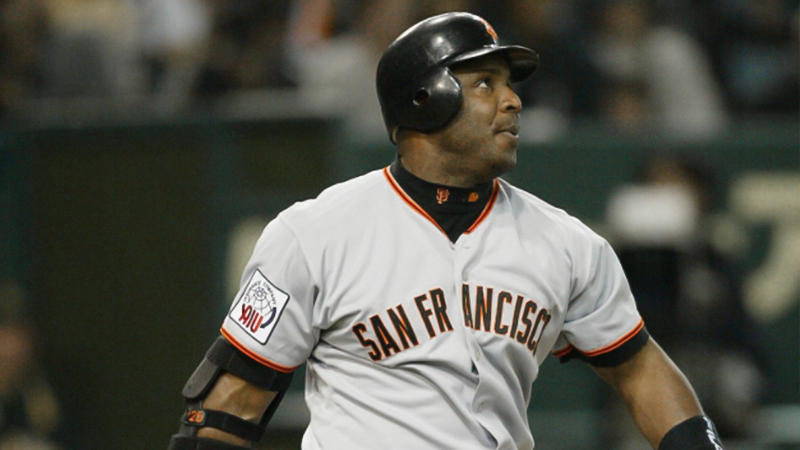
In the annals of sports history, few seasons are as statistically jarring as Barry Bonds’ 2004 campaign. It was a year where the San Francisco Giants slugger seemed to transcend the sport of baseball itself, posting numbers so dominant they appeared to break the logic of the game.
This utter dominance led to one of the most famous “what-if” scenarios in sports media: What if Barry Bonds had played the entire 2004 season without a bat?.
Originally popularized by Jon Bois in his “Chart Party” series for SB Nation, this experiment sought to determine if Bonds was so feared by pitchers that he could lead the league in On-Base Percentage (OBP) simply by standing at the plate and never swinging.
While the original experiment relied on simulations, recent statistical re-evaluations have used advanced data modeling to find a more definitive answer.
The Legend of Batless Barry Bonds
The premise is simple but absurd: Barry Bonds walks to the plate for every single one of his 613 plate appearances in 2004, but he doesn’t bring a bat with him.
He cannot hit home runs, he cannot strike out looking (or swinging, obviously), and he cannot put the ball in play. His only path to first base is through a Walk (BB) or a Hit By Pitch (HBP).
In the original “Chart Party” video, Jon Bois relived every plate appearance to see how pitchers would react. However, because the original work used simulations, some analysts wondered if a more rigid mathematical approach could yield a “final, non-simulated batless OBP”.
Methodology: Decoding the Math of a Batless Season
To solve this problem without relying on the randomness of a simulation, researchers utilized Retrosheet’s 2004 event files to isolate every pitch thrown to Bonds. By analyzing the data, every pitch result was categorized into five types:
- Ball (B)
- Called Strike (C)
- Hit By Pitch (H)
- Hit (X)
- Foul (F)
The Earned-Base-Value (EBV) System
The core of the non-simulated approach relies on what is termed Earned-Base-Value (EBV). This system assigns a value to each plate appearance based on the likelihood of Bonds reaching base:
- If a sequence results in 4 balls, the EBV is 1 (he reached base).
- If a sequence results in 3 strikes, the EBV is 0 (he is out).
- If he is Hit by a Pitch, the EBV is 1, as the lack of a bat does not change the outcome of being struck by the ball.
Handling the “Chaos” of Hits and Fouls
The most difficult part of the experiment is determining what happens to the pitches Bonds actually swung at in real life. If he doesn’t have a bat, a “hit” or a “foul” cannot exist. To account for this, the model uses percentages derived from Bonds’ actual 2004 performance:
- Swing Accuracy: All pitches Bonds swung at in 2004 were in the strike zone 80.9% of the time and outside the zone 19.1% of the time.
- General Pitch Location: Regardless of the outcome, pitchers threw into the strike zone 41.3% of the time and outside of it 58.7% of the time.
When the model encounters a hit (X), it splits that result into two potential realities: a strike (80.9% probability) or a ball (19.1% probability). This process continues for every foul and hit until every plate appearance is resolved into a definitive result of either 3 strikes or 4 balls.
The Shocking Results: A .598 OBP Without a Bat
After running the data through a rigorous R script that processed hundreds of thousands of data points, the result is nothing short of legendary.
Without a bat, Barry Bonds would have achieved a single-season OBP of 0.598484 in 2004.
To put this in perspective:
- Historically Dominant: A .598 OBP would still be the best in baseball history, surpassing every player other than the real-life 2004 Barry Bonds.
- Comparison to Reality: This is only slightly lower than his actual 2004 OBP of .609.
- The Ultimate Threat: This means that Bonds was so terrifying to pitchers that even if he had been physically incapable of hitting the ball, he still would have reached base nearly 60% of the time.
Why Was Bonds So Productive Without a Bat?
The reason a batless Bonds remains the greatest “hitter” in history comes down to pitcher psychology and zone control.
In 2004, pitchers were so afraid of giving Bonds anything to hit that they threw more balls than strikes. Because Bonds had an elite eye, he rarely swung at pitches outside the zone.
If he never swung at all, pitchers would be forced to throw three strikes before throwing four balls. However, because they were already throwing balls 58.7% of the time, the odds were heavily stacked in Bonds’ favor.
Even when he was “forced” to take strikes he would have otherwise hit, the sheer volume of balls thrown his way ensured he would walk at an unprecedented rate.
The Strategic Value of a .000 Slugging Percentage
One of the most interesting debates arising from this experiment is the actual value of a player who gets on base 60% of the time but provides zero power (a .000 Slugging Percentage).
While Bonds would never hit a home run, some analysts argue he would still be “immeasurably valuable” in a modern lineup.
As a leadoff or cleanup hitter, having a runner on base 60% of the time creates constant scoring opportunities for the rest of the team. He would essentially be a permanent fixture on the basepaths, waiting to score off the hits of his teammates.
Critiques and Statistical Variations
While the 0.598 figure is the most refined non-simulated number available, other researchers have found slightly different results using different methods:
- Reddit user /u/cg2916 ran 30 simulations and found an OBP of .5871, though this was limited to home plate appearances.
- Researcher Nick Sun used antithetic variables in simulations to find an average OBP of around .592.
There are also questions regarding whether intentional walks should be removed from the data before calculating strike-zone percentages. Some argue that including intentional walks skews the “out-of-zone” percentage, potentially making Bonds’ batless performance look even better than it might have been in a “fair” environment.
Conclusion: The Man Who Broke Baseball
The “Barry Bonds Without a Bat” experiment is more than just a fun trivia question; it is a testament to the most feared offensive force the game has ever seen.
Whether you use the original Jon Bois simulation or the refined 0.598 OBP calculated via Retrosheet data, the conclusion remains the same: Barry Bonds did not need a bat to be the best player in the world.
In 2004, Bonds reached a level of “statistical brokenness” that may never be seen again. He proved that in the game of baseball, sometimes the most dangerous thing you can do is absolutely nothing.