
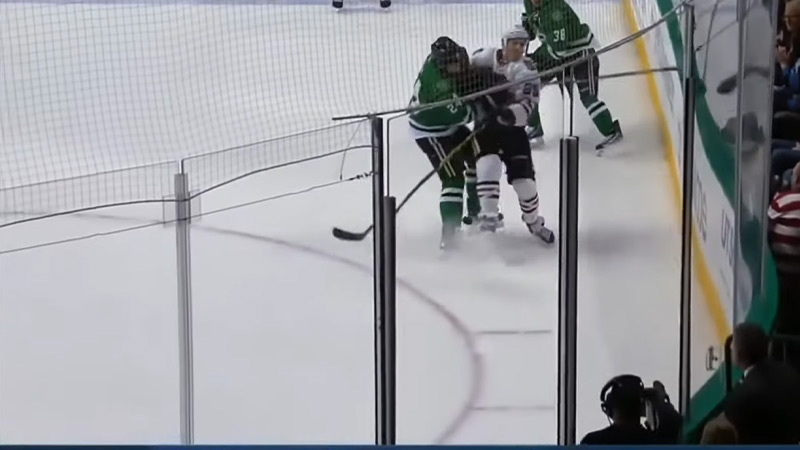
Unlike most professional sports leagues, the NHL allows fighting under regulated rules rather than automatically imposing heavy fines or ejections.
Hockey players are not fined simply for participating in a standard, mutual fight. Instead, they typically receive a five-minute major penalty, requiring them to remain in the penalty box.
However, certain situations can lead to additional consequences, including monetary fines and suspensions.
These include instigating fights late in games, engaging in excessive violence, or accumulating multiple fighting majors throughout a season.
Coaches may also face financial penalties. Therefore, while routine hockey fights do not result in fines, serious violations can.
The On-Ice Disciplinary Framework: Penalties, Misconducts, and Shorthanded Gameplay
To properly understand why players are not routinely issued monetary fines for fighting, one must analyze the league’s structured on-ice penalty enforcement system.
When two opposing players willingly engage in a mutual fight, game officials immediately halt the play.
The participating players retreat from standard play, and referees, together with linesmen, carefully supervise the altercation from a safe position to prevent severe injuries and manage safety.
The 5-Minute Major Penalty
Once the altercation is safely broken up by the officials, both participating athletes are assessed a 5-minute major penalty.
This primary consequence requires both combatants to proceed immediately to the penalty box, where they must serve their full five minutes without operational substitution.
Because major penalties for a mutual fight are assessed simultaneously to both teams, play generally resumes at five-on-five skater strength unless supplementary infractions are tacked on during the sequence.
Supplementary Violations and Time Extensions
While a clean, mutual altercation carries only 5-minute major penalties, officials retain full authority to assess secondary penalties based on the specific actions of the participants:
- Instigator Violations: If a player unprovokedly initiates a fight or forces an unwilling opponent to engage, that player can be assessed an additional 2-minute minor penalty or a 10-minute misconduct.
- Game Misconducts: An aggressive participant who persists in attacking an opponent after the opponent has surrendered or after the fight has been stopped faces an immediate game misconduct penalty.
- Equipment Violations: League rules strictly prohibit players from deliberately removing their helmets prior to or during an altercation. Intentionally removing a helmet to prepare for a fight results in an extra unsportsmanlike conduct penalty.
These cumulative infractions can result in individual athletes spending up to 15 total minutes in the penalty box. This extended confinement imposes significant operational stress on team rosters, forcing coaches to adjust line rotations and manage periods of shorthanded gameplay.
Through these tactical time penalties and power play dynamics, the league regulates on-ice aggression without needing to issue routine out-of-pocket player fines.
Financial Triggers and Mandatory Suspensions
Although routine fights do not carry personal cash fines, specific regulatory boundaries exist where monetary penalties and formal player suspensions are automatically triggered.
The league utilizes targeted financial mechanisms to prevent teams from using fighting as an aggressive tactical tool during critical game moments.
The $10,000 Late-Game Instigator Fine
One of the most explicit monetary fines associated with ice hockey fighting is directed at team management rather than the athlete.
To prevent head coaches from inserting aggressive players late in a contest to instigate altercations and disrupt the game, strict rules govern the final minutes of play.
If a player receives an instigator penalty within the final five minutes of regulation time or at any point during overtime, the player’s head coach is assessed a mandatory $10,000 fine.
This strict monetary deterrent ensures that coaching staff remains directly accountable for controlling player behavior when a game’s outcome is nearly finalized.
Major Penalty Accumulation Limits
To disincentivize players from repeatedly engaging in fights throughout the season, the league enforces strict seasonal accumulation thresholds. Fighting penalties are tracked systematically across all regular-season games:
- The 10-Major Threshold: A player who accumulates 10 major penalties for fighting within a single regular season receives an automatic one-game suspension.
- Escalating Penalty Sanctions: For every subsequent major fighting penalty earned beyond the initial 10-penalty mark, the player receives progressively longer automatic suspensions.
Because suspended players forfeit their daily salary for every game missed during a formal suspension, accumulating excessive fighting majors translates directly into substantial financial losses.
Excessive Violence, Unwarranted Conduct, and League Intervention
When an on-ice physical altercation exceeds the boundaries of a standard hockey fight, league safety departments intervene with direct disciplinary sanctions.
Substantial financial fines—frequently reaching $10,000 or higher depending on league regulations—as well as multi-game suspensions are levied against players for dangerous actions, including:
- Executing sucker punches against defenseless or unsuspecting opponents.
- Leaving the player’s bench or penalty box specifically to join an ongoing fight on the ice.
- Utilizing illegal hits, targeted headshots, or dangerous physical acts under the guise of an altercation.
In these extreme cases, monetary fines are deducted directly from the athlete, serving as a primary mechanism to deter dangerous behavior that threatens athlete safety.
Health Metrics, Player Safety Initiatives, and Evolving Regulations
The financial and regulatory framework governing hockey altercations is continually shaped by broader administrative priorities.
In recent years, governing bodies have demonstrated an expanding commitment to curbing aggressive on-ice behavior and establishing tighter operational regulations.
Headshot Prevention and Concussion Mitigation
A central driving force behind evolving fight rules is the heightened emphasis on player health and safety. Governing authorities have implemented aggressive measures to eliminate headshots and reduce the incidence of concussions across all game situations.
While traditional fighting remains permissible under current league guidelines, the continuous focus on brain health and long-term athlete wellness indicates that future regulatory cycles may introduce even stricter penalties and enhanced financial consequences for aggressive physical actions.
Organizational Risk and Roster Investments
Beyond formal league sanctions, franchises face substantial indirect financial costs whenever key players participate in altercations. Modern hockey front offices view player health through the lens of risk management.
When a high-earning player sustains a hand fracture, facial injury, or concussion during a fight, the organization suffers an immediate loss on its roster investment.
Furthermore, sitting key penalty-killers or offensive leaders in the penalty box for 5 to 15 minutes weakens team efficiency, directly impacting game outcomes and standing points.
Global Standards: North American Tradition vs. IIHF Governance
The tolerance of regulated fighting with time-based penalties is predominantly a North American professional phenomenon. International hockey governance operates under a completely different regulatory philosophy.
Zero Tolerance in International Competition
Under the regulatory authority of the International Ice Hockey Federation (IIHF), which governs international tournaments and Olympic ice hockey events, fighting is strictly prohibited. In stark contrast to North American league policies:
- Any player who engages in a fight in IIHF-governed competition is subject to immediate game ejection and match penalties.
- International governance models apply direct financial fines and automatic multi-game suspensions immediately following an altercation.
This global contrast highlights how North American professional hockey stands alone in treating fighting as a minor rule infraction penalized through box time rather than an automatic ejection offense accompanied by personal financial penalties.
Conclusion
The belief that hockey players face direct out-of-pocket financial fines every time they engage in a fight is a widespread myth.
In standard North American professional ice hockey, routine altercations are handled strictly through on-ice penalty box time, primarily via 5-minute major penalties, extra misconducts, and temporary shorthanded team dynamics.
However, money and formal suspensions enter the equation the moment established boundaries are breached.
Through $10,000 head coach fines for late-game instigators, automatic game suspensions for accumulating 10 major fighting penalties, and direct financial sanctions for excessive violence or sucker punches, governing bodies enforce strict financial boundaries.
As sports medicine advances and player safety initiatives continue to target head injuries and concussions, the rules governing fighting will undoubtedly continue to adapt, maintaining a delicate balance between hockey’s traditional culture and modern athletic governance.






