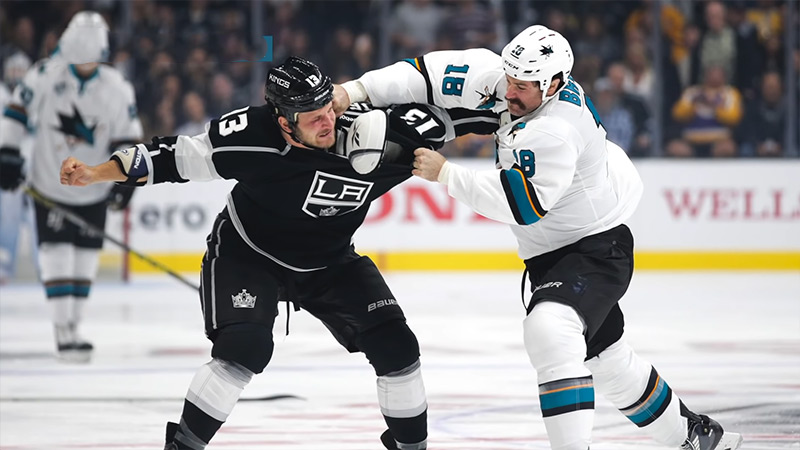
For millions of sports fans around the globe, ice hockey is synonymous with high-speed athletic precision, punishing body checks, and, occasionally, bare-knuckle physical altercations.
In North American professional sports, particularly within the National Hockey League (NHL), physical confrontations have historically been treated as an unwritten mechanism for players to police the game themselves.
However, when elite athletes transition from their domestic clubs to the international stage at the Winter Olympic Games, they enter a completely different regulatory environment.
The return of NHL superstars from Canada and the United States to the Winter Olympics for the first time since 2014 has renewed global interest in how international rules govern physical play.
In North American showcases like the 4 Nations Face-Off, fans previously witnessed intense rivalry games featuring three distinct fights within the first nine seconds of play.
Yet, viewers expecting similar physical showdowns on the Olympic stage are met with immediate structural boundaries: fighting is strictly prohibited in Olympic ice hockey.
The IIHF Rulebook: Zero Tolerance in Action
Explicit Governance Under Rule 46
Olympic ice hockey does not operate under domestic league guidelines; instead, every match is governed strictly by the regulations set forth by the International Ice Hockey Federation (IIHF).
The foundational principle regarding physical altercations is explicitly outlined within Rule 46 of the official IIHF rulebook. The IIHF explicitly establishes that fighting is “not part of international ice hockey’s DNA”.
This institutional philosophy changes how on-ice officials manage high-tension moments during a match. Unlike domestic leagues where referees may allow physical altercations to run their course before intervening, Olympic officials operate under a directive of immediate prevention.
Referees step in immediately to separate players before punches can even be thrown.
IIHF Rule 46 Penalty Structure
| Step | Action or Penalty | Description |
|---|---|---|
| 1 | Immediate On-Ice Intervention | Officials intervene to prevent an altercation from escalating. |
| 2 | Willing Combatant Classification | Officials identify players who willingly participate in the fight. |
| 3 | Major Penalty — 5 Minutes | A player who continues fighting after being ordered to stop receives a major penalty. |
| 4 | Game Misconduct | The penalized player is removed for the remainder of the game. |
| 5 | Supplementary Discipline | Further review may result in additional suspensions. |
Defining the “Willing Combatant” and Penalty Escalation
Under Rule 46, the IIHF establishes strict criteria for identifying and penalizing physical altercations on the ice. The rulebook defines “willing combatants” as players who willingly participate in a fight or brawl.
Once an individual is categorized as a willing combatant, the referee is obligated to levy severe penalties and remove the player from the match.
The penalty breakdown for fighting under IIHF governance follows a strict, non-negotiable escalation path:
- Five-Minute Major Penalty: Any player who persists in a fight after being ordered by an official to stop incurs a 5-minute major penalty in the penalty box.
- Automatic Game Misconduct and Instant Ejection: Beyond the major penalty, violators automatically receive a game misconduct penalty. This results in an instant ejection from the match, forcing the player to leave the ice and head directly to the locker room for the remainder of the game.
- Supplementary Discipline: The rulebook explicitly notes that further supplementary discipline may be imposed by disciplinary committees following post-game reviews.
This multi-layered penalty structure ensures that engaging in a physical brawl carries an immediate, game-altering penalty that directly penalizes the player’s national team.
High Stakes: Multi-Tournament Suspensions and Team Impact
Carrying Discipline Across International Events
The consequences of receiving a game misconduct for fighting in an Olympic tournament extend far beyond the sixty minutes of regulation time. One of the most critical legal and regulatory aspects of IIHF governance is the cross-tournament portability of disciplinary suspensions.
When suspensions are issued by IIHF disciplinary panels, they are not confined to a single tournament isolated in time. Instead, suspensions carry over from one official IIHF event to the next.
For example, if a player receives a disciplinary suspension during the gold medal match at the Winter Olympics, that suspension remains active and must be served during the player’s next official IIHF-sanctioned tournament, such as the IIHF World Championships.
[ Olympic Gold Medal Match Violation ]
                  │
                  ▼
[ IIHF Disciplinary Panel Review & Suspension ]
                  │
                  ▼
[ Suspension Carries Over to Next IIHF Event ]
(e.g., IIHF World Championship)
Strategic and Tactical Disadvantages for National Squads
Because international hockey tournaments operate on brief schedules with zero margin for error, losing a player to an automatic game misconduct places a national team at a massive disadvantage.
When a player is ejected for fighting, the offending team not only loses a key athlete for the remainder of the game, but they must also serve a mandatory 5-minute major penalty, placing their team short-handed on the penalty kill.
In high-stakes Olympic competition—where special teams execution frequently decides medal outcomes—the severe risk of leaving a team short-handed makes fighting extremely rare in international play.
Coaching staffs actively drill discipline into their rosters because a single impulse to throw a punch can forfeit a medal opportunity for an entire nation.
Olympic Rules vs. NHL Culture: A Comparative Analysis
The Structural Divide in Officiating and Discipline
To understand why Olympic hockey feels structurally different from domestic professional hockey, one must contrast the rule frameworks of the IIHF and the NHL.
In the NHL, fighting has historically been treated as an unwritten, self-policing mechanism managed by player culture. When two players engage in a fight in an NHL game, officials generally allow the altercation to finish provided both players remain upright and safe.
Once the fight concludes, the standard punishment in the NHL is a 5-minute penalty assigned to each individual player, after which both athletes return to the ice without facing ejection.
In contrast, the Olympic stage treats fighting as an absolute violation of sportsmanship. The IIHF enforces a strict stance where fighting is completely forbidden, punishing any physical brawl with an automatic game misconduct and instant ejection.
| Feature / Metric | NHL Domestic Play | Olympic Games (IIHF Rules) |
|---|---|---|
| Official Policy on Fighting | Treated as an unwritten aspect of play | Explicitly prohibited under Rule 46 |
| Standard Penalty Assessed | 5-minute penalty without ejection | 5-minute major + automatic game misconduct |
| Ejection Requirement | Rare; reserved for severe infractions | Instant and automatic ejection |
| Referees’ On-Ice Protocol | Allow fight to finish safely | Intervene immediately to prevent punches |
| Long-Term Suspension Scope | Applies within domestic league games | Carries over across all future IIHF events |
The Adaptation of Domestic Stars to the Global Stage
The contrast in rules creates an intriguing tactical challenge when professional NHL stars represent their national teams at the Winter Olympics.
Roster selections for top-tier nations often include physically aggressive players who are accustomed to playing on the physical edge in domestic competition.
For instance, top North American players—such as brothers Matthew and Brady Tkachuk representing the United States—are renowned for their high-intensity, aggressive style of play. However, when competing in Milan for the 2026 Winter Games, these athletes must strictly alter their approach.
On the Olympic stage, engaging in the same physical skirmishes that draw minor penalties in domestic play can lead to immediate ejections, post-game reviews, and multi-game international suspensions.
Tournament Mechanics: How Olympic Ice Hockey Works
Understanding the strict enforcement of fighting rules requires a broader view of how Olympic ice hockey tournaments are structured and executed.
Tournament Scale and Roster Rules
The Winter Olympic Games feature two elite tournaments divided by gender:
- Men’s Tournament: Features 12 national teams competing for gold.
- Women’s Tournament: Features 10 national teams competing for gold.
- Qualification Strictness: The qualification process is intensely competitive; for example, Great Britain failed to qualify for the 2026 Games in either the men’s or women’s categories.
Each participating national team operates under strict roster limits. On match days, teams assemble a game-day squad of 22 players. During active play, each team fields six players on the ice at any given time—consisting of five skaters and one goalkeeper.
Because of the intense physical demands of international play, line changes occur continuously, with coaches constantly rotating skaters from the 22-player squad throughout the match.
                 OFFICIAL OLYMPIC MATCH STRUCTURE

        +-------------------------------------------------+
        |           Regulation: Three 20-Min Periods      |
        |   (6 Players on Ice: 5 Skaters + 1 Goalkeeper)   |
        +-------------------------------------------------+
                                │
                                ▼
                      [ Score Tied at 00:00 ]
                                │
                                ▼
        +-------------------------------------------------+
        |           Sudden-Death Overtime Period          |
        |    (5 to 20 Mins | Reduced 3-on-3 Skaters)    |
        +-------------------------------------------------+
                                │
                                ▼
                       [ Still Tied? ]
             ┌──────────────────┴──────────────────┐
             ▼                                     ▼
   [ General Matches ]                   [ Gold Medal Match ]
     Penalty Shootout                      Must Be Decided in
    Decides the Winner                     Open Play (No Shootout)
Conclusion
The strict ban on fighting in Olympic ice hockey highlights a fundamental distinction between domestic entertainment and international athletic competition.
By enforcing Rule 46 and upholding an uncompromising stance against willing combatants, the IIHF ensures that Olympic matches are decided by world-class speed, tactical strategy, and team discipline.
When the world’s best hockey players step onto the Olympic ice, they must trade the self-policing culture of domestic leagues for the absolute discipline required by international play.
With game ejections, short-handed penalty kills, and multi-tournament suspensions waiting for any player who breaks protocol, Olympic ice hockey remains a clean, high-velocity showcase of pure athletic excellence.