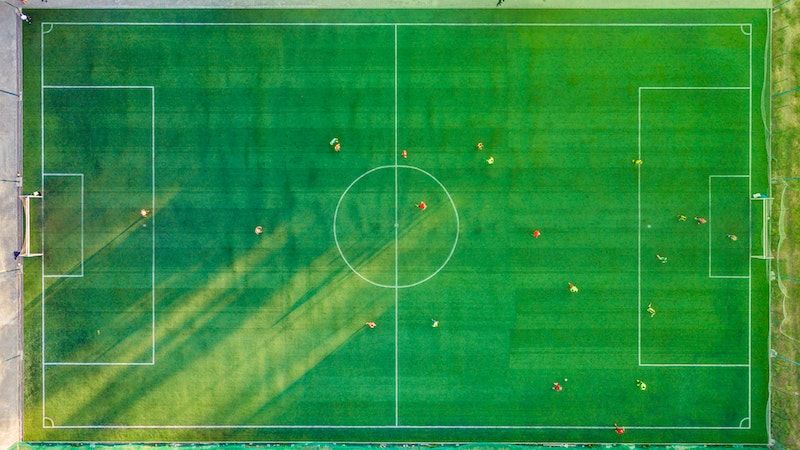
In most professional sports, the field of play is a rigid, non-negotiable measurement. A basketball court or an American football field remains identical whether you are in London or Los Angeles.
However, soccer offers a fascinating departure from this uniformity. Fans often notice that some pitches feel expansive and open, while others seem cramped and claustrophobic.
This variation is not an accident; it is a fundamental part of the game’s heritage. From regulatory flexibility to tactical maneuvering and architectural necessity, the geometry of the pitch is as dynamic as the players who compete upon it.
The Regulatory Framework: Understanding IFAB Guidelines
The primary reason soccer fields vary in size is that the game’s official governing bodies establish flexible range limits rather than fixed, unchangeable dimensions. This approach is designed to accommodate various factors, including stadium restrictions and different levels of play.
The International Football Association Board (IFAB), which maintains the Laws of the Game, provides a broad “window” for what constitutes a legal playing surface.
According to these regulations, the touchline (the length) must be between 90 meters and 120 meters, while the goal line (the width) must fall between 45 meters and 90 meters. This creates a massive potential difference in surface area.
Theoretically, a team could play on a field that is nearly twice as wide as another while still remaining within the laws of the sport. This flexibility is rare in the world of professional athletics, allowing local clubs to adapt their facilities to their specific environment.
International vs. Domestic Standards
While local and domestic matches enjoy significant leeway, the requirements for high-stakes international competition are much stricter.
When the world’s best national teams meet, the “wiggle room” provided by the IFAB narrows considerably to ensure a fair and predictable environment for athletes.
| Competition Level | Length (Touchline) | Width (Goal Line) |
|---|---|---|
| Domestic/General | 90m – 120m | 45m – 90m |
| International Matches | 100m – 110m | 64m – 75m |
| Standardized Elite Pitch | 105m | 68m |
Despite the broad legal ranges, there is a clear move toward uniformity at the highest levels of the game. Most top-tier professional clubs and modern stadiums now aim for a “gold standard” dimension of 105 meters by 68 meters.
This specific measurement is often preferred by UEFA and FIFA for major tournament finals, as it provides a balanced environment that neither favors pure speed nor pure defensive congestion.
Historical and Architectural Constraints
The physical footprint of a stadium often dictates the size of the pitch long before a ball is even kicked. Many of the world’s most iconic soccer venues were constructed decades ago, often in the hearts of dense urban centers where space was—and remains—at a premium.
Retrofitting Older Structures
Older venues that have been retrofitted for modern soccer must often squeeze the pitch into pre-existing concrete structures. If a stadium was built in the early 20th century, the distance between the stands and the field might be fixed.
If the club wants to increase its seating capacity or improve fan amenities, they are often forced to work with the existing pitch perimeter, which may result in a shorter or narrower field than the modern “gold standard”.
Multi-Use Facilities and Cricket Ovals
In certain regions, soccer is played in stadiums originally designed for other sports. A common example is the adaptation of cricket ovals for soccer.
Because cricket fields are circular or elliptical, they often feature curved perimeters that don’t easily accommodate a perfect rectangle. This frequently results in shorter touchlines as the corners of the pitch approach the boundary of the oval.
The Proximity of the Fans
The integration of the pitch with the surrounding architecture also plays a role. Many European stadiums are famous for having stands built remarkably close to the touchlines to enhance the atmosphere and fan experience.
While this creates an intense environment for the players, it severely restricts a club’s ability to expand the field size later on. Once the concrete is poured and the stands are set, the pitch dimensions are essentially locked in place.
The Tactical Chess Match: Geometry as Strategy
One of the most intriguing aspects of variable pitch sizes is how they can be used as a tactical tool. While many assume field size is purely a matter of logistics, smart managers often view the dimensions of their home turf as the “twelfth man” on the field.
Utilizing Wide Pitches for Attacking Fluidity
Teams that rely on a philosophy of “width” generally prefer the largest possible pitch. By maximizing the width of the field, a team can stretch the opposition’s defensive lines.
This creates more space for wingers to operate in one-on-one situations and allows wing-backs to make overlapping runs without running into a crowd of defenders.
A wide pitch tires out a defensive team because they must cover more lateral ground to block passing lanes and shut down crosses.
Narrow Pitches and Defensive Solidity
Conversely, teams that prioritize defensive stability often opt for narrower dimensions. By shrinking the width of the field, a coach can effectively congest the central spaces, making it much harder for technically gifted passing teams to find gaps.
In a narrower space, even a modest defensive block can appear impenetrable because there is simply less ground to cover. This tactical choice often levels the playing field for an underdog when facing a world-class offensive opponent.
The Short Pitch and the High Press
The length of the field is equally important for tactical “traps”. Managers who employ a high-pressing system—where the team tries to win the ball back as close to the opponent’s goal as possible—often favor shorter pitches.
On a shorter field, the distance between the opponent’s goal and the halfway line is reduced, allowing the pressing team to pin their rivals deep in their own half more effectively. It limits the “escape routes” for a defending team trying to play the ball out from the back.
Scaling the Pitch for Youth and Development
Beyond the professional game, the variation in soccer field sizes serves a vital developmental purpose. It would be physically impossible and developmentally detrimental for a seven-year-old to play on a full-sized professional pitch.
Physical Scaling and Stamina
Children simply do not have the lung capacity, stamina, or leg strength required to cover a 105-meter field. If youth games were played on adult pitches, the game would devolve into long periods of running with very little tactical or technical engagement.
Smaller fields ensure that the physical demands of the game are proportional to the age and athletic ability of the players.
The Benefit of “Touch Multipliers”
One of the core principles of youth coaching is increasing the number of times a player touches the ball. Smaller fields naturally create more frequent ball contacts for every player on the pitch.
Instead of the ball being 40 yards away for long stretches, it is always within a short distance, forcing young players to make quick decisions, improve their dribbling, and refine their passing under pressure.
These “touch multipliers” are essential for accelerating skill development in the early stages of a player’s career.
Goalkeeper Proportions and the “Frame”
Field scaling also includes the size of the goals and the penalty boxes. A standard adult goal is 24 feet wide and 8 feet high. Putting a young child in front of a net that size would be demoralizing, as they would have almost no chance of reaching a well-placed shot.
By shrinking the goals and the surrounding boxes, the game remains fair, ensuring that goalkeepers have a realistic chance of making saves and that attackers must develop accuracy rather than just relying on the sheer size of the target.
FAQ: Common Questions About Pitch Dimensions
Can a team change their pitch size mid-season?
In most professional leagues, teams must register their pitch dimensions before the season begins. While they can choose their size within the IFAB limits, they generally cannot change the markings from week to week to suit a specific opponent, as this would undermine the integrity of the competition.
Are the lines of the pitch included in the measurements?
Yes, according to the Laws of the Game, the lines themselves are part of the area they enclose. For example, if a ball is on the touchline, it is still in play. The width of these lines must not exceed 12 centimeters (5 inches).
Why doesn’t FIFA just mandate one universal size?
FIFA and the IFAB value the diversity of the sport. Mandating a single size would disqualify hundreds of historic stadiums that simply do not have the physical room to expand. By allowing a range, the game remains accessible to clubs in various urban and historical settings.
Is the grass length regulated as well?
While the dimensions of the lines are regulated, the height of the grass is usually a league-specific guideline. Most elite leagues prefer the grass to be cut between 20mm and 30mm.
Like the field dimensions, grass height can be used tactically—shorter, wet grass makes for a faster game, while longer grass can slow down a fast-passing opponent.
Conclusion: Embracing the Variability of the Game
The fact that soccer fields are not all the same size is one of the sport’s most enduring and unique characteristics. It is a rare blend of historical necessity, legal flexibility, and tactical ingenuity.
Whether it is an old stadium in South America adapted from a different era or a modern youth pitch designed to foster the next generation of talent, the geometry of the pitch is a living part of the game’s strategy.
Understanding these dimensions allows fans to see beyond the surface of the match. It reveals why certain teams struggle away from home and why others seem so dominant on their own turf.
The pitch is not just a stage for the players; it is a tactical tool that shapes the very nature of the contest. By embracing this variability, soccer retains a level of unpredictability and local flavor that few other sports can match.
Next time you watch a match, look closely at the white lines—they might be telling a different story than the one you’re used to.