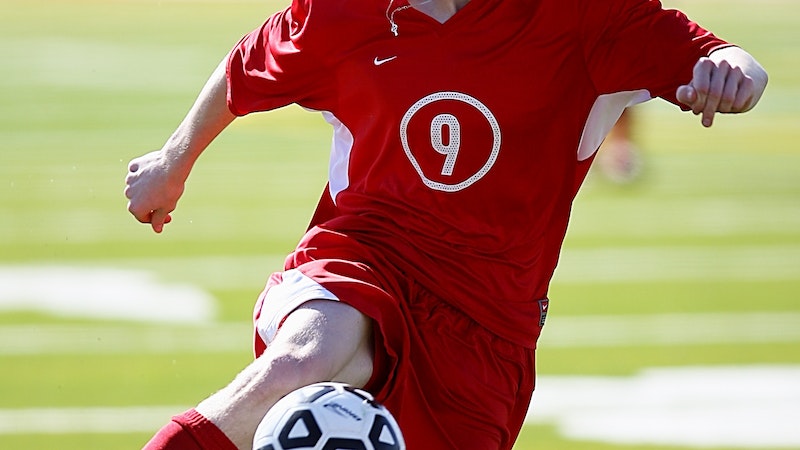
Kicking a soccer ball appears to be a singular, fluid motion, yet it is actually a masterpiece of human biomechanics.
To the casual observer, it looks like a simple leg swing, but for elite athletes, it is a sophisticated, full-body event driven by a proximal-to-distal kinetic chain.
This sequence ensures that energy generated in the larger muscles of the trunk and hips is transferred efficiently through the limbs to the point of impact.
Understanding the specific muscles involved—from the explosive power of the quadriceps to the stabilizing force of the standing leg—is essential for maximizing performance and preventing injury.
The Biomechanics of the Power Phase
The execution of a soccer kick is a multi-stage process requiring the synchronization of nearly every major muscle group in the body. While the leg making contact with the ball receives the most attention, the process begins long before the foot touches the leather.
The Role of the Kinetic Chain
In sports science, the kinetic chain refers to the notion that the body is a series of interconnected segments. When you kick a ball, the energy doesn’t start in your foot; it starts in your core and hips.
This “proximal-to-distal” flow means that larger, stronger muscles at the center of the body initiate the movement, while the smaller, faster muscles in the extremities finalize it.
Phases of the Kick
To understand which muscles are active at any given time, we must look at the four primary phases of the kick:
- The Approach and Plant: Setting the foundation with the non-kicking leg.
- The Backswing (Cocking): Stretching the muscles of the kicking leg to store elastic energy.
- The Acceleration: Snapping the leg forward toward the ball.
- The Impact and Follow-Through: Making contact and safely decelerating the limb.
Primary Muscles of the Kicking Leg
The kicking leg is responsible for the “Power and Execution” of the strike. It acts as a whip, where the upper leg provides the leverage and the lower leg provides the final velocity.
The Quadriceps: The Primary Drivers
The quadriceps are arguably the most critical muscle group during the acceleration phase. They act as the primary drivers of the forward strike.
- Rectus Femoris: This is unique because it crosses both the hip and the knee, helping to flex the hip and extend the knee simultaneously.
- Vastus Medialis and Lateralis: These muscles contract powerfully to extend the knee, snapping the shin forward at high speeds.
- Vastus Intermedius: Works in tandem with the other vasti muscles to provide a stable, powerful extension.
The Hip Flexors and Glutes
Before the forward snap, the leg must be cocked back. This is where the glutes and hip flexors play their most vital roles.
- Iliopsoas (Iliacus and Psoas Major): These muscles act alongside the rectus femoris to drive the entire thigh forward from its cocked position.
- Gluteus Maximus: During the wind-up phase, the gluteus maximus contracts to extend the hip backwards, essentially “loading” the spring for the forward movement.
The Hamstrings and Deceleration
While the quads accelerate the leg, the hamstrings (biceps femoris, semitendinosus, and semimembranosus) flex the knee during the backswing. However, their most critical job occurs right before impact.
They contract eccentrically to decelerate the leg, protecting the knee joint from overextending or sustaining injury during the high-velocity swing.
Lower Leg, Foot, and Ankle Stability
| Muscle | Primary Function in Kick | Impact on Performance |
|---|---|---|
| Gastrocnemius & Soleus | Plantar flexion (pointing toes) | Creates a rigid hitting surface for laces/instep kicks. |
| Tibialis Anterior | Dorsiflexion/Stabilization | Stabilizes the foot angle to ensure a clean strike. |
| Hip Adductors | Medial rotation/Inward pull | Essential for side-foot passes or curving the ball. |
The Supporting Leg: The Foundation of Stability
The non-kicking leg, often called the plant leg, is the unsung hero of the soccer kick. Without a stable base, the power generated by the kicking leg would be lost to balance corrections.
Pelvic and Hip Stability
When you swing your kicking leg, your entire center of mass shifts. To counteract this, the gluteus medius and minimus of the supporting leg contract heavily.
This prevents the supporting hip from collapsing or tilting under the weight of the swing, ensuring the pelvis remains level for a more accurate strike.
Impact Absorption and Grounding
The plant leg must also deal with the sudden force of the player’s momentum stopping as they ground themselves.
- Quadriceps and Hamstrings: These muscles work dynamically in the plant leg to absorb the impact forces of planting the foot onto the pitch.
- The Calf Complex: The gastrocnemius activates intensely in the supporting leg to lock the ankle joint into the turf. This “anchoring” effect prevents the foot from slipping, which is a common cause of both missed shots and ligament injuries.
Core and Upper Body Force Transmission
High-performance kicking is a full-body effort. If the core is weak, the energy generated by the legs is dissipated through the torso—a phenomenon often called “energy leakage.”
The Power of Proximal Stiffness
The abdominals and obliques (including the rectus abdominis and internal/external obliques) create a rigid torso. This “proximal stiffness” is the secret to elite power; it provides a solid platform against which the limbs can pull, allowing for a much more efficient energy transfer.
Rotational Balance and Spinal Support
- Erector Spinae: These muscles run along the spine and are responsible for keeping the athlete upright. They work to counteract the intense rotational forces generated by the kick, protecting the lower back.
- Shoulders and Chest: You will often see soccer players throw their opposite arm out or across their body when kicking. The deltoids and pectoralis major control this arm swing to balance the rotational force of the kicking leg, maintaining the player’s center of gravity.
Strategic Training for a More Powerful Kick
To optimize the muscles used in a soccer kick, training should focus on the specific ways these muscles function during the movement.
Developing Eccentric Hamstring Strength
Since the hamstrings act as the brakes for your kick, a stronger hamstring allows the quads to fire faster without the body’s natural “protective” reflex slowing the leg down. Exercises like Nordic hamstring curls or Romanian deadlifts are gold standards for soccer players.
Enhancing Core Stability
Standard crunches are rarely enough for soccer-specific power. Athletes should prioritize “anti-rotational” exercises like Pallof presses or weighted planks. These movements train the core to maintain the “proximal stiffness” required to transfer force from the hips to the ball.
Plyometric and Explosive Power
Because kicking is a high-velocity movement, training the quadriceps and glutes for explosiveness is key. Box jumps, lateral bounds, and split squats help the nervous system recruit muscle fibers quickly, which translates directly to a harder strike on the pitch.
Frequently Asked Questions
Which muscle is most important for kicking a soccer ball?
While it is a team effort, the quadriceps are the primary drivers for forward acceleration and knee extension. However, without the gluteus medius of the plant leg providing stability, that power cannot be directed accurately.
Why do my hamstrings hurt after practicing long kicks?
This often happens because the hamstrings have to work extremely hard to decelerate your leg after the ball is hit. If they are not strong enough to handle this eccentric load, they can become strained.
How does the core help in kicking a ball?
The core acts as a bridge. It creates “proximal stiffness,” which prevents energy from being lost as it travels from your center to your leg. A strong core also helps you maintain balance against the rotational forces of the swing.
What muscles are used for a side-foot pass?
In addition to the standard quads and glutes, a side-foot pass heavily recruits the hip adductors. These muscles pull the leg inward across the body to position the inside of the foot toward the ball.
Maximizing Your Athletic Potential
Dominating on the soccer field requires more than just skill; it requires an anatomical understanding of how your body generates force. By focusing on the proximal-to-distal kinetic chain, you can begin to see the kick not as a leg movement, but as a total-body explosion.
Focusing on the following areas will yield the greatest improvements:
- Stability: Strengthening the plant leg’s glutes and calf complex.
- Power: Explosive training for the quadriceps and hip flexors.
- Protection: Eccentric hamstring work and core rigidity.
Whether you are a professional athlete or a weekend warrior, training the right muscles will ensure your shots are harder, your passes are more accurate, and your body remains resilient against the rigors of the game.