An indirect free kick is one of the most technical restarts in soccer, often causing confusion for players and fans alike. Unlike its direct counterpart, this specific set piece mandates that the ball must touch another player before a goal can be legally scored.
Whether it is a goalkeeper violation or a technical field foul, understanding the mechanics of this rule is essential for mastering the game’s flow.
This guide breaks down the official regulations, the critical referee signals to watch for, and the specific infractions that lead to this unique scoring opportunity on the pitch.
The Fundamental Mechanics of the Two-Touch Rule
At its core, an indirect free kick is a method of restarting play where a goal cannot be scored directly from the initial kick. For a goal to be considered valid, the ball must touch at least one other player from either team before it enters the net.
This “secondary touch” requirement changes the tactical approach of the restart entirely, as the kicker cannot simply blast the ball into the top corner without a teammate or opponent getting a piece of it first.
If a player decides to take a direct shot on goal from an indirect free kick and the ball enters the opponent’s net without touching any other player, the goal is disallowed. In this scenario, play is restarted with a goal kick awarded to the defending team.
This underscores the importance of both the kicker and the attackers being aware of the referee’s instructions before play resumes.
Understanding this mechanic is vital for elite competitive play, where a single misunderstood signal can result in a wasted scoring opportunity.
Visual Cues: Identifying the Referee’s Signal
Recognizing an indirect free kick before it is taken is crucial for both attacking and defending teams. The referee provides a specific, standardized signal to communicate this decision to everyone on the field.
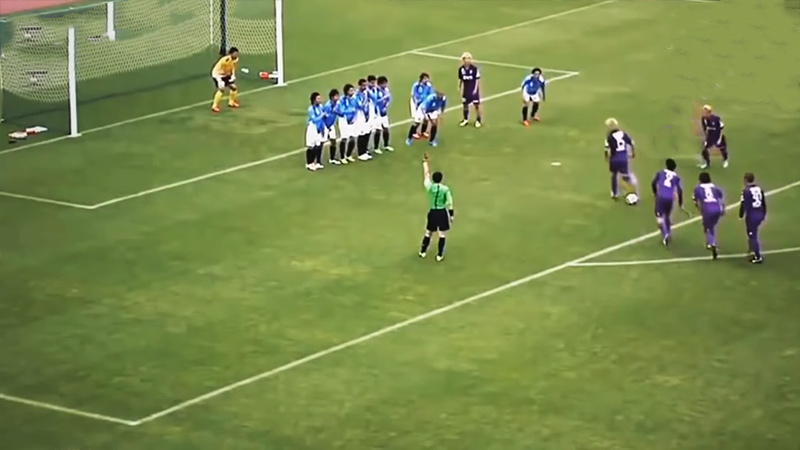
They signal an indirect free kick by raising one arm straight up in the air. This signal is not momentary; the referee will maintain this position until the kick has been executed and the ball has either touched another player or traveled out of play.
Why Signal Visibility Matters for Strategy
For the attacking team, seeing the raised arm means they must coordinate a “tap” or a cross rather than a direct shot. For the defending team, it changes how they set their wall.
If they know the kick is indirect, they may focus more on blocking the second player or the passing lanes rather than just the initial shooter.
The referee’s consistency in holding this signal ensures that no player is left guessing about the nature of the restart as the whistle blows.
Positioning the Ball for the Restart
Generally, the kick is taken from the exact spot where the offense or infraction occurred. However, there is a major exception regarding the six-yard box.
If an indirect free kick is awarded to the attacking team inside the opponent’s six-yard box, the ball is not placed where the foul happened.
Instead, it is moved to the nearest point on the goal area line (the “six-yard line”) that runs parallel to the goal line. This creates one of the most exciting and chaotic moments in soccer, as the defending team often lines up directly on their goal line to block the shot.
Common Infractions Leading to an Indirect Free Kick
Indirect free kicks are typically awarded for technical infractions or “non-contact” fouls, rather than the physical challenges that lead to direct free kicks.
These rules are designed to maintain the integrity of the game and prevent unfair technical advantages, particularly regarding goalkeeper conduct and dangerous play.
Goalkeeper-Specific Violations
The goalkeeper has a unique set of restrictions to prevent time-wasting and unfair ball control. An indirect free kick is awarded if the goalkeeper holds the ball for more than six seconds before releasing it into play.
Additionally, the “back-pass rule” is a common source of these kicks; a keeper cannot pick up the ball with their hands if a teammate has deliberately kicked it to them with their foot.
Furthermore, if a goalkeeper releases the ball from their hands and then touches it again before another player has touched it (double handling), an indirect free kick is given to the opposition.
Field Player and Technical Rules
Field players can also trigger these restarts through several non-contact offenses. The most frequent reason for an indirect free kick in professional soccer is an offside violation.
Beyond offside, “playing in a dangerous manner” is a key category. This includes actions like a high-kick near an opponent’s head or attempting to kick the ball while an opponent is trying to head it, even if no physical contact is made.
Impeding the progress of an opponent without making contact—essentially “blocking” them without playing the ball—is another technical foul that results in an indirect restart.
Conduct and Interference Standards
The rules also cover behavioral issues that disrupt the spirit of the game. Using offensive, insulting, or abusive language can result in an indirect free kick for the opposing team.
Additionally, players are prohibited from preventing the goalkeeper from releasing the ball from their hands. This prevents attackers from “shadowing” a keeper or standing directly in their path to disrupt a quick transition to offense.
Comparing Direct and Indirect Free Kicks
To truly master soccer strategy, one must understand the clear distinction between direct and indirect free kicks. While both serve to restart the game after a foul, their applications and consequences are vastly different.
| Feature | Direct Free Kick | Indirect Free Kick |
|---|---|---|
| Goal Scoring | Can be scored directly | Requires a touch by a second player |
| Primary Cause | Physical contact fouls or handballs | Technical infractions or non-contact fouls |
| Referee Signal | Arm pointed horizontally | Arm raised vertically |
| Penalty Area Result | Penalty kick (if by defense) | Indirect free kick (even if in the box) |
As seen in the table above, the most significant difference lies in the nature of the foul. Direct free kicks are the penalty for physical aggression—tripping, pushing, or striking—and the illegal use of hands. Indirect free kicks are the remedy for technical errors, such as the back-pass or dangerous play.
Notably, if a technical infraction occurs inside the penalty area, it does not result in a penalty kick; the referee awards an indirect free kick instead, often leading to a high-pressure “wall” situation just yards from the goal.
Tactical Execution: Scoring from an Indirect Kick
When a team is awarded an indirect free kick near the opponent’s goal, the tactical setup becomes a game of chess. Since the ball must touch two players, the “tap and blast” is the most common strategy.
One player will stand over the ball and lightly touch it, just enough to move it, which technically puts the ball in play. A second player immediately follows with a powerful shot on goal.
Defensively, the challenge is immense. Because the kick is indirect, the defenders know they have a split second while the first player touches the ball to rush forward and close the gap.
In situations where the kick is very close to the goal (such as those resulting from a back-pass), the entire defending team may stand on the goal line between the posts.
This creates a wall of bodies that the attacking team must navigate with precision rather than just raw power.
Frequently Asked Questions About Indirect Free Kicks
Can you be offside on an indirect free kick?
Yes, the standard offside rules apply during the restart. If an attacking player is in an offside position when the ball is played, the referee can blow the whistle and award a fresh indirect free kick to the defending team.
What happens if the ball hits the referee?
Under current FIFA and IFAB laws, the referee is no longer considered “part of the field” in a way that allows play to continue if the ball hits them and changes possession or creates a scoring chance.
If the ball touches the referee and stays in play, a dropped ball is usually the restart. However, for the purpose of the “two-touch” rule on an indirect free kick, a touch off the referee does not count as a second touch to make a goal valid.
What if the ball goes into the kicker’s own goal?
If an indirect free kick is kicked directly into the kicker’s own goal without touching another player, a goal is not awarded to the opposition.
Instead, the game restarts with a corner kick for the opposing team. This is a rare occurrence but highlights the consistency of the “no direct goal” rule.
Elevating Your Game Knowledge
Mastering the nuances of the indirect free kick is a hallmark of an advanced soccer mind. These rules ensure that the game remains fair, penalizing technical errors without necessarily granting the massive advantage of a direct shot or a penalty kick.
For coaches and players, recognizing the referee’s raised arm immediately shifts the tactical objective from individual brilliance to collective coordination.
Whether you are a newcomer to the sport or a seasoned veteran, keeping these distinctions in mind will help you better understand the complex tapestry of soccer’s regulations.
The next time you see a referee’s hand high in the air, you’ll know exactly what’s at stake: a moment of tactical precision where the second touch is just as important as the first.