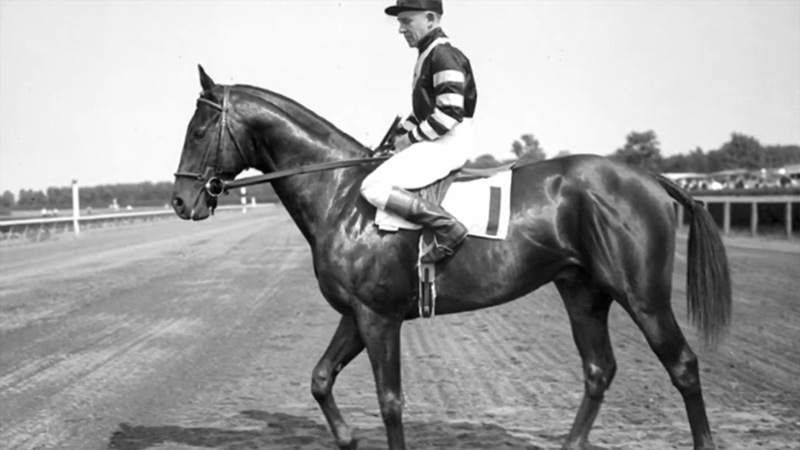
In the world of horse racing, few names carry as much weight as Seabiscuit. During the height of the Great Depression, this “knobby-kneed” underdog became a national sensation, representing the hope of a struggling population. However, a champion horse is only as good as the team behind it.
If you have ever wondered, “Who was Seabiscuit’s jockey?” the answer is not just one man, but a story of a legendary partnership and a selfless friendship that defined an era of racing.
According to the sources, while several men touched the reins, the story of Seabiscuit’s success is primarily centered on two iconic figures: Red Pollard and George Woolf.
Red Pollard: The Primary Jockey and the “Soul” of the Team
When discussing who rode Seabiscuit, the conversation must begin with Red Pollard (born John Pollard). A Canadian jockey, Pollard is recognized by the sources as Seabiscuit’s primary rider.
A Legendary Partnership Begins
The partnership that would change racing history began in 1936. At the time, Seabiscuit was considered a temperamental and difficult horse.
However, Pollard possessed a unique quality that set him apart from other riders of his day. The sources emphasize that Red Pollard is considered the main jockey who understood the horse’s temperament best.
This understanding was not merely technical; it was a deep, intuitive bond. While other riders might have tried to break the horse’s spirit or force him into a specific style of running, Pollard worked with Seabiscuit’s natural inclinations.
This synergy allowed the horse to transform from a struggling underdog into a dominant force on the track.
Resilience in the Face of Adversity
Red Pollard’s career was not a simple path to glory. He was known for his incredible resilience, frequently overcoming serious injuries to return to the saddle. These injuries were a recurring theme in his life, often leaving him sidelined during some of the most critical moments of Seabiscuit’s career. Despite these physical setbacks, his place as the “soul” of the Seabiscuit team remained undisputed.
George Woolf: The “Iceman” and the Greatest Match Race
While Pollard was the primary jockey, another name is inextricably linked to Seabiscuit’s legacy: George Woolf.
The Ultimate Substitute
George Woolf was not a rival to Pollard, but rather a close friend. This friendship proved vital in 1938, a year that would define Seabiscuit’s place in history.
Due to one of Pollard’s many serious injuries, he was unable to ride in what is arguably the most famous horse race of all time: the match race against the Triple Crown winner, War Admiral.
In a move that highlighted the trust within the team, George Woolf stepped in to ride Seabiscuit in his famous 1938 victory over War Admiral.
Woolf, known as “The Iceman” for his cool nerves under pressure (a detail not explicitly in the sources but widely recognized in racing history), executed a perfect strategy that allowed the underdog Seabiscuit to defeat the heavily favored War Admiral.
A Selfless Legacy
The sources highlight that Woolf’s participation was a result of his friendship with Pollard. He didn’t just ride for the glory; he rode to keep the dream alive for his injured friend.
This dynamic created a rare narrative in sports history—two elite athletes working together for the benefit of a single animal.
The Architects: Tom Smith and Charles Howard
The jockeys were the ones in the spotlight, but the sources remind us that they were part of a larger, carefully constructed team. Two other men were essential to Seabiscuit’s rise:
- Tom Smith (The Trainer): The silent and enigmatic trainer who first saw potential in Seabiscuit.
- Charles Howard (The Owner): The visionary owner who provided the financial backing and public relations savvy to turn Seabiscuit into a household name.
Together with Pollard and Woolf, Smith and Howard formed a “human team” that provided the stability and strategy necessary for Seabiscuit to flourish.
Summary of Key Facts
| Role | Name | Key Contribution |
|---|---|---|
| Primary Jockey | Red Pollard | Formed legendary partnership in 1936; understood the horse’s temperament,. |
| Substitute Jockey | George Woolf | Pollard’s friend; rode Seabiscuit to victory over War Admiral in 1938. |
| Trainer | Tom Smith | The man responsible for training the legendary horse. |
| Owner | Charles Howard | The owner who brought the team together. |
Conclusion: A Team Effort
So, who was Seabiscuit’s jockey? While Red Pollard was the man who spent the most time in the saddle and shared the deepest connection with the horse, George Woolf was the one who steered him through his most iconic moment of triumph,.
Their story is a reminder that greatness is rarely achieved alone. It took the combined efforts of a resilient Canadian jockey, a cool-headed friend, a brilliant trainer, and a determined owner to turn an unlikely horse into an American legend.