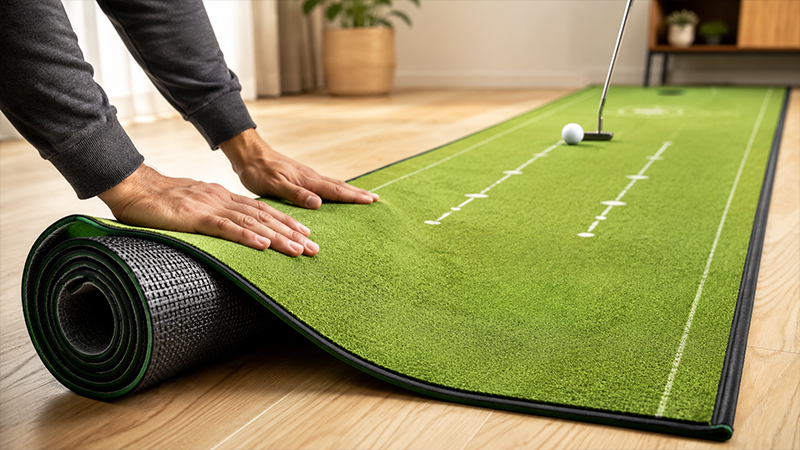
Achieving a perfectly level surface is the most important step in setting up a home golf practice area. When a putting mat is new, it often has curls or creases from being stored in a box.
These imperfections can change the path of the ball, making your practice less effective.
To ensure a true roll, you must use specific techniques to relax the material and remove any physical memory from the fibers.
1. Preparing Your Space for a Flat Putting Surface
Before you begin the process of removing creases, you must prepare the environment. The temperature of the room plays a significant role in how the mat reacts to flattening efforts.
It is best to place the mat in a warm room because low temperatures often cause the backing of the mat to become stiff. A stiff backing is much harder to flatten than one that has been allowed to reach a moderate room temperature.
In addition to temperature, the floor itself must be considered. You should always lay the putting mat on a perfectly flat surface, such as wood or tile floors.
Placing the mat on thick carpeting is not recommended, as the lack of a solid foundation can prevent the mat from staying flat and stable.
You should also ensure the floor is clean before laying the mat down, as debris underneath can create small bumps on the putting surface.
2. Initial Unboxing and Fiber Manipulation
When you first unroll the mat, you will likely notice that the ends or certain sections remain curved. One of the first actions you should take is to manually massage or bend the mat back against the direction of the curl.
This helps to break in the fibers and the backing right away. This manual manipulation is a proactive way to start the flattening process before applying more advanced methods.
3. Using Heat for Rapid Crease Removal
Heat is one of the most effective tools for smoothing out a putting surface. There are several ways to apply heat safely without damaging the material.
The Steam and Iron Method
Using a clothes steamer is considered the fastest way to smooth out creases. The steam penetrates the fibers and allows them to relax quickly. If you do not have a steamer, you can use a standard clothing iron, but you must be careful.
The iron should be set to a low setting to avoid melting the plastic components of the mat. It is also advisable to use a cloth barrier between the iron and the mat surface to protect the material from direct heat.
The Hairdryer Technique
For specific spots that have stubborn creases, a hairdryer is a useful tool. You should use the hairdryer to gently heat the creased areas.
While doing this, move the dryer continuously to ensure you do not damage the mat by concentrating heat in one spot for too long.
After the area is warm and the fibers have softened, place heavy items on top of the spot while it cools down to lock in the flat shape.
4. Mechanical Solutions: Reverse Rolling and Flipping
If heat is not available or if you prefer a mechanical approach, tension and gravity can be used to straighten the mat.
Reverse Rolling
One common technique is reverse rolling. To do this, you unroll the mat and then immediately roll it back up tightly in the opposite direction of its original curl.
You should let the mat sit in this reverse-rolled state for several hours. This forces the material to counteract the curve it developed while in the packaging.
5. The Reverse Edge Method
Sometimes the edges of the mat will curl upward even if the main body is flat. In this case, you can use the reverse edge method.
This involves turning the entire mat over so the putting surface faces the floor. Leave the mat in this position for approximately 24 hours to allow gravity to pull the edges down.
6. The Role of Weight in Achieving a Level Surface
Applying weight is a reliable way to ensure the mat stays flat after you have applied heat or tension. You can place heavy, flat objects across the entire surface of the mat. Examples of suitable items include large books, heavy boards, or fitness weights.
These should be placed specifically on the creases or any areas that appear to be lifted. Leaving these weights in place for 24 hours is usually sufficient to achieve a professional-grade surface.
7. Maintaining a Flawless Putting Surface
Once the mat is flat, you should take care to maintain it. Keeping the floor clean and avoiding folding the mat will prevent new creases from forming.
By combining heat, weight, and proper surface selection, you can create a practice environment that accurately reflects the conditions you will find on an actual green.