Lifting in racing means easing off or fully releasing the throttle while the car is still traveling at speed. It looks like the simplest input a driver makes, yet it shapes lap time, tire life, fuel use and how a car behaves in every corner.
Ask a racing coach where amateur drivers lose the most time, and many will point to the throttle before the brakes. A lift that lasts a fraction too long costs speed on corner exit. A lift that is too sharp can unsettle the rear of the car and turn a good lap into a spin.
At the highest level, lifting is also a strategy. Formula 1 engineers radio “lift and coast” instructions to save fuel and cool the brakes. Endurance crews plan lifting zones to stretch a stint by an extra lap, and sim racers study throttle traces to find hidden tenths.
This guide explains what lifting is, the physics behind it, the main types of lift, how it changes between racing disciplines and how to practice it.
Whether you race karts at weekends, compete in an online league or simply follow motorsport, you will finish with a clear picture of one of racing’s most misunderstood skills.
What Does Lifting Mean in Racing?
Lifting is any reduction in throttle pedal travel while the car is moving at speed. The name comes from the physical action itself: the driver lifts the right foot away from the accelerator.
Drivers and engineers use the word in four closely related ways:
- Full lift: the foot comes completely off the throttle for a moment.
- Partial lift: the pedal eases back only slightly, often called “breathing” or “feathering” the throttle.
- Lifting through a corner: taking a corner with a short lift instead of staying flat out or using the brakes.
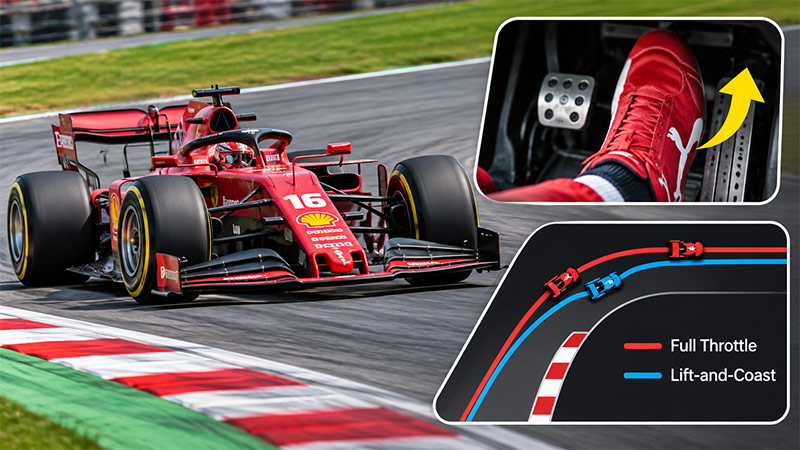
- Lift and coast: lifting early before a braking zone and rolling briefly before the brake is applied.
Lifting is often confused with braking and coasting, but each input does a different job.
| Input | What the driver does | Effect on the car | Typical use |
|---|---|---|---|
| Lifting | Reduces or releases the throttle | Mild slowing; weight moves gently forward | Fast corners, balance changes, fuel saving |
| Braking | Presses the brake pedal | Strong slowing; large forward weight shift | Slowing for medium and slow corners |
| Coasting | Uses neither throttle nor brake | Car rolls and slows from drag and engine braking | The gap between a lift and the brakes in lift and coast |
In short, a lift is the gentlest way to slow down or rebalance a race car. The best drivers treat it as a precise tool, never as a nervous reflex.
The Physics Behind Lifting: Weight Transfer and Grip
Lifting matters because it moves weight around the car. When the throttle closes, the car slows, and inertia pushes load toward the front axle.
More load on the front tires gives them more grip, which helps the car turn in. Less load on the rear tires takes grip away, which can make the back of the car feel light or loose. Almost every lifting decision is a trade between these two effects.
Three forces slow the car during a lift:
- Engine braking: a closed throttle creates resistance inside the engine that slows the driven wheels. It is strongest in low gears and at high revs.
- Aerodynamic drag: at high speed, air resistance alone slows the car noticeably, especially in cars with large wings.
- Rolling resistance: tire deformation and drivetrain friction add a smaller, steady drag.
Aerodynamics adds a hidden twist. Downforce grows with the square of speed, so a lift that scrubs off speed also takes away grip. That is why some fast corners are quicker flat out: keeping speed up keeps the wings working.
The drivetrain layout changes the result too. In a rear-wheel-drive car, engine braking acts on rear tires that are already losing load, so a lift tends to rotate the car. In a front-wheel-drive car, the front tires handle both steering and engine braking, so a lift usually tightens the line without much drama.
The Four Main Types of Lift
Not every lift is the same. Drivers change how much, how quickly and how long they lift depending on the corner, the car and the race situation.
The full lift
The driver releases the throttle completely for a short moment. It creates the biggest forward weight shift short of braking. Drivers use it for corners that sit just above flat-out speed, or when the car needs a firm nudge to turn in.
The partial lift
The pedal comes back only a little, for example from full throttle to around three quarters. Just enough weight moves forward to help the front tires bite while the car stays settled. This is the classic technique for long, fast sweepers.
The confidence lift
This is a brief lift driven by nerves rather than need. Many drivers lift at corners their car could take flat out, simply because the speed feels uncomfortable. Data shows it as a small dip in the throttle trace with no real benefit, and removing it is one of the quickest ways to find lap time.
The tactical lift
Some lifts have nothing to do with the corner itself. Drivers lift to manage tire temperatures, avoid contact in traffic, open a gap before a restart or save fuel. The most organized version of the tactical lift is lift and coast.
Lift and Coast: Lifting as Race Strategy
Lift and coast means lifting off the throttle before the usual braking point, rolling for a moment, then braking as normal. The driver gives away a small amount of lap time to protect something more valuable over the full race.
The technique follows a simple sequence:
- The driver lifts at a set marker before the normal braking point.
- The car coasts, slowing through drag and engine braking alone.
- The driver brakes slightly later in the sequence and with less pressure, because the car is already slower.
- Corner entry and exit continue as usual.
Teams ask for lift and coast for five main reasons:
- Fuel saving: less time at full throttle burns less fuel. Teams can start with a lighter fuel load and use lifting to reach the finish.
- Brake cooling: shorter, lighter braking lowers disc and pad temperatures and reduces wear.
- Tire care: gentler deceleration puts less stress on the front tires.
- Energy management: in hybrid race cars, how the car slows affects how much energy the system can recover and redeploy.
- Engine life: fewer seconds at peak load per lap help power units last their full mileage.
The cost is usually a small fraction of a second per lifting zone. Engineers choose zones at the end of long straights before heavy braking, where the saving is largest and the time loss smallest.
In endurance racing, the gains add up quickly. Stretching every stint by a single lap can remove a full pit stop across a long race, which is worth far more than the time lost to lifting.
Lift-Off Oversteer: When a Lift Rotates the Car
Lift-off oversteer happens when a driver lifts mid-corner, weight rushes forward and the rear tires lose grip. The back of the car steps out, and the car rotates more than the driver intended.
It occurs because tires in a corner are already working close to their limit. A sudden lift unloads the rear axle and drops its grip below what the corner demands. Rear-engined cars, short-wheelbase cars and cars with a stiff rear setup are especially prone to it.
Using it as a tool
Skilled drivers turn this effect into an advantage. A small, controlled lift on corner entry helps point the nose into a tight bend. Front-wheel-drive touring car racers rely on it to fight understeer, and rally drivers use it to set up weight transfer before a direction change.
Keeping it under control
- Lift smoothly: a gradual release moves weight forward gently, while a snap release unloads the rear all at once.
- Avoid big lifts at high speed mid-corner: commit to the throttle earlier or brake before turn-in instead.
- Catch the slide correctly: steer into the slide and, in a rear-wheel-drive car, gently reapply throttle to reload the rear. Lifting further or stamping on the brakes usually makes it worse.
- Adjust the setup: a softer rear anti-roll bar or a gentler coast setting on the differential can calm lift-off behavior. Sim racers can test these changes safely in a few laps.
How Lifting Differs Across Racing Disciplines
The physics of a lift never changes, but how drivers use it depends heavily on the type of racing. Power, aerodynamics, surface and race length all shift the balance.
| Discipline | How drivers use lifting | What to watch for |
|---|---|---|
| Formula 1 | Lift and coast for fuel, brakes and energy; deciding which fast corners are flat out | Losing downforce after a lift in high-speed corners |
| NASCAR and oval racing | Lifting into the turns on shorter ovals; staying flat out in the draft on superspeedways | An unexpected lift in a tight pack can trigger contact behind |
| Endurance racing | Fuel targets per lap; lifting to pass slower classes safely | Keeping lap times consistent across long stints |
| Karting | Minimal lifting, because low power makes momentum precious | A short lift to help the kart rotate in fast corners |
| Rally | Lifting to transfer weight on loose surfaces | Lifting over a crest can pitch the nose down on landing |
| Sim racing | The same techniques, measured with detailed telemetry | Copying another driver’s lift points without matching their setup |
Famous corners show how lifting evolves over time. Drivers once debated whether to lift through Eau Rouge at Spa, yet modern Formula 1 cars take it flat out. As cars gain grip and downforce, yesterday’s lift often becomes today’s flat-out corner.
Reading Lifting in Telemetry
Telemetry turns lifting from a feeling into a fact. Almost every data logger and racing simulator records throttle position from 0 to 100 percent, lined up against speed, brake pressure and steering angle.
Four patterns in the throttle trace tell most of the story:
- A dip while speed keeps rising or holds steady: a confidence lift you can probably remove.
- A slow, sagging recovery after a lift: hesitation on corner exit that costs speed down the next straight.
- A sharp drop to zero followed by a quick steering correction: a likely moment of lift-off oversteer.
- Throttle at zero for a stretch before brake pressure rises: a lift-and-coast zone, whether planned or accidental.
The most useful habit is overlaying your lap against a faster one, from a teammate, a coach or your own best lap. Focus on where the traces separate rather than on their overall shape.
Pay special attention to exit speed after fast corners. A small speed deficit at the exit carries all the way down the following straight, so a single unnecessary lift can cost more time than it first appears.
How to Master Lifting: A Step-by-Step Practice Plan
Good lifting comes from deliberate practice, not bravery. Always train on a supervised track day, in a karting session or in a simulator, and never on public roads.
- Learn the car’s balance: in one familiar corner, try lifting at slightly different points and note how the car responds.
- Work one corner at a time: choose the fastest corner where you currently lift and focus only on that bend.
- Replace full lifts with partial lifts: test whether a small breath of throttle gives the rotation you need.
- Shorten the lift in small steps: reduce its length gradually instead of jumping straight to flat out.
- Use reference points: pick a fixed marker, such as a board or kerb, for where each lift starts and ends.
- Check the data after every run: confirm that minimum and exit speeds actually improved.
- Practice lift and coast on purpose: run a stint with an early lift before each braking zone and compare lap time against fuel used.
- Build consistency before speed: a lift you can repeat on every lap is worth more than one perfect lap.
Common lifting mistakes to avoid
- Lifting too abruptly: a snap release unloads the rear and invites a spin.
- Lifting and braking without a plan: combining both by accident overloads the front tires and causes understeer.
- Keeping confidence lifts: many corners are flat out long before they feel flat out.
- Reapplying the throttle too late: a hesitant exit wastes the speed the lift was meant to protect.
- Ignoring conditions: a lift that works on fresh tires may not work on worn ones, and wet tracks demand extra smoothness.
- Copying other drivers blindly: lift points depend on setup, gearing and driving style.
Conclusion
Lifting in racing is far more than taking your foot off the gas. It is a precise input that moves weight, changes grip and shapes every corner you drive.
Used well, a lift helps the car turn in, protects tires and brakes, and saves fuel when strategy demands it. Used poorly, it costs time or triggers a spin.
The fastest drivers treat lifting as a deliberate choice. They know when to breathe the throttle, when to commit flat out and when to lift and coast for the race ahead.
Start with one corner, study your data and remove one unnecessary lift at a time. Then explore our other racing technique guides and test your new throttle control on the track.