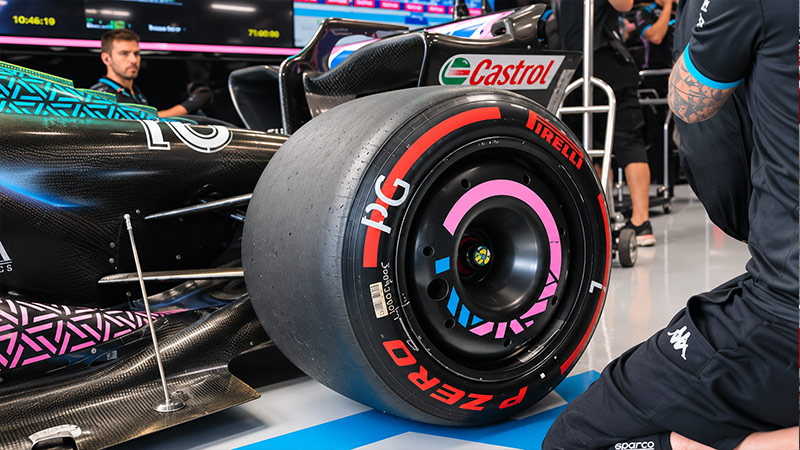
Walk past any Formula 1 garage before a session and you will see every wheel wrapped in a thick, padded cover with a cable running to the wall.
Those covers are tire warmers, also called tire blankets. They rarely make headlines, yet they influence grip, safety and race strategy on every lap.
A modern F1 tire is engineered to deliver enormous grip, but only inside a narrow temperature range. Below that range, the rubber feels hard and slippery, more like plastic than a racing compound.
A driver leaving the pits on cold tires can lose seconds on the first lap and, far worse, lose control of a car built to corner at extreme speed.
Tire warmers close that gap. By heating each tire before it touches the asphalt, teams give drivers usable grip from the first corner, protect expensive rubber from early damage and open up strategic options during pit stops.
This guide explains what F1 tire warmers are, how they work, why temperature matters so much, how the rules have tightened over time and why the sport has seriously debated banning them.
Whether you follow every Grand Prix or race at club level yourself, you will come away with a clear, practical understanding of how heat shapes performance.
What Are F1 Tire Warmers?
F1 tire warmers are electrically heated blankets that wrap around the tread and sidewalls of a complete wheel and tire assembly. Inside each blanket sit resistive heating elements, similar in principle to a household electric blanket but built for far higher, tightly controlled temperatures.
Each blanket connects to a control unit that reads temperature sensors and switches the heating elements on and off to hold a set target. Teams monitor every set in the garage, so engineers know exactly how warm a tire is before it is fitted to the car.
A typical system includes four core parts:
- Heating elements: resistive wires or panels layered inside the blanket to spread heat evenly across the tread and sidewall.
- Insulated outer shell: tough, heat-resistant fabric that traps warmth and survives the knocks of a busy garage and pit lane.
- Thermostatic controller: the brain of the system, holding the target temperature and helping teams stay within regulatory limits.
- Power cables and connectors: these keep blankets running in the garage, in the pit lane and on the grid, often powered by portable generators.
The scale is significant. In a standard race weekend, each driver receives around 13 sets of dry-weather tires, plus intermediates and full wets.
Many of those sets spend hours inside warmers, which is why blanket management is a real operational discipline rather than a minor detail.
Why Tire Temperature Matters So Much
Tire temperature matters because grip depends heavily on how warm and pliable the rubber is. Rubber is viscoelastic, which means it behaves partly like a solid and partly like a very thick liquid.
Grip comes from two main mechanisms. The first is mechanical keying, where warm rubber flows into the tiny peaks and valleys of the asphalt. The second is adhesion, a molecular bond between rubber and track surface that strengthens as the compound reaches its ideal temperature.
Pirelli designs its dry compounds to work within an operating window, often cited at roughly 90°C to 110°C on the surface. Harder compounds generally need more heat than softer ones. Outside that window, performance drops quickly.
| Temperature state | What happens to the tire | What the driver feels |
|---|---|---|
| Below the window | The compound stays stiff, and the surface can tear into ridges, known as cold graining | Sliding, weak braking and a nervous rear end |
| Inside the window | The rubber is pliable and bonds well with the asphalt | Strong, predictable grip and confidence on the brakes |
| Above the window | Overheating causes blistering and faster degradation | Grip fades over a stint, with rising lap times |
Temperature also controls tire pressure. As the air inside a tire heats up, pressure rises, changing the shape of the contact patch and how the structure responds to load.
Warmers let teams set and check pressures at a stable, known temperature, so the car behaves as engineers expect from the first lap.
There is also a difference between surface heat and core heat. A tire’s surface warms quickly from sliding, but it cools just as fast.
The inner structure, or carcass, holds heat much longer. Warmers heat the entire assembly, including the wheel rim, which helps the tire keep its temperature once the car is moving.
How Teams Use Tire Warmers Across a Race Weekend
Tire warmers are part of nearly every phase of a Grand Prix weekend, and the routine follows a clear sequence:
- Preparation in the garage. Mechanics fit blankets to fresh sets and begin heating them ahead of each session, within the time limits set by the regulations.
- Practice and qualifying runs. Blankets stay on until the last moment before the car leaves the garage. Mechanics remove them in seconds, so the tires lose as little heat as possible.
- The starting grid. Warmed sets travel to the grid on portable power. They come off only in the final minutes before the formation lap.
- The formation lap. Drivers weave, brake hard and accelerate firmly to build extra heat in the tires and brakes before the start.
- Pit stops. A fresh set waits in the pit lane, still wrapped and heated. The crew strips the blankets just before the car arrives, so the driver rejoins with warm, responsive tires.
This choreography demands precise timing. A set uncovered too early loses valuable heat, while a set heated beyond the permitted window can breach the rules. The best crews treat warmer management as carefully as any other part of the pit stop.
The Rules: Lower Temperatures, Shorter Heating Windows
The direction of F1’s tire warmer rules has been consistent for years: less heat, applied for less time. Pirelli, the sport’s single tire supplier, works with the FIA and the teams to set limits that balance safety, performance and sustainability.
The table below summarizes the key milestones, newest first. Figures are approximate, and limits are reviewed season by season, so check the current FIA Sporting Regulations for the latest values.
| Period | Change | Why it mattered |
|---|---|---|
| Mid-2023 | Teams voted against a proposed ban on warmers for slick tires in 2024 | Blankets stayed, but the push to reduce them continued |
| 2023 | Heating time cut to around two hours; full wet tires redesigned to run without blankets | The first blanket-free tire in regular F1 use |
| 2022 | Limit set at about 70°C for front and rear tires with the switch to 18-inch wheels | A major step down from earlier temperatures |
| Before 2022 | Caps of roughly 100°C for fronts and 80°C for rears | Tires reached the track close to their working range |
Each reduction forces Pirelli to design tires that switch on faster and tolerate a wider range of temperatures. Teams, in turn, rely more on driver technique and careful out-lap management to bring the rubber up to its working range.
Slicks, Intermediates and Full Wets: Different Heat Needs
Not every F1 tire relies on warmers in the same way. The need for pre-heating depends on the compound, the construction and the weather.
Dry-weather slicks
Pirelli’s range runs from hard to very soft compounds, and the selection for each event is matched to the circuit.
Harder compounds resist wear but need more heat to switch on, so warmers make a bigger difference on cool days and at low-grip venues. Softer compounds reach their window sooner, which is one reason they suit single fast laps in qualifying.
Intermediates
Built for damp tracks and light standing water, intermediates still use warmers. Wet conditions pull heat out of a tire rapidly, so starting with a warm carcass helps drivers find grip on a slippery surface in the first few corners.
Full wets
Since 2023, Pirelli’s full wet tire has been designed to run without blankets. Its compound and deep tread generate heat through constant flexing as the grooves clear water.
This change proved that blanket-free running is possible in specific conditions, and it gave engineers valuable real-world data for the wider debate.
How Warmers Shape Safety, Performance and Strategy
Tire warmers influence far more than a single out-lap. Their effects ripple through safety, raw pace and race strategy.
Safer out-laps
A car leaving the pits on cold tires is most vulnerable in slow corners and under heavy braking, where low grip meets low aerodynamic load.
Pre-heated tires sharply reduce the risk of spins and lock-ups on the first lap of a stint, especially when drivers rejoin in traffic or onto a track littered with rubber debris.
The power of the undercut
The undercut works when a driver pits first and uses fresh tires to set faster laps than a rival on worn rubber. Warmers make fresh tires quick almost immediately, which strengthens this tactic.
Without them, out-laps would be slower, and staying out longer, known as the overcut, would often become the smarter call.
Protecting tire life
Pushing hard on cold rubber can cause graining and flat spots early in a stint. That damage compromises grip for many laps afterward. Warmers help tires begin their life in good condition, which supports longer, more predictable stints.
Safety car restarts
Warmers cannot help once a car is on track. Behind a safety car, tires lose heat steadily, so drivers weave and brake firmly to keep temperatures up. These restarts show just how much F1 relies on the heat warmers provide at every other moment of a race.
The Great Debate: Should F1 Ban Tire Warmers?
Few technical topics in F1 have generated as much discussion as the future of tire warmers. Both sides make serious arguments.
The case for a ban:
- Energy and sustainability. Heating dozens of tire sets for hours at every event consumes significant energy. F1 has committed to a Net Zero Carbon target by 2030, and removing warmers would be a visible step toward it.
- Cost and logistics. Blankets, controllers and generators must be shipped around the world. Fewer systems mean less freight and lower operating costs.
- Driver skill. Bringing cold tires up to temperature rewards precise, sensitive driving, which supporters see as a purer test of talent.
- Precedent. IndyCar has long raced without tire warmers, showing that top-level racing can run without them.
The case against a ban:
- Out-lap safety. Drivers have warned that cold tires on powerful, heavy cars create real risks, especially at cool circuits and on street tracks with low grip.
- Tire design compromises. To work without warmers, tires need a wider operating window. That can mean trade-offs in peak grip, durability or both.
- Testing feedback. Blanket-free prototypes tested by teams received mixed reviews, which played a part in the decision to keep warmers for 2024.
For now, the sport has chosen gradual reduction over an outright ban. Lower temperature caps and shorter heating windows deliver part of the sustainability benefit while keeping drivers safe on out-laps.
What Club and Grassroots Racers Can Learn From F1
Most club racers never use tire warmers, and many series ban them outright. The principles behind F1 tire management, however, apply at every level of motorsport.
- Measure, do not guess. A tire pyrometer reads temperature across the inside, middle and outside of the tread. Uneven readings reveal camber or pressure problems long before lap times do.
- Track hot and cold pressures. Record pressures before and after each session. Knowing how much pressure rises helps you hit your target once the tires are working.
- Respect the out-lap. Build heat progressively with firm, smooth inputs. Avoid sudden aggression in the first corners, where cold tires are least forgiving.
- Read the conditions. Cold mornings, shaded sections and damp patches all slow warm-up. Adjust your approach and your expectations to match.
- Know your rulebook. Check whether your series permits warmers and, if so, what limits apply. Rules vary widely between championships and countries.
For fans, the same ideas make every Grand Prix easier to read. Watch the out-lap after a pit stop, the weaving behind a safety car and the onboard telemetry graphics. Each one tells a story about heat, grip and confidence.
Conclusion
F1 tire warmers may look like simple electric blankets, yet they sit at the center of grip, safety and strategy.
By heating tires into their operating window before they touch the track, warmers protect drivers on out-laps, preserve expensive rubber and sharpen tactics such as the undercut.
At the same time, rising pressure for sustainability has pushed the sport toward lower temperatures, shorter heating windows and blanket-free wet tires. The debate is far from over, and each new regulation cycle may bring fresh change.