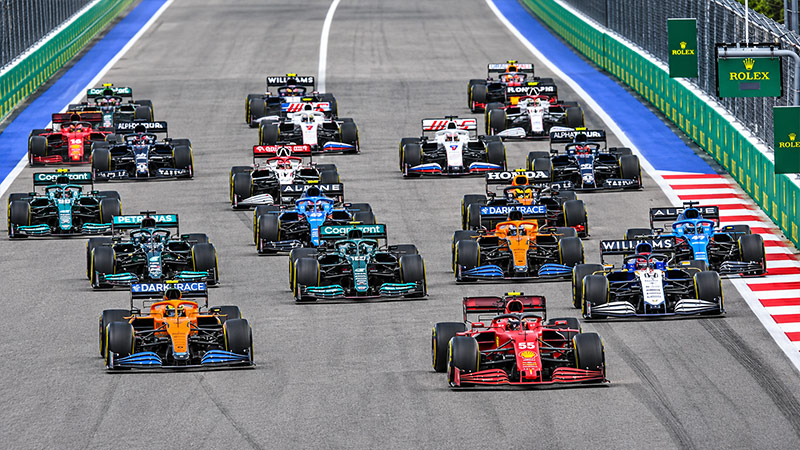
Five red lights, a roar of engines and a sprint into Turn 1. That is the moment most fans remember. Yet every Grand Prix start is shaped a few minutes earlier, on a lap that awards no points and allows no racing: the F1 formation lap.
Drivers use this single lap to bring tyres and brakes up to temperature, check their cars and settle into position. Get it right and the launch feels effortless. Get it wrong and a race can unravel before it has truly begun.
What Is the F1 Formation Lap?
The formation lap is one full, non-competitive lap of the circuit that the whole field completes immediately before a standing start. It is also called the warm-up lap. Fans sometimes call it the parade lap, although the drivers’ parade is a separate pre-race event.
When the green lights come on, the pole-sitter leads the field away and every other driver follows in grid order. At the end of the lap, the cars return to their grid boxes for the lights-out sequence.
Three features make it distinctive:
- No racing. Overtaking is banned, except to restore the original grid order.
- No effect on race distance. The lap is not counted as one of the race laps.
- High stakes anyway. Tyre, brake and power unit temperatures at the end of the lap shape the first corner and often the whole first stint.
Why Formula 1 Uses a Formation Lap
The formation lap exists for two reasons: safety and fairness. Slick tyres and carbon brakes work poorly when cold, and a full grid charging into the first braking zone without grip would be dangerous.
Getting cars ready to race: Tyre blankets warm the tyres on the grid, but they start to cool as soon as the blankets come off. The lap lets drivers add heat to the tyres and brakes before the first full-speed braking zone.
A final systems check: Drivers confirm the clutch bite point, steering feel and power unit settings. Engineers watch live telemetry and can warn of a fault before the start.
One last read of the track: Conditions can change between the grid opening and the start. The lap shows drivers any damp patches, debris or shifts in grip.
A fair, orderly start: Returning every car to the grid in the same sequence means the race begins from the order earned in qualifying. Every driver gets the same chance to prepare.
The Start Procedure, Step by Step
The formation lap sits at the heart of a tightly timed countdown. On a dry race day, the sequence runs like this:
- Reconnaissance laps. About 40 minutes before the start, the pit exit opens. Cars complete one or more laps to check set-up and track conditions, then line up on the grid.
- Grid countdown. Mechanics, engineers and guests fill the grid. Countdown boards then clear it in stages, from ten minutes down to the final minute.
- Blankets off, wheels on. Tyre blankets are removed and wheels must be fitted by a set deadline. A car that misses it must start from the back of the grid or the pit lane.
- Engines on. At the one-minute signal, engines fire up and the last team members leave the grid.
- Green lights. The formation lap begins. The pole-sitter sets the pace and the field follows in grid order.
- Back to the grid. Cars stop in their grid boxes with engines running. A marshal at the back waves a green flag once the last car is in place.
- Lights out. Five red lights come on one by one, then go out after a variable pause. The race is on.
If a driver has a problem in their grid box, they raise an arm. The start is aborted and a fresh procedure begins once the car is dealt with.
Tyres, Brakes and Battery: The Engineering Behind the Weaving
The weaving fans see on the formation lap is not showmanship. It is a deliberate routine built around temperature.
Tyre surface: Slick tyres grip best inside an operating window that, depending on compound, sits roughly between 90 and 120°C. Weaving flexes and scrubs the tread, warming the surface and clearing grit picked up on the grid.
Tyre core: Short, sharp bursts of acceleration and braking load the tyre’s structure. That builds deeper heat, which lasts longer than surface heat into the opening corners.
Brakes: Carbon brakes need several hundred degrees to bite consistently. Drivers brake hard and repeatedly on the straights, sometimes pressing throttle and brake together, to build heat without wearing the discs.
Battery and power unit: In the hybrid era, the start is as much electrical as mechanical. Teams use the lap to bring the battery to its ideal charge and the engine to its target temperature for the launch.
Launch preparation: Practice starts are not allowed on the formation lap. Drivers instead confirm switch settings and the clutch bite point, so the launch matches the starts they rehearsed earlier in the weekend.
The skill lies in the balance. Too gentle and the tyres cool. Too aggressive and the rear tyres overheat, or the driver spins on cold rubber in front of a global audience.
Formation Lap Rules and Penalties
The FIA Sporting Regulations keep the formation lap tightly controlled. These are the rules that matter most:
- No overtaking. Drivers may pass only to restore the original grid order, for example when a car is slow away from its grid box. A driver who cannot regain their place must start from the back of the grid.
- Keep the field together. The formation must stay as tight as possible behind the leader. The pole-sitter controls the pace, but an unreasonably slow lap can draw the race director’s attention.
- Stalls mean an aborted start. If a car stalls or a driver signals a problem after the lap, the start is aborted. The field completes an extra formation lap, the race loses one lap, and the stalled car usually starts from the pit lane.
- Stop in the right place. Cars must stop correctly inside their grid box. At the 2023 Saudi Arabian Grand Prix, Fernando Alonso received a five-second penalty for lining up slightly out of position.
- Wet-weather starts. In heavy rain, race control can start the race behind the safety car. The field completes one or more formation laps behind it, and a standing start can follow once conditions allow.
Formation Lap Moments That Changed Races
Cold tyres, nervous drivers and a full grid at low speed make the formation lap more eventful than it looks. A few scenarios recur season after season.
The spin on cold tyres: A driver weaving too hard, or catching a damp kerb, can spin at little more than walking pace. Often they recover and regain their slot. Sometimes they damage the car or beach it in the gravel, and the race ends before it starts.
The stall on the grid: A missed bite point or a power unit fault at the end of the lap triggers an aborted start. The field goes round again, every car loses tyre temperature, and the race loses a lap.
The rain-hit start: The 2021 Belgian Grand Prix is the extreme case. Heavy rain at Spa meant the race was started behind the safety car and never got going. Only a few laps were run, all behind it, and half points were awarded. The episode led to new rules for shortened races.
The out-of-position penalty: Alonso’s 2023 Saudi penalty showed how a few centimetres on the grid can cost five seconds. A further penalty after the race briefly cost him a podium, before it was overturned.
How to Watch the Formation Lap Like an Insider
Next time the green lights come on, look past the slow procession. These clues reveal a lot about the start to come:
- Weaving intensity. Aggressive weaving on a cool day signals a team worried about tyre temperature.
- Tyre choice. Harder compounds take longer to warm up, so drivers on them often work hardest on this lap.
- The leader’s pace. Front-runners wait longest on the grid while the rest of the field forms up. A pole-sitter may adjust the pace to limit how much their tyres cool before lights out.
- Team radio. Messages during the lap often mention bite-point checks, brake temperatures or switch changes.
- The back of the grid. Watch for the marshal’s green flag. A delay there can point to a problem with a car.
- A raised arm. A driver raising an arm in their grid box means trouble and, most likely, an aborted start.
Conclusion
The F1 formation lap may look like a gentle procession, yet it is one of the most carefully managed laps of any Grand Prix weekend.
In just a few minutes, drivers bring tyres, brakes and batteries into their working windows, confirm their launch settings and return to the grid slot they earned.
Every weave, burst of throttle and radio call serves the start that follows. The rules are strict: a stall, a spin or a car a few centimetres out of position can rewrite a result before the first corner.
Once you know what to look for, the formation lap previews the race itself. Share this guide with a fellow fan, and watch the next formation lap with fresh eyes.