Formula 1 uses a safety car to slow the field and hold it in a controlled queue whenever the track is too dangerous for racing speed, but not dangerous enough to stop the race completely. It gives marshals a protected window to clear crashed cars, debris or standing water while the Grand Prix keeps running.
Picture it: lap 34, twenty cars flying past at over 300 km/h, and one of them slams into the barrier on the exit of a fast corner. Carbon fibre is scattered across the racing line. Marshals need to get out there right now.
Without a way to slow every car instantly and predictably, each second of cleanup puts people at risk. That is the safety car’s job.
In this guide, you’ll learn exactly why F1 deploys it, how a safety car period works lap by lap, how it differs from the Virtual Safety Car and a red flag, and why a single deployment can turn a race result upside down.
What Is the F1 Safety Car?
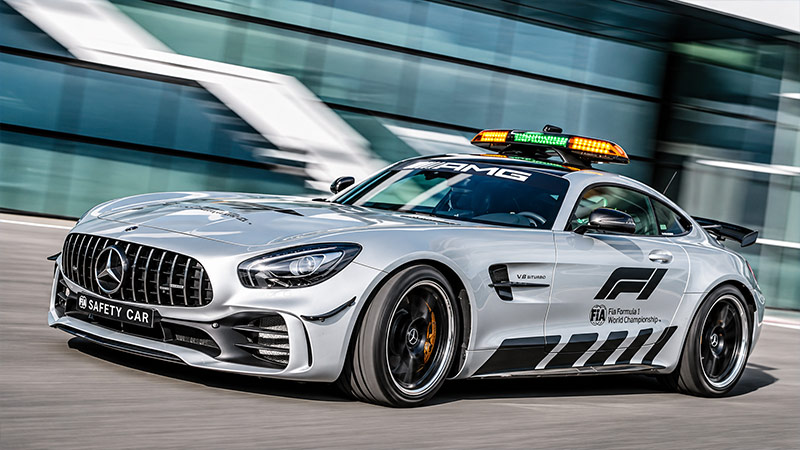
The F1 safety car is a high-performance road car, modified for track duty, that leads the field at a controlled pace during a neutralised period. Since 2021, Mercedes-AMG and Aston Martin have shared the role, alternating across the calendar.
Don’t let the words “road car” fool you. These machines carry several hundred horsepower, uprated brakes, track-tuned suspension and a roof-mounted light bar.
They need every bit of that performance, because an F1 car running too slowly loses tyre and brake temperature fast, which makes it harder to control and less safe.
Behind the wheel is Bernd Mayländer, a former touring car and sportscar racer who has been F1’s regular safety car driver since 2000. Beside him sits a co-driver who talks to Race Control, watches the timing screens and keeps an eye on the cars behind.
The safety car also works alongside the FIA Medical Car, which carries a doctor and can reach an incident within seconds. One car slows the race; the other gets help to whoever needs it.
Why Does F1 Use a Safety Car? 6 Core Reasons
The safety car exists for one overriding purpose: to protect people on and around the circuit without ending the race. These are the situations that trigger it.
- Protecting track marshals. Marshals step onto a live circuit to recover cars and sweep debris. A slow, bunched-up field is far less dangerous to work beside than cars passing at full speed.
- Recovering crashed or stranded cars. When a car stops in an exposed spot, such as near the racing line or where a crane can’t reach it quickly, recovery crews need time and space.
- Clearing debris. Fragments of carbon fibre can puncture tyres or strike another driver at extreme speed. Even a small piece on the racing line is a serious hazard.
- Managing dangerous weather. Heavy rain throws up spray that leaves drivers almost blind. Races can start behind the safety car, or be neutralised mid-race until conditions improve.
- Repairing the track. Damaged barriers, loose drain covers and oil or fluid spills all need attention before full racing resumes.
- Keeping the race alive. Stopping the race with a red flag for every incident would wreck the competition and the broadcast schedule. The safety car keeps the event moving while the problem is fixed.
The decision belongs to the FIA Race Director, who weighs where the incident is, how long the fix will take and how exposed the people on the ground will be.
How a Safety Car Period Works, Step by Step
Every safety car period follows the same tightly controlled sequence, from the first warning to the green-flag restart.
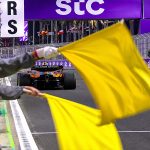
- Race Control deploys the safety car. A message appears on timing screens, marshals wave yellow flags with “SC” boards, and drivers get a warning on their steering wheel displays.
- Drivers slow down immediately. They must stay above a minimum time shown on their dashboards, which stops anyone from racing to the back of the queue.
- Overtaking stops. Drivers hold position, with narrow exceptions, such as passing a car that has slowed with a clear problem.
- The safety car joins the track. It leaves the pit exit with its orange lights flashing, aiming to slot in ahead of the race leader.
- The field forms a queue. Every driver must stay within ten car lengths of the car in front, so the pack compresses into a tight line.
- Lapped cars may be released. When the Race Director judges it safe, lapped cars are waved past to rejoin at the back, so the leaders race each other at the restart.
- The lights go out. When the orange lights switch off, the safety car will enter the pit lane at the end of that lap.
- The leader controls the restart. The leader sets the pace into the final sector, and overtaking resumes once the cars cross the control line.
One detail surprises many new fans: laps completed behind the safety car still count toward the race distance. A long neutralisation can therefore shorten the amount of real racing left.
Safety Car vs Virtual Safety Car vs Red Flag
F1 has three levels of response, and the Race Director picks the lightest one that still keeps everyone safe.
| Safety Car | Virtual Safety Car (VSC) | Red Flag | |
|---|---|---|---|
| What happens | A real car leads the field in a queue | Every driver slows to a set minimum time; no car on track | The session stops and cars return to the pit lane |
| Gaps between cars | Erased as the field bunches up | Roughly preserved | Erased once the race resumes |
| Typical trigger | A major incident needing several minutes to clear | A minor incident that can be fixed quickly | A blocked track, barrier damage or severe weather |
| Pit stops | Allowed, and cost much less time than usual | Allowed, with a smaller time saving | Tyre changes and repairs permitted during the stoppage |
| In use since | 1973 trial; permanent from 1993 | 2015 | Long-standing |
The VSC was created after Jules Bianchi’s crash at the 2014 Japanese Grand Prix, where his car struck a recovery vehicle in wet conditions. He died of his injuries in 2015. The VSC slows every car at once, everywhere on the circuit, removing any temptation to keep pushing through a yellow-flag zone.
How the Safety Car Reshapes Race Strategy
A safety car can undo an hour of careful racing in a single lap, which is why every strategist watches for it. Here’s where it changes the game.
- The “cheap” pit stop. Under green flags, a pit stop typically costs around 20 seconds. Behind the safety car, the field is moving so slowly that the loss can be roughly halved, so teams often pit the moment it’s called.
- Leads disappear. A 15-second advantage built over 20 laps vanishes as the queue forms. The leader suddenly has a rival right behind them at the restart.
- Stay out or pit? If most rivals pit, a driver who stays out gains track position but runs on older tyres. It’s a gamble decided in seconds, often with incomplete information.
- Cold tyres and brakes. Slow laps drain heat from tyres and brakes. That’s why drivers weave and brake hard behind the safety car, and why restarts are so risky.
- Circuit-specific planning. Teams study how often each track has produced safety cars in past seasons. Street circuits such as Monaco, Singapore, Baku and Jeddah, with walls close to the racing line, tend to see more of them, and strategies are built with that likelihood in mind.
For fans, this is where the safety car becomes fascinating. It isn’t just a pause. It’s a reset button that rewards teams who prepare and punishes those who hesitate.
A Short History of the F1 Safety Car
The safety car had a messy start in 1973, vanished for two decades, and returned in 1993 to become a permanent part of the sport.
| Year | Milestone |
|---|---|
| 1973 | First use at the Canadian Grand Prix at Mosport Park. A Porsche 914 picked up the wrong car as leader, and confusion over the result lasted for hours. |
| 1993 | The safety car becomes a permanent fixture, first deployed at the Brazilian Grand Prix. |
| 1996 | Mercedes-Benz begins its long run as official supplier. |
| 2000 | Bernd Mayländer becomes the regular safety car driver. |
| 2015 | The Virtual Safety Car is introduced. |
| 2021 | Aston Martin joins Mercedes-AMG in sharing safety car duties. |
| 2022 | Procedures for lapped cars are clarified after the Abu Dhabi controversy. |
The 1973 chaos taught an important lesson. A safety car only works when everyone, from the driver in the car to the timing team, knows exactly who is leading and what happens next. Modern procedures are built around that clarity.
Controversies That Changed the Rules
Because a safety car can decide a race, its use has sparked some of the sport’s biggest arguments, and each one has tightened the rules.
Singapore 2008
Renault driver Nelson Piquet Jr. crashed deliberately on team orders to bring out the safety car, helping teammate Fernando Alonso win.
When it came to light in 2009, senior team figures received bans, later overturned in a French court. The episode showed how much a safety car can be worth, and how firmly the sport must guard against abuse.
Abu Dhabi 2021
A late safety car set up a final-lap showdown for the world title. Only the lapped cars between Lewis Hamilton and Max Verstappen were allowed to unlap, and the safety car came in a lap earlier than usual. Verstappen, on fresh tyres, passed Hamilton on the last lap to win the championship.
The FIA’s later review cited human error in how the procedure was applied. The race director was replaced, a remote operations room was created to support Race Control, and the 2022 rules were reworded to make clear that all lapped cars must be allowed to unlap.
Races finishing behind the safety car
When an incident happens near the end, a race can finish in a queue with no restart. Many fans dislike it. Officials can use a red flag instead to allow a restart, but it remains a judgment call each time.
Conclusion
The safety car is far more than a pace-setter with flashing lights. It’s Formula 1’s most practical answer to a hard problem: how to protect marshals, drivers, and spectators without ending the race every time something goes wrong.
From its chaotic debut in 1973 to the precise, data-guided procedures of today, it has grown into a key part of how the sport balances risk and competition.
It also shapes results, rewarding teams who prepare, punishing those who hesitate, and turning comfortable leads into last-lap battles.