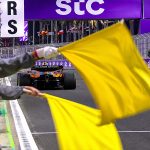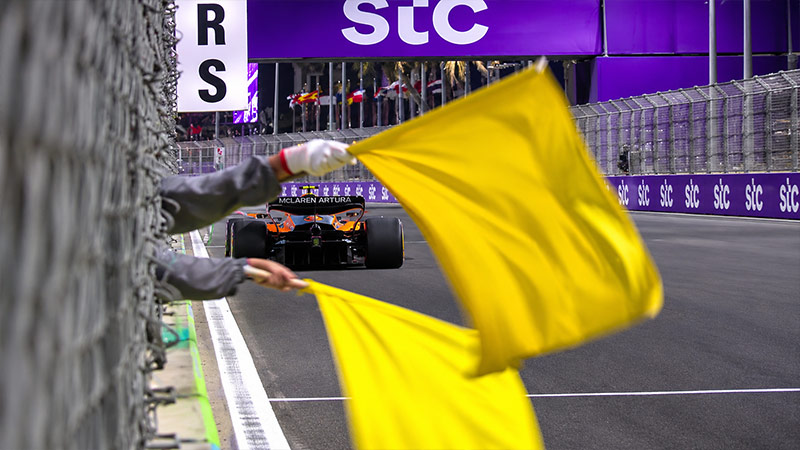
A single yellow flag tells a Formula 1 driver to be careful. Two waved yellow flags say something far more serious: the track ahead may be blocked, marshals may be standing on it, and the car must be ready to stop.
The double yellow flag is one of the most important signals in the sport, yet many newer fans find it confusing. It decides whether a pole lap counts, it has cost world champions grid places, and it sits at the heart of F1’s modern safety culture.
.You’ll also see how stewards judge compliance under the 2026 penalty guidelines, which famous incidents shaped the rule, and how to spot double yellows from your sofa or the grandstand.
What Is a Double Yellow Flag in F1?
A double yellow flag in F1 is a warning that a serious hazard sits on or right beside the racing line.
Under Appendix H of the FIA International Sporting Code, drivers passing it must reduce speed significantly, must not overtake, and must be prepared to change direction or stop.
The official name is the “double waved yellow flag.” Teams, commentators and fans usually shorten it to “double yellow.”
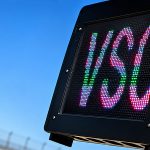
It is shown as two yellow flags waved at the same marshal post, or as the matching signal on the trackside LED light panels.
Marshals and race control use it in two main situations:
- A blocked track: a car, debris or another obstacle wholly or partly blocks the circuit.
- People at work: marshals are on or beside the track, often recovering a stranded car with a crane or tractor.
The restriction starts at the post showing the flags and ends when the driver passes the green flag or green light at the post after the incident. Everything in between is a no-overtaking, slow-down zone.
Single Yellow vs Double Yellow Flag: Key Differences
The single word that separates the two signals is “stop.” A single yellow asks for caution; a double yellow asks for a speed at which the driver could stop before reaching the hazard.
| Point of comparison | Single waved yellow | Double waved yellow |
|---|---|---|
| What it signals | Hazard beside or partly on the track | Track wholly or partly blocked, or marshals at work |
| Driver action | Reduce speed, be ready to change direction | Reduce speed significantly, be ready to change direction or stop |
| Overtaking | Not allowed | Not allowed |
| 2026 sector-time benchmark | At least 5% slower than comparable laps | At least 15% slower than comparable laps |
| Practice and qualifying lap | Must show a clear lift | Lap time deleted |
| Usual qualifying penalty if ignored | 3-place grid drop | 5-place grid drop |
The sector-time benchmarks come from the 2026 stewards’ guidelines. They are one accepted way to prove compliance, not the only one, and stewards still look at the full picture.
What Drivers Must Do Under Double Yellow Flags
Under double yellows, a driver’s job switches from going fast to proving they slowed. Here is what the rules expect, step by step:
- Lift and brake early. The speed cut must be significantly and noticeably greater than for a single yellow, because the driver must be able to stop.
- Hold position. No overtaking until the green signal after the incident. Passing a car that has clearly slowed with a problem is generally not treated as an overtake.
- Be ready to change line or stop. Debris, a recovery vehicle or a marshal could be around the next corner.
- Abandon the push lap. In practice and qualifying, any lap time set through a double yellow sector is deleted, so there is nothing to gain.
- Respect the delta under VSC or Safety Car. Since the 2023 Monaco Grand Prix, a stricter speed reference applies inside double yellow zones when the field is already neutralised.
The burden of proof sits with the driver
The 2026 guidelines make one point very clear: the onus is on the driver to show a sufficient reduction in speed. Stewards examine throttle, brake and steering data before and through the incident zone.
One accepted way to prove compliance is a sector time at least 15% slower than the driver’s previous laps in similar conditions.
“Similar conditions” takes tyre compound and wear, fuel load, energy deployment and weather into account. A car that loses control under yellow or double yellow flags will usually be investigated.
How the Double Yellow Signal Reaches the Driver
At over 300 km/h, a driver has a fraction of a second to read a warning. That is why F1 uses several layers of signals, and why the oldest one still matters most.
- Marshal flags: two yellow flags waved at a marshal post. These remain the primary signal and the fail-safe if electronics fail.
- LED light panels: FIA panels around the circuit flash the same warning. Under Appendix H, a light signal carries the same meaning as the flag.
- Cockpit alerts: the steering-wheel display and radio tones warn drivers of an upcoming double yellow zone.
- Team radio: engineers watch the timing screens and call out hazards ahead.
These layers help, but they do not shift responsibility. At the 2020 British Grand Prix, George Russell said he only caught the signal in his peripheral vision and thought it was a single yellow.
His team had warned of “a yellow” without saying “double.” The stewards still gave him a five-place grid drop, ruling it was the driver’s job to see and follow the flag.
Double Yellow Flags in Qualifying: Why Laps Get Deleted
Qualifying is where double yellows bite hardest. A single lap decides the grid, and the temptation to keep pushing through a warning zone is huge.
For years, the line between “slowed enough” and “not enough” was a judgment call. After Sergio Pérez was penalised for not slowing for double yellows at the 2016 Singapore Grand Prix, the FIA told drivers to abandon their lap whenever they met double waved yellows in practice or qualifying.
The next big step came at the 2021 United States Grand Prix. Following debate over a qualifying lap at the Turkish Grand Prix, the race director’s notes stated that any driver in a double yellow sector would have that lap time deleted. Since then, deletion has worked much like a track limits breach: automatic and immediate.
Why qualifying yellows still spark debate
A late crash can freeze the order, because drivers behind cannot improve through the yellow zone. That is why Michael Schumacher was sent to the back of the grid at Monaco in 2006, after stewards ruled he stopped at Rascasse on purpose.
The topic returned in 2026. Max Verstappen crashed at the penultimate corner in Austrian Grand Prix qualifying, and the warning was upgraded from single to double yellows around 22 seconds later.
George Russell took pole, and Carlos Sainz then proposed an automatic three-place grid drop for any driver who causes a yellow or red flag in qualifying.
Charles Leclerc pushed back, arguing that a driver who ends up in the wall already pays a price, and Verstappen was not convinced either.
Double Yellow Flag Penalties and Famous Incidents
Ignoring double yellows is one of the most consistently punished offences in F1. In qualifying, stewards treat a five-place grid drop as the usual penalty, compared with three places for a single yellow.
In a race, stewards usually choose a time penalty or a drive-through, depending on how serious the breach was. Penalty points can be added to the driver’s licence too, and 12 points within 12 months bring a one-race ban.
| Event | Driver | What happened | Outcome |
|---|---|---|---|
| 2021 Qatar GP qualifying | Max Verstappen | Passed Pierre Gasly’s stricken car under double yellows; the panels and dash showed no warning | Lap deleted, 5-place grid drop, 2 penalty points |
| 2021 Qatar GP qualifying | Valtteri Bottas | Reached the same spot earlier, under a single yellow, without lifting | 3-place grid drop |
| 2021 Bahrain GP qualifying | Sebastian Vettel | Set a personal best through a double yellow zone | 5-place grid drop |
| 2020 British GP qualifying | George Russell | Mistook a double yellow for a single after Nicholas Latifi spun | 5-place grid drop |
| 2016 Singapore GP qualifying | Sergio Pérez | Did not slow enough after Romain Grosjean crashed in Q2 | Grid penalty |
The Qatar case is the clearest lesson. Red Bull argued that the light panels and dashboard had not shown a warning, and the stewards accepted there was mitigation.
They still applied the standard penalty, because the marshal’s waved flags were visible and drivers must obey them.
Double Yellow vs Virtual Safety Car, Safety Car and Red Flag
A double yellow is a local warning: it covers one marshalling sector, while the rest of the lap stays at racing speed. When the danger is greater, race control escalates to a whole-track response.
| Signal | Area covered | What drivers do |
|---|---|---|
| Double waved yellow | One sector | Slow significantly, no overtaking, be ready to stop |
| Virtual Safety Car (VSC) | Whole track | Stay slower than an FIA reference time (the delta) everywhere, no overtaking |
| Safety Car | Whole track | Queue behind the Safety Car, no overtaking |
| Red flag | Whole session | Slow down and return to the pit lane |
The link between double yellows and the VSC is direct. When the VSC arrived in 2015, the regulations said it would normally be used when double waved yellows are needed on a section of track and competitors or officials may be in danger.
The two can also stack. Since 2023, a car passing a double yellow zone during a VSC or Safety Car period sees its delta reset to zero on the dashboard and must stay under a dedicated, stricter speed reference for that zone. This stops drivers from speeding through the danger area to recover time lost elsewhere.
Why the Rule Exists: The Lesson of Suzuka 2014
The double yellow flag exists to protect two groups: drivers and the marshals who volunteer to work beside the track. F1 learned the cost of getting it wrong at the 2014 Japanese Grand Prix.
On 5 October 2014, in heavy rain at Suzuka, marshals were recovering Adrian Sutil’s crashed Sauber with a crane at the Dunlop Curve. The sector was under double waved yellow flags.
A lap later, Jules Bianchi lost control of his Marussia at the same spot and struck the recovery vehicle. He suffered severe head injuries and died in July 2015.
The FIA’s 10-person Accident Panel found that Bianchi had not slowed enough to avoid losing control.
Its central conclusion was simple: if drivers follow the double yellow rules, neither competitors nor officials should be put in immediate danger. The panel recommended taking speed control out of the driver’s hands, which led straight to the Virtual Safety Car.
How the rule has tightened
| Year | Change |
|---|---|
| 2026 | Stewards’ guidelines put the onus on drivers and set a 15% sector-time benchmark for double yellows |
| 2023 | Dedicated double yellow delta under VSC and Safety Car, from the Monaco Grand Prix |
| 2021 | Laps set through a double yellow sector deleted, from the United States Grand Prix |
| 2016 | Drivers told to abandon practice and qualifying laps under double yellows |
| 2015 | Virtual Safety Car introduced |
Each step moved the rule from “slow down by an amount you judge” toward “slow down by an amount we can measure.” That shift is the main reason modern F1 is far stricter about double yellows than the sport was a decade ago.
How to Spot Double Yellow Flags as a Fan
Once you know what to look for, double yellows are easy to catch, and they make qualifying far more interesting to follow.
- On TV: watch the track map and timing graphics for a sector marked in yellow, and look for flashing panels on onboard shots.
- On team radio: listen for engineers saying “double yellow” or “abort the lap.”
- At the circuit: look for two marshals waving yellow flags at one post, recovery vehicles moving, or marshals on the grass.
- On the timing screen: a purple sector set through a double yellow zone will usually be deleted, so wait before celebrating a pole.
- After the session: check the stewards’ decisions, since summons for yellow flag breaches often come hours after qualifying ends.
Quick F1 flag chart
Save or print this chart for your next race weekend.
| Flag | Meaning |
|---|---|
| Green | Track clear; normal racing resumes |
| Single waved yellow | Hazard nearby; slow down, no overtaking |
| Double waved yellow | Serious hazard or marshals at work; slow significantly, be ready to stop |
| Yellow with red stripes | Slippery surface ahead, such as oil, water or debris |
| Blue | A faster car is about to lap you; let it pass |
| White | Slow vehicle on track ahead |
| Red | Session stopped; return slowly to the pit lane |
| Black and white diagonal | Warning for unsporting behaviour |
| Black with orange disc | Car has a mechanical problem; pit now |
| Black | Driver disqualified; return to the pits |
| Chequered | End of the session or race |
Conclusion
The double yellow flag is F1’s clearest message that danger is close. It tells drivers to slow down significantly, hold position and be ready to stop, because a car or a marshal may be in the way.
That simple instruction shapes qualifying results, grid positions and even championship fights. Since 2014, the FIA has turned a once vague rule into a measurable one, with automatic lap deletions, delta times and, from 2026, clear sector-time benchmarks.
Behind every change sits the same lesson from Suzuka: speed near a hazard leaves no room for error.