Every Formula 1 qualifying hour has one moment where a good weekend and a bad one are separated by a few hundredths of a second.
It is not the fight for pole. It is the final minute of Q2, when 16 drivers chase 10 places in the top-ten shootout and six of them watch their names drop below the line.
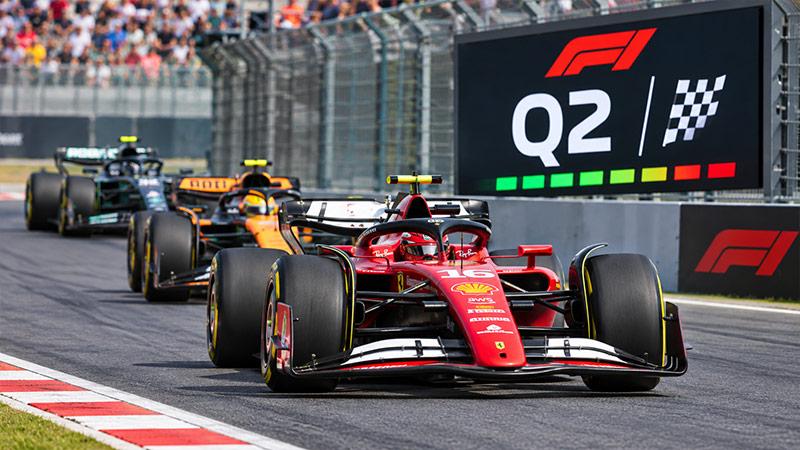
Q2 is the middle part of qualifying, and it is the part newer fans understand least. It looks like a repeat of Q1, but the stakes, the strategy and the pressure are different.
In 2026, Cadillac’s arrival has created the first 22-car grid since 2016, so the cut in Q2 is now bigger too.
This guide explains exactly how Q2 works under the 2026 FIA Sporting Regulations: how long it lasts, who gets knocked out, how teams plan their runs, what can go wrong, and why a driver’s fate in Q2 so often shapes their Sunday. By the end, you will know exactly what to watch for when the Q2 clock starts.
Q2 at a glance: the quick answer
Q2 is the second of three knockout sessions in F1 qualifying. In 2026, the 16 fastest drivers from Q1 get 15 minutes to set a lap time. The 10 fastest go through to Q3 to fight for pole position. The six slowest are eliminated and fill grid places 11 to 16.
| Session | Length | Cars on track | Knocked out | Grid places decided |
|---|---|---|---|---|
| Q1 | 18 min | 22 | 6 slowest | P17 to P22 |
| Q2 | 15 min | 16 | 6 slowest | P11 to P16 |
| Q3 | 13 min | 10 | None | P1 to P10 |
A seven-minute break separates each session, so the full qualifying hour still runs to exactly 60 minutes.
Where Q2 fits in the qualifying hour
Qualifying is a one-hour time trial that sets the starting grid for the Grand Prix. It runs as a knockout in three parts, and each part has a different job.
Think of it like this. Q1 is the safety check, where the slowest cars are filtered out. Q2 is the job interview, where the midfield fights for the last places at the top table. Q3 is the final, where the fastest 10 drivers fight for pole.
For front-running teams, Q2 is about getting through as cheaply as possible, using as few fresh tyres as they can. For midfield teams, P10 in Q2 is effectively their pole position. That clash of priorities is what makes the session so interesting to watch.
There is one more detail worth knowing. Once qualifying begins, cars are under parc fermé conditions. Teams can make only very minor set-up changes from this point. In practice, the car you see in Q2 is the car that races on Sunday.
How Q2 works, step by step
The rules of Q2 are simple. The skill lies in using them well. Here is how the session runs from green light to chequered flag.
- The slate is wiped clean. Times from Q1 do not carry over. All 16 drivers start Q2 from zero, so a dominant Q1 lap counts for nothing.
- The clock starts at 15 minutes. The pit exit light turns green and drivers can head out whenever their team chooses.
- Only the single best lap counts. Drivers can run as many laps as their tyres and time allow. Only their fastest valid lap is used to rank them.
- The real deadline is the start of the final lap. A lap that begins before the clock reaches zero still counts once it is completed. Drivers must cross the line to start their last flying lap before the chequered flag falls.
- The cut is made at the flag. The top 10 move on to Q3. Drivers in 11th to 16th are locked into those grid places, in the order of their Q2 times.
- Ties go to whoever was first. If two drivers post identical times, the one who set it earlier ranks ahead.
- No valid lap means the back of the group. A driver who reaches Q2 but sets no valid time is classified behind everyone who did.
What changed in Q2 for 2026
Three changes make Q2 in 2026 different from the session fans watched up to 2025.
Six drivers out, not five
The FIA’s 2026 Sporting Regulations include a scaling clause for a 22-car grid: six cars are eliminated after both Q1 and Q2. The cut-off is still at P10, but 16 cars now chase those 10 places instead of 15. Every midfield team has one more rival to beat.
Q2 kept its length, but the gap after it shrank
Q2 still runs for 15 minutes. Q3 grew from 12 to 13 minutes, and the break between Q2 and Q3 was cut from eight to seven minutes to keep the hour at 60 minutes. Teams that make it through now have one minute less to cool the car, study the data and fit new tyres.
Energy management is now part of every lap
The new power units lean far more on electrical energy, so how a driver harvests and deploys battery power shapes the lap time.
Early in the season, pushing harder in some corners could leave the battery short later in the lap. Williams driver Carlos Sainz described his Q2 at Suzuka as a lap where the harder he pushed, the slower he went.
The FIA responded quickly. For the Japanese Grand Prix, it cut the maximum energy recharge allowed in qualifying from 9.0 MJ to 8.0 MJ.
Further changes agreed for Miami onwards aimed to make qualifying laps feel more natural again, including letting drivers start their flying lap at full throttle.
For Q2, the lesson is clear: the out-lap now matters almost as much as the flying lap, because a driver must arrive at the line with the battery charged and the tyres warm.
How teams attack Q2
Fifteen minutes sounds like plenty of time. It is not. Here is how teams plan the session.
Two runs is the standard plan
Most drivers set a “banker” lap in the first half of the session, then return to the garage. They head out again for a final attempt in the closing minutes. The banker protects them if the session is disrupted later.
The track gets faster as the session goes on
Rubber builds up on the racing line with every lap, so grip improves through the hour. The last two minutes of Q2 are usually the quickest. That is why the order often shuffles dramatically as the flag falls.
Tyres are a budget, not an endless supply
Pirelli supplies each driver with a fixed allocation of tyre sets for the whole weekend. Every new set of soft tyres used in Q2 is one fewer for Q3 or the race. Top teams sometimes try to get through on a single run, or on a used set, to save fresh rubber for Q3. Midfield teams rarely have that luxury.
Clean air is gold
With 16 cars on track, finding a clear gap is hard, especially on tight street circuits. Teams time their release from the garage to avoid traffic. On circuits with long straights, some teams do the opposite and place a driver behind another car to gain a slipstream, or “tow”.
The pit wall watches the cut-off line
Strategists track the projected time needed for P10 in real time. A driver comfortably above it may stay in the garage to save tyres. A driver close to the line will go again, even at the cost of a fresh set.
What can go wrong in Q2?
Because most drivers leave their best lap until the end, Q2 is fragile. A single incident can rearrange the order.
- Red flags. When the session is stopped, the clock stops with it and restarts with the time that remained. New for 2026, the rules state that any lap completed after the red flag is first displayed is invalid, whatever the driver saw on their dashboard. A late red flag can freeze the order and leave drivers without a strong time scrambling on cold tyres at the restart.
- Track limits. A lap is deleted if a driver runs wide beyond the white lines at the corners the stewards monitor. A deleted final lap can drop a driver from P8 to P14 in an instant.
- Yellow flags. Drivers must slow down through a yellow flag zone. Anyone on a flying lap behind an incident usually loses that lap.
- Impeding. Being blocked by a slower car costs vital time. A driver found guilty of impeding a rival can be handed a grid penalty.
- Energy errors. Under the 2026 rules, a poorly managed out-lap can leave a driver short of battery power when it matters most.
Big names are not safe. Even Max Verstappen was knocked out in Q2 at Suzuka in 2026, a reminder that one compromised lap is all it takes.
Sprint weekends: how SQ2 differs
Six rounds of the 2026 calendar use the sprint format. On those weekends, a separate Sprint Qualifying session on Friday sets the grid for Saturday’s sprint race. It uses the same knockout idea, but everything is compressed.
| Session | Length | Cars on track | Knocked out | Sprint grid places decided |
|---|---|---|---|---|
| SQ1 | 12 min | 22 | 6 slowest | P17 to P22 |
| SQ2 | 10 min | 16 | 6 slowest | P11 to P16 |
| SQ3 | 8 min | 10 | None | P1 to P10 |
SQ2 is the sprint version of Q2. Sixteen drivers get just 10 minutes, and the six slowest fill places 11 to 16 on the sprint grid.
In dry conditions, both SQ1 and SQ2 must be run on new medium tyres, so there is no room to save softs, and there is only one practice hour before the session.
The result is a sharper test of preparation and execution, with little time for a second attempt if the first run goes wrong.
Why Q2 shapes the race result
Q2 decides more than a grid slot. It often decides what kind of race a driver can have.
It is the gateway to the points
Only the top 10 finishers score points in a Grand Prix. Reaching Q3 guarantees a start inside that group. For a midfield team, a P10 in qualifying can be the best result of the weekend.
The old tyre rule is gone
For years, drivers who reached Q3 had to start the race on the tyres they used for their fastest Q2 lap. That gave P11 a tactical edge, because it was the highest place with a free choice of starting tyre.
The rule was scrapped in 2022, and every driver now chooses freely. Today, the main consolation for missing Q3 is that a driver may have more fresh tyre sets left for the race.
The qualifying order is not always the final grid
Grid penalties, such as those for using extra power unit parts, are applied after qualifying. A driver who already knows they will start from the back may barely run in Q2 to save tyres.
The margins are tiny
At the 2026 Barcelona-Catalunya Grand Prix, George Russell topped Q2 for Mercedes. Behind him, both Alpine drivers, Franco Colapinto and Pierre Gasly, went out alongside Arvid Lindblad, Gabriel Bortoleto, Oliver Bearman and Carlos Sainz. That is six capable drivers from five different teams, all shut out of the top-ten shootout.
Conclusion
Q2 is where Formula 1 qualifying stops being a warm-up and becomes a real fight. In 2026, 16 drivers get 15 minutes, every Q1 time is wiped, and only the 10 fastest earn a place in the pole shootout.
The six who miss out fill grid places 11 to 16, often by hundredths of a second. Behind that simple rule sits a layered contest of tyre budgets, traffic, track evolution and, under the new power unit rules, careful battery management.
Red flags, track limits and one mistimed run can undo a fast car. Once you understand those pressures, Q2 stops looking like filler. It becomes the clearest window into which teams are quick and which drivers deliver when it matters.