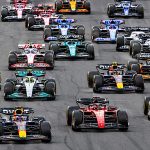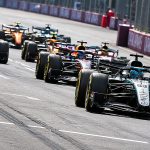
Twenty-two cars sit in near silence. Mechanics have cleared the tarmac, engines hum, and five red lights glow above the track one by one.
When they go out, every driver launches toward the first corner at once. That moment, and everything that decides who starts where, is the Formula 1 grid.
If you have ever wondered what commentators mean by “the grid,” why pole position matters so much, or how a driver ends up starting from the pit lane, this guide has you covered.
We will walk through what the F1 grid is, how the order is set, what happens on it before the race, and why a single grid slot can shape an entire Grand Prix.
What Is the F1 Grid?
The F1 grid has two meanings, and fans use both all the time.
1. The starting grid: This is the marked formation on the main straight where cars line up before a race. Each car has a numbered grid box painted on the track, and the order is set mainly by qualifying. The fastest qualifier starts from pole position, at the very front.
2. The lineup of teams and drivers: When people talk about “the 2026 F1 grid,” they usually mean every team and driver competing that season. In this sense, “making it onto the grid” means landing a Formula 1 race seat, one of the most exclusive jobs in world sport.
In short, the starting grid is a place on the track, while the season grid is the field of competitors. Most of this guide focuses on the starting grid, then returns to the lineup later on.
How the Starting Grid Is Decided: Qualifying Explained
Grid order is earned in qualifying, a timed session split into three knockout rounds. On a standard weekend it runs on Saturday, the day before the Grand Prix.
- Q1 (18 minutes): Every car sets lap times. With 22 cars in 2026, the slowest six are eliminated and fill the last grid slots, P17 to P22.
- Q2 (15 minutes): The remaining 16 cars go again. Six more drop out and take P11 to P16.
- Q3 (12 minutes): The top ten fight for pole position. Their best laps set P1 to P10.
The gaps are often tiny, with several cars separated by less than a tenth of a second. That is why qualifying is one of the most intense hours of the whole weekend.
A few extra rules shape the order:
- The 107% rule: A driver whose best Q1 lap is more than 7% slower than the fastest Q1 time may need the stewards’ permission to start. This keeps cars that are dangerously off the pace from racing.
- Sprint weekends: At selected events, a separate Sprint Qualifying session on Friday sets the grid for the short Saturday Sprint, while regular qualifying sets the Sunday Grand Prix grid.
- Tie-breaks: If two drivers post identical times, the driver who set the time first ranks ahead.
Inside the Grid Layout: Pole, Rows, and the Staggered Formation
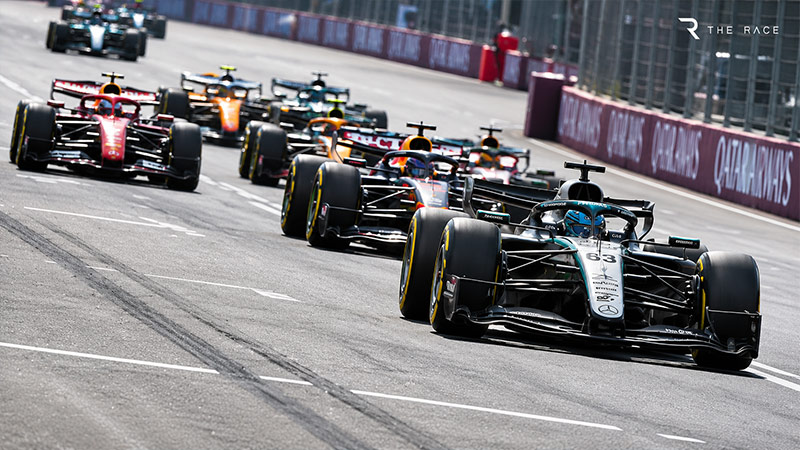
The starting grid follows a staggered two-by-two pattern. Cars line up in pairs, but each one sits slightly behind the car diagonally ahead, roughly eight metres apart. This offset gives every driver a clearer view forward and lowers the risk of contact at the start.
Here are the terms you will hear most:
- Pole position (P1): The front slot, awarded to the fastest qualifier. It usually sits on the side of the track that gives the best line into Turn 1.
- Front row: P1 and P2, the two most valuable starting spots on the grid.
- Odd and even sides: Odd-numbered positions (P1, P3, P5 and so on) line up on one side, even-numbered positions on the other.
- Clean side vs dirty side: The racing line collects rubber across the weekend, which adds grip. The off-line side can be dusty and slippery, so cars starting there may get a slower launch.
- Grid boxes: Painted markings show exactly where each car must stop. A driver who lines up out of position can be penalised.
Grid Penalties, Pit Lane Starts, and Other Twists
Qualifying sets the provisional grid, but the final order can still change before lights out.
- Power unit and gearbox penalties: Each driver has a limited allocation of engine components per season. Going over it brings grid drops, often five or ten places, and a big enough haul sends a driver straight to the back.
- Sporting penalties: Stewards can hand out grid drops for offences such as impeding a rival in qualifying or causing a collision in the previous race.
- Pit lane starts: Once qualifying begins, cars enter parc fermé, a set of rules that freezes most setup changes. If a team breaks those rules, for example to rebuild a car after a crash, the driver usually starts from the pit lane and joins after the field has passed.
- Disqualification from qualifying: A technical breach, such as a part that fails inspection, can wipe a driver’s lap times and drop them to the rear.
When penalties stack up, the official starting grid published before the race can look quite different from the qualifying results. Always check the final grid, not just the qualifying sheet.
The Race Start Sequence: From Grid Walk to Lights Out
The last hour before a Grand Prix follows a tightly timed routine. Here is how it unfolds:
- Pit exit opens: Around 40 minutes before the start, cars leave the garage, complete reconnaissance laps to check the track, and park in their grid boxes.
- The grid walk: Teams, media and guests fill the grid. Mechanics fit tyre blankets, engineers run final checks, and broadcasters roam between cars for quick interviews.
- The grid clears: A countdown of signals tells everyone to leave. Only drivers and cars remain as the clock ticks toward the formation lap.
- The formation lap: Drivers complete one slow lap in grid order, weaving to heat their tyres and pressing hard on the brakes to warm them. Overtaking is not allowed, except to recover a lost position after a problem.
- Lights out: Once every car is back in its box, five red lights come on one at a time, a second apart. After a short, unpredictable pause, they all go out, and the race begins.
- Jump start checks: Sensors detect any car that moves before the lights go out. Offenders usually receive a time penalty during the race.
That unpredictable pause is deliberate. It stops drivers from guessing the timing, so the start rewards pure reaction and a clean getaway.
The F1 Grid as a Lineup: Teams and Drivers in 2026
The 2026 season brought the biggest shake-up to the lineup in a decade. Cadillac joined as the 11th team, lifting the field to 22 cars for the first time since 2016. Sauber became the Audi works team, and new power unit and chassis regulations reset the competitive order.
Here is how the grid looked at the start of the 2026 season:
| Team | Drivers | Power unit |
|---|---|---|
| McLaren | Lando Norris, Oscar Piastri | Mercedes |
| Mercedes | George Russell, Kimi Antonelli | Mercedes |
| Red Bull Racing | Max Verstappen, Isack Hadjar | Red Bull Ford |
| Ferrari | Charles Leclerc, Lewis Hamilton | Ferrari |
| Williams | Alexander Albon, Carlos Sainz | Mercedes |
| Racing Bulls | Liam Lawson, Arvid Lindblad | Red Bull Ford |
| Aston Martin | Fernando Alonso, Lance Stroll | Honda |
| Haas | Esteban Ocon, Oliver Bearman | Ferrari |
| Audi | Nico Hülkenberg, Gabriel Bortoleto | Audi |
| Alpine | Pierre Gasly, Franco Colapinto | Mercedes |
| Cadillac | Sergio Pérez, Valtteri Bottas | Ferrari |
Seats can change during a season through injuries, form or contract decisions, so it is worth checking the official entry list before each race weekend.
Why Grid Position Matters So Much
Starting position is one of the strongest predictors of a race result. A large share of Grands Prix are won from the front row, though a grid slot is a head start, not a guarantee.
- Track type: At tight street circuits such as Monaco and Singapore, overtaking is rare, so qualifying can be close to decisive. At tracks with long straights, such as Monza or Bahrain, drivers can recover more easily.
- Clean air: The leader runs in undisturbed air, which helps the car’s aerodynamics and protects its tyres. Cars following closely lose some downforce and can struggle to stay in touch.
- Turn 1 risk: Starting further back means more cars around you on the run to the first corner, which raises the chance of contact.
- Strategy: An alternative tyre plan, a well-timed pit stop under a safety car, or simply a faster car can lift a driver through the field.
Comebacks do happen. The record belongs to John Watson, who won the 1983 United States Grand Prix West at Long Beach from 22nd on the grid. Still, every team would rather start at the front and control the race from there.
F1 Grid Glossary: Key Terms at a Glance
| Term | What it means |
|---|---|
| Pole position | The front grid slot, earned by the fastest qualifier |
| Front row | The first two grid positions, P1 and P2 |
| Grid box | The painted marking where each car must stop |
| Parc fermé | Rules that freeze most car setup changes after qualifying begins |
| Grid penalty | A drop of several places, applied before the race |
| Pit lane start | Starting from the pit exit after the field has passed |
| Formation lap | The warm-up lap driven in grid order before the start |
| Lights out | The moment all five red lights go out and the race begins |
| 107% rule | Drivers must lap within 7% of the fastest Q1 time to qualify by right |
Conclusion
The F1 grid is far more than a painted line on the tarmac. It is the reward for a perfect qualifying lap, the stage for a tense pre-race ritual, and a snapshot of every team and driver competing in a given season.
Knowing how qualifying sets the order, how penalties reshuffle it, and why the clean side or the front row matters will change the way you watch every start. Keep the glossary handy as a quick refresher before race weekend.
The next time five red lights glow and go dark, you will understand what each driver has at stake and why one grid slot can decide a Grand Prix.