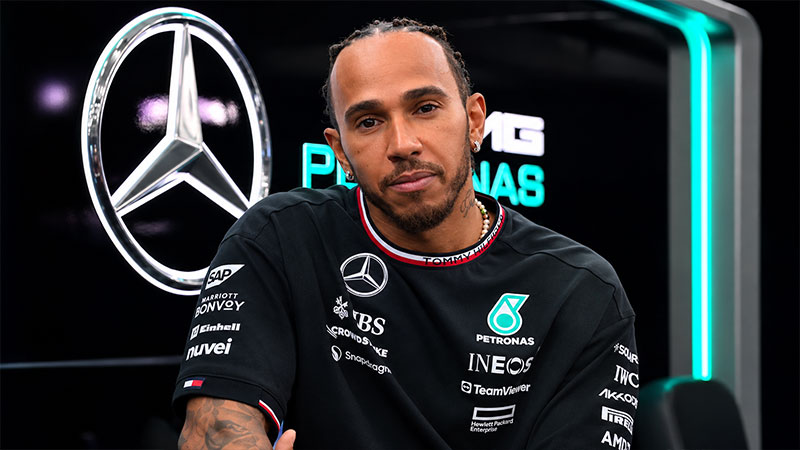
On 1 February 2024, Lewis Hamilton confirmed what had seemed unthinkable only weeks earlier: Formula 1’s most successful driver would leave Mercedes at the end of the season and race for Ferrari from 2025.
The announcement ended one of the most dominant partnerships in sporting history, a run that produced six drivers’ championships and more than 80 race wins.
So why did Lewis Hamilton leave Mercedes? There was no single trigger. The decision grew out of five connected forces: a hunger for a fresh challenge, a contract that offered little long-term security, a car that had stopped winning, a childhood dream of racing in red, and a financial and post-career package Mercedes could not match.
Below, we break down each factor, explain how they fit together, and look at what the move reveals about ambition, timing and legacy at the very top of elite sport.
The End of a 12-Year Partnership
Hamilton’s Mercedes era remains the benchmark for modern Formula 1 success. When he left McLaren for the Brackley-based team in 2013, many observers called it a gamble. Mercedes had won just one race since returning as a works team in 2010.
The bet paid off once the hybrid turbo era began in 2014. Hamilton won titles in 2014, 2015, 2017, 2018, 2019 and 2020, while Mercedes collected eight straight constructors’ championships from 2014 to 2021.
His six Mercedes crowns, added to his 2008 title with McLaren, matched Michael Schumacher’s record of seven.
The turning point came at the 2021 Abu Dhabi Grand Prix, where a controversial late safety car restart handed the title to Max Verstappen. Hamilton never came as close to an eighth championship with Mercedes again.
That near-miss matters because it set the stage for everything that followed: a team suddenly off the pace, a driver approaching 40, and a shrinking window to chase history.
Reason 1: The Desire for a New Challenge
After 12 seasons in the same garage, Hamilton wanted to test himself somewhere new. He had achieved nearly everything possible with Mercedes, and staying risked a slow, comfortable finish to his career.
Hamilton framed the switch as a fresh challenge, the same instinct that took him from McLaren to Mercedes in 2013. Back then, critics doubted him, and he proved them wrong. Ferrari offered a similar test on an even bigger stage: restoring winning momentum at the sport’s oldest and most scrutinized team.
For an athlete who has always thrived on proving doubters wrong, the chance to write a second chapter was a powerful motivator. An eighth title would carry extra weight if it came in red, for a team that had not won a drivers’ championship since Kimi Räikkönen in 2007.
Reason 2: Contract Frustrations and the One-Plus-One Clause
Contract structure played a decisive role. In August 2023, Hamilton signed a new Mercedes deal covering 2024 and 2025. Crucially, it was a one-plus-one arrangement: a firm commitment for 2024, with a second year that Hamilton could walk away from.
Mercedes was reluctant to offer a longer, multi-year contract. Hamilton would turn 40 in January 2025, and the team was quietly planning around Andrea Kimi Antonelli, the highly rated Italian teenager from its junior programme. Keeping a seat flexible protected that long-term plan.
Ferrari, by contrast, reportedly put a multi-year agreement on the table, matching Hamilton’s ambition to keep racing beyond 2025. When a rival offers long-term security and your current team hesitates, loyalty becomes a much harder argument.
The clause also explains the timing. Because the exit route already existed, Hamilton could finalize the Ferrari deal before the 2024 season and announce it in early February, giving both teams a full year to plan.
Reason 3: Mercedes’ Struggles Under Ground-Effect Rules
The 2022 regulation overhaul reshaped the competitive order. New ground-effect aerodynamics rewarded teams that mastered airflow under the car, and Mercedes got its concept badly wrong.
The team’s slim-sidepod design suffered from porpoising, a violent bouncing at high speed, and rarely delivered consistent pace. Hamilton went an entire season without a win for the first time in his career, while George Russell took the team’s only 2022 victory in Brazil. In 2023, Mercedes failed to win a single Grand Prix as Red Bull won 21 of 22 races.
Those two seasons shook Hamilton’s faith in the team’s direction. Mercedes eventually abandoned its original concept, but progress was slow. With his career clock running, Hamilton could not afford to wait for a turnaround that might never come.
Ironically, Mercedes improved in 2024. Hamilton won at Silverstone and Spa, ending a victory drought of more than two and a half years. By then, however, his future in red was already sealed.
Reason 4: A Childhood Dream and Faith in Ferrari’s Project
For Hamilton, Ferrari was never just another offer. He has spoken about growing up watching the Scuderia, racing as Ferrari in video games, and dreaming of one day wearing red.
His hero, Ayrton Senna, was widely reported to have wanted a Ferrari drive before his death in 1994. Completing that unfinished story carried real emotional weight for a driver who has always named Senna as his greatest inspiration.
The move was not purely sentimental, though. Hamilton trusted the people leading the project, especially team principal Fred Vasseur. Their history runs deep: Vasseur’s ART Grand Prix team carried Hamilton to the 2006 GP2 title, the final step before his Formula 1 debut with McLaren in 2007. That relationship gave Hamilton confidence his input would shape the team.
He also saw promise in Ferrari’s power unit and long-term technical plan, including preparation for the sweeping 2026 regulations. Partnering Charles Leclerc, one of the fastest qualifiers on the grid, promised a strong benchmark and a team capable of fighting at the front.
Reason 5: Financial and Post-Career Opportunities
Money was not the main motivation, but it mattered. Ferrari’s offer was widely reported to be among the most valuable packages in Formula 1 history, comfortably ahead of what Mercedes had on the table.
Beyond salary, the deal reportedly included commitments tied to life after racing, such as long-term ambassador roles with the Ferrari brand. Those links fit neatly with Hamilton’s growing business interests in fashion, film production and sports ownership, where association with one of the world’s most recognized luxury names adds lasting value.
For a driver building a global brand designed to outlive his racing career, Ferrari offered something Mercedes could not easily replicate: the prestige of the prancing horse, on and off the track.
How Mercedes Moved On
Mercedes responded by backing its long-term plan. Andrea Kimi Antonelli, just 18, was promoted to race alongside George Russell from 2025, making him one of the youngest drivers in Formula 1 history.
The choice confirmed what the contract talks had signalled: Mercedes was already preparing for life after Hamilton.
Team principal Toto Wolff accepted the decision publicly and praised Hamilton’s contribution, and the two parted on good terms after a farewell season that included two wins and an emotional final race in Abu Dhabi.
Hamilton’s first season at Ferrari proved far tougher than many expected, with a Sprint victory in Shanghai as an early high point. Both driver and team, however, framed the move as a long-term project rather than a quick fix.
What the Move Tells Us About Legacy and Risk
Hamilton’s switch is a case study in decision-making at the top of any field. Four lessons stand out:
- Timing beats comfort. Waiting for Mercedes to recover could have cost him his final competitive years.
- Security shapes loyalty. A short contract signalled limited long-term commitment, and a rival filled the gap.
- Purpose amplifies performance. The emotional pull of Ferrari strengthened every practical reason to go.
- Legacy is built through bold choices. His career has been defined by calculated risks, from McLaren to Mercedes to Ferrari.
Whatever results follow, the move cemented Hamilton’s reputation as an athlete willing to bet on himself rather than settle for a safe finish.
Conclusion
Lewis Hamilton left Mercedes because five forces lined up at once. He wanted a new challenge after twelve years and six titles. His one-plus-one contract offered little long-term security as Mercedes planned around Andrea Kimi Antonelli.
The team’s ground-effect struggles left him winless for two seasons and raised doubts about its future. Ferrari offered a childhood dream, a trusted leader in Fred Vasseur and a promising technical project.
A major financial and post-career package made the offer hard to refuse. Together, these factors turned an unthinkable split into a logical next step.
Hamilton chose ambition over comfort, betting that his greatest chapter could still be written in red.