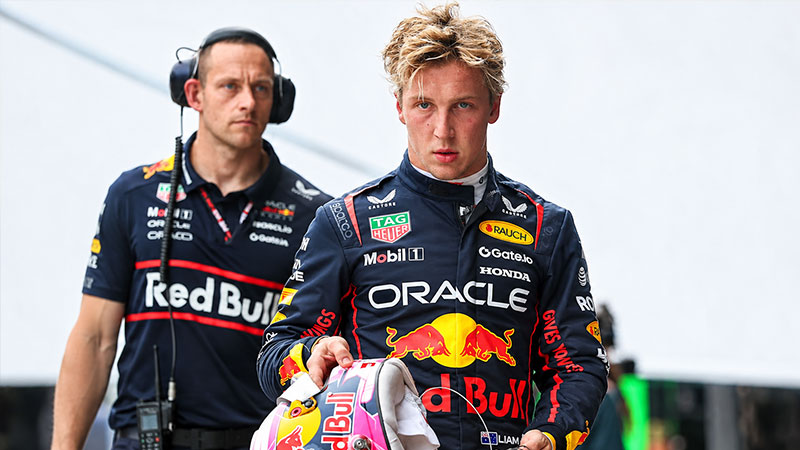
Liam Lawson drives for Red Bull because Red Bull developed him. The New Zealander joined the Red Bull Junior Team in 2019, reached Formula 1 as a stand-in in 2023, and was promoted to Red Bull Racing for 2025.
That promotion lasted just two races. Before the 2025 Japanese Grand Prix, Red Bull swapped him with Yuki Tsunoda and sent him back to its second team, Racing Bulls. Lawson began the 2026 season with Racing Bulls, a Red Bull-owned team that runs the same Red Bull-Ford power unit as the senior squad.
So the question usually means one of two things. Why did Red Bull pick him for its top seat, and why is he still in a Red Bull-owned car after the demotion? This guide answers both, step by step.
Who Is Liam Lawson?
Liam Lawson is a New Zealand racing driver, born on 11 February 2002 in Hastings and raised in Pukekohe. He rose through karting and junior single-seaters before Red Bull signed him at 17.
His record before Formula 1 shows range, not just speed:
- 2019: Won the Toyota Racing Series in New Zealand and joined the Red Bull Junior Team.
- 2020: Finished fifth in FIA Formula 3.
- 2021: Raced in Formula 2 and finished runner-up in the German DTM touring car series with a Ferrari.
- 2022: Finished third in Formula 2.
- 2023: Finished runner-up in Japan’s Super Formula championship.
That mix of open-wheel, touring car and Japanese racing matters. Red Bull wants drivers who adapt quickly to new cars, tyres and tracks, and Lawson proved he could do it across three continents.
Lawson’s Red Bull path at a glance
| When | Milestone |
|---|---|
| Start of 2026 | Begins the season with Racing Bulls alongside rookie Arvid Lindblad |
| Late 2025 | Retained by Racing Bulls; Isack Hadjar promoted to Red Bull Racing |
| March 2025 | Swapped with Yuki Tsunoda after two races for Red Bull Racing |
| December 2024 | Named Max Verstappen’s 2025 teammate, replacing Sergio Pérez |
| October 2024 | Replaces Daniel Ricciardo at RB from the US Grand Prix |
| August 2023 | Makes his F1 debut at the Dutch Grand Prix for an injured Ricciardo |
| 2019 | Joins the Red Bull Junior Team |
How Red Bull’s Two-Team System Works
Red Bull owns two Formula 1 teams. Red Bull Racing, based in Milton Keynes, is the senior team where Max Verstappen won four straight drivers’ titles from 2021 to 2024. Racing Bulls, based in Faenza, Italy, is the second team, previously known as Toro Rosso, AlphaTauri and RB.
The second team is a proving ground. Young drivers learn against the full grid there, and the best are promoted. Sebastian Vettel, Max Verstappen and Pierre Gasly all moved up this way.
Promotion is never permanent, though. Daniil Kvyat lost his senior seat after four races of 2016, Gasly after 12 races of 2019, and Alex Albon after the 2020 season. Lawson’s two-race spell is the shortest of the group, but the pattern is familiar.
The key point for this article: any driver in either car is a Red Bull driver under contract to the same parent company. Lawson has never left the Red Bull family; he has only changed garages within it.
Why Red Bull Picked Lawson for 2025
Red Bull needed a new partner for Verstappen after the 2024 season. Sergio Pérez finished eighth in the drivers’ championship, and Red Bull Racing slipped to third in the constructors’ standings. The team confirmed Pérez’s exit on 18 December 2024 and named Lawson the next day.
Several factors pushed Lawson ahead of the more experienced Yuki Tsunoda:
- Racecraft in limited starts. Lawson made 11 Grand Prix starts across 2023 and 2024 and scored points in Singapore, Austin and Brazil. In Austin he climbed from near the back of the grid to ninth.
- Adaptability. His success across five different championships suggested he could learn a difficult car quickly.
- Temperament. Red Bull management, including then team principal Christian Horner and adviser Helmut Marko, publicly backed his racecraft and resilience.
- Long-term planning. At 22, Lawson could grow with the team into the 2026 rule changes and Red Bull’s first in-house power unit, built with Ford.
There was also a widely discussed engine angle. Tsunoda had long been backed by Honda, which ended its Red Bull partnership after 2025 to join Aston Martin. Red Bull never named this as a reason, but it formed part of the public debate.
The Two-Race Reset: Australia, China and the Tsunoda Swap
Lawson’s Red Bull Racing career lasted two weekends, both at circuits he had never raced in Formula 1. In Melbourne he qualified near the back and crashed out of a wet race. In Shanghai he qualified last for both the sprint and the Grand Prix, and left without a point.
On 27 March 2025, Red Bull confirmed that Tsunoda would take the seat from the Japanese Grand Prix, his home race. Lawson moved back to Racing Bulls, with the team saying it wanted to protect his development rather than leave him under pressure in a car he had not mastered.
Context matters here. The RB21 was widely seen as a difficult car with a small operating window that only Verstappen could fully exploit. Tsunoda also struggled in it through 2025, which suggests the problem was never Lawson alone.
Back at Racing Bulls, and Why Red Bull Kept Him
Lawson’s restart at Racing Bulls was slow, but his form improved through 2025. He finished sixth in Austria, then fifth in Azerbaijan after qualifying third in Baku. Those drives showed the composure Red Bull had hoped to see.
The wider organisation changed around him too. In July 2025, Red Bull replaced Christian Horner with Laurent Mekies, the former Racing Bulls team principal, and Alan Permane took charge at Racing Bulls.
In late 2025, Red Bull confirmed its 2026 lineups:
| Team | Drivers for 2026 |
|---|---|
| Red Bull Racing | Max Verstappen, Isack Hadjar |
| Racing Bulls | Liam Lawson, Arvid Lindblad |
Tsunoda moved to a reserve role. Keeping Lawson gave Racing Bulls a driver with a full season of experience beside a rookie, just as new chassis and power unit rules reset the field.
What Comes Next for Liam Lawson
Lawson’s future still runs through Red Bull. Racing Bulls exists to prepare drivers for the senior team, so every Red Bull lineup decision affects his path.
Three things will shape his next step:
- Results against Lindblad. Beating a highly rated rookie teammate is the clearest way to stay in contention.
- Speed under the 2026 rules. Drivers who adapt fastest to a new era tend to earn promotion.
- Red Bull’s lineup reviews. The company changes drivers quickly, in both directions, so a strong run can reopen the senior door.
Driver news moves fast. For the latest confirmed lineups, check the official Formula 1 website and the Red Bull Racing and Racing Bulls team pages.
Conclusion
Liam Lawson drives for Red Bull because he is one of its own. The company spotted him in 2019, guided him through championships on three continents, and gave him Formula 1 chances in 2023 and 2024.
It promoted him for 2025 believing his racecraft and resilience could handle the seat beside Max Verstappen.
Two hard races ended that chapter quickly, yet Red Bull kept faith in him, and strong drives at Racing Bulls earned him another season.
His story shows how the Red Bull system really works: fast decisions, intense pressure and real second chances for drivers who respond.