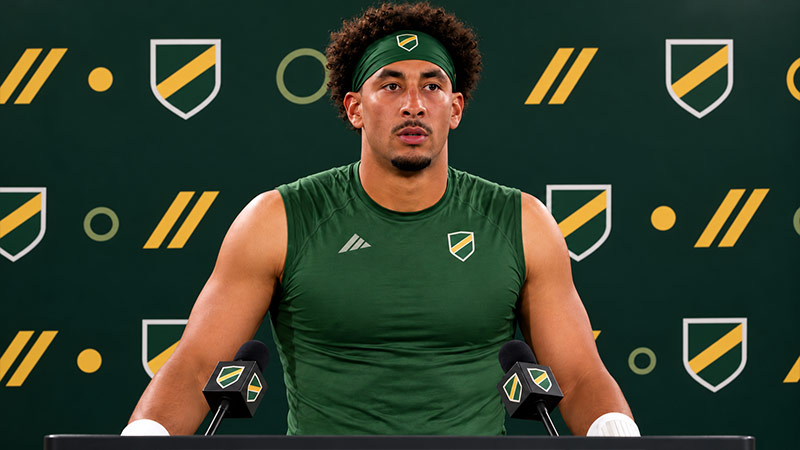
Few quarterbacks in contemporary professional football generate as much fierce debate as Green Bay Packers quarterback Jordan Love.
On public forums, sports talk shows, and digital fan spaces, opinions regarding his performance remain starkly divided, with a vocal segment of fans and commentators dismissing him as “mid” or “ass”,.
This harsh, label-based discourse contrasts sharply with analytical frameworks that often rate him as an upper-tier passer.
Understanding why Jordan Love attracts such intense criticism requires dissecting a complex matrix of factors: the massive financial expectations of his contract, visible mechanical fluctuations, playoff missteps, and a broader divide between traditional “eye test” film evaluation and advanced metrics.
The Anatomy of the Criticism: Why Skepticism Persists
High Financial Stakes and Contractual Pressure
A primary driver behind the magnified scrutiny on Jordan Love is the financial commitment made by Green Bay.
After signing a monumental four-year, $220 million contract extension averaging $55 million annually, expectations shifted dramatically. In the modern landscape of professional sports, elite compensation commands near-flawless execution.
When a quarterback earns top-market money, routine mistakes, missed throws, or offensive lulls are no longer viewed as standard growing pains; they are framed as evidence of overpayment.
Mechanical Flaws, Inconsistent Accuracy, and Decision-Making
On film, detractors point to recurring technical issues that affect his down-to-down consistency. Analysts and observers frequently highlight:
- Footwork and Release Dynamics: Love occasionally relies on “fadeaway” throwing mechanics where he fails to set his back foot, contributing to erratic deep-ball placement and a noticeably slow wind-up release.
- Field Vision and Progression Timing: Critics note instances where he is late on reading defensive coverages, leading to delayed throws into tight windows.
- Turnover Volatility: A tendency to force high-risk passes into double or triple coverage when attempting to extend plays.
These mechanical lapses contribute to noticeable dips in traditional statistical metrics. For example, periods of low completion percentage—at times dipping toward the 50% baseline—fuel the argument that his fundamental accuracy remains raw.
System Dependency vs. Individual Hardware
Another line of critique centers on the offensive environment designed by head coach Matt LaFleur.
Detractors argue that Green Bay’s offensive architecture heavily leverages high-percentage checkdowns, designed screen concepts, and manufactured yards-after-catch (YAC) opportunities.
From this perspective, raw production is seen as a byproduct of brilliant play-calling rather than quarterback dominance.
Furthermore, skeptics note a lack of traditional accolades, such as Pro Bowl or All-Pro selections, which casual fans historically use to validate elite status.
In terms of multi-year baseline production, averages of roughly 3,300 passing yards, 24 touchdowns, and 9 interceptions per season do not immediately strike observers as undeniable elite production without deeper context.
Postseason Stumbles and Situational Awareness
In big moments, specific high-profile errors have disproportionately shaped public narrative. Critics often point to his 1-3 postseason record, accompanied by 5 interceptions across his first three playoff appearances.
Situational game management errors—such as throwing away a pass on a critical 3rd & 2, incurring delay-of-game penalties immediately following timeouts, or throwing forced “arm punts” to end season-defining drives—provide undeniable tape evidence for those who argue he lacks top-tier processing in high-leverage situations.
The Analytics Dilemma: Expected Points Added (EPA) vs. The “Eye Test”
| Traditional Eye Test Critics | Advanced Analytics Defenders |
|---|---|
| Focus on game film and throwing mechanics | Focus on Expected Points Added (EPA) |
| Emphasize his 1–3 playoff record | Highlight top 5–10 efficiency rankings |
| Point to games with 50% completion rates | Value strong touchdown-to-interception ratios |
| Highlight forced throws and costly turnovers | Account for team context and defensive pressure |
The Pushback Against Advanced Metrics
Much of the debate surrounding Jordan Love stems from a fundamental conflict in how football performance is measured. Advanced analytics enthusiasts frequently rely on metrics like Expected Points Added (EPA) per play to demonstrate his impact.
However, traditional film evaluators and casual viewers strongly reject the notion that EPA should serve as the definitive evaluation tool.
Critics argue that EPA is inherently a team-wide metric rather than an isolated quarterback statistic. A quarterback’s EPA is heavily influenced by:
- Offensive line protection quality and pocket clean duration.
- Receiver separation and open-field playmaking ability.
- Offensive scheme design and opponent defensive weakness.
Because EPA aggregates team execution into quarterback output, skeptics contend it inflates performance metrics for passers operating within well-designed schemes.
When Statistical Models Fail the Visual Test
For fans who prioritize visual assessment, statistical models often fail to capture drive-by-drive reality. In playoff matchups, a quarterback may possess high overall efficiency numbers while presiding over prolonged offensive dry spells.
For instance, stretches where multiple consecutive second-half drives end in short punts highlight how abstract efficiency numbers can feel disconnected from actual game flow and scoreboard results.
The Defense: Contextualizing Jordan Love’s Real Value
Upper-Tier Efficiency and Explosive Scoring Potential
While criticism remains vocal, there is a substantial case supporting Jordan Love as an upper-tier NFL starting quarterback.
When evaluating efficiency across full season samples, advanced metrics and passer ratings consistently rank him inside or near the top 10, with peak stretches reaching the top 5–6 league-wide.
He has demonstrated explosive scoring capability, posting multi-touchdown performances against elite defenses and orchestrating high-volume scoring bursts that few young quarterbacks can replicate.
His ability to make off-platform throws and push the ball downfield gives the Green Bay offense a dynamic ceiling that traditional game managers cannot provide.
Supporting Cast Realities: Protection and Skill Group Youth
Evaluating any quarterback in a vacuum ignores structural realities. Throughout key stretches of his tenure, Love has operated under challenging surrounding conditions:
- Offensive Line Instability: High pressure rates and pass-blocking breakdowns have frequently forced him into uncomfortable, rushed decisions. Film analysis regularly shows plays where pass protection collapses almost immediately after the snap.
- Receiving Corps Inexperience: Unlike veteran quarterbacks throwing to established All-Pro receivers, Love has anchored an offense composed primarily of young, developing pass-catchers. Route-running errors and missed assignments by young receivers can turn well-placed passes into apparent miscommunications or turnover opportunities.
Comprehensive Evaluation & Key Analytical Takeaways
To fairly evaluate Jordan Love, one must look beyond binary labels like “elite” or “ass. His actual profile reflects a modern, high-variance quarterback capable of elite production alongside periodic mechanical missteps.
Jordan Love Evaluation Matrix: Strengths vs. Areas for Improvement
| Strengths | Developmental Areas |
|---|---|
| Top-tier efficiency ceiling (EPA per play) | Down-to-down mechanical stability |
| High touchdown rate in scoring zones | Eliminating high-risk turnover throws |
| Deep-range throwing power and off-platform ability | Postseason situational awareness |
| Strong navigation of a young skill-position roster | Consistency in baseline completion percentage |
Key Analytical Factors:
- Volatility vs. Capability: His high arm talent allows Green Bay to attack every zone of the field, but his willing aggressiveness inevitably leads to noticeable turnover plays.
- Contract Context: His $55 million annual salary reflects the market rate for high-upside starters, which naturally invites severe criticism during cold stretches.
- Growth Trajectory: As his young receiving corps matures and offensive line continuity stabilizes, mechanical consistency will be the main metric determining whether he moves permanently into the elite tier.
Conclusion
Jordan Love is neither an unmitigated disaster nor a flawless superstar; he represents a high-upside franchise starter operating under intense spotlight.
While critics validly highlight mechanical inconsistencies and costly postseason errors, discounting his high efficiency ceiling and explosive scoring capability ignores the reality of modern quarterback development.
As his career progresses, bridging the gap between high-level analytics and steady, down-to-down execution will ultimately settle the debate.