
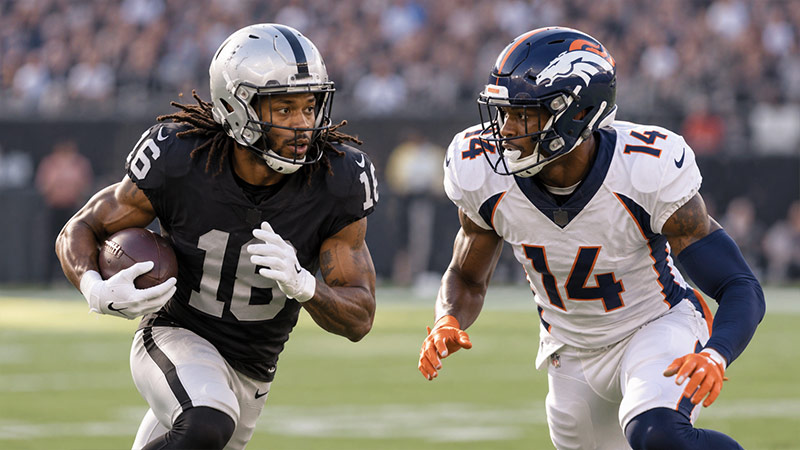
Choosing between Jakobi Meyers and Courtland Sutton requires more than comparing recognizable names. Both receivers have delivered useful fantasy seasons, but your decision should reflect their current production, your scoring format, and the kind of performance your lineup needs.
As of October 14, 2026, Meyers is my preferred option between the two, assuming both are healthy and available. His early-season receiving production gives him the stronger immediate case. Sutton’s previous success keeps him relevant, but it does not automatically make him the better weekly starter.
That recommendation comes with an essential distinction: choosing the better option between two players does not mean either belongs ahead of every alternative on your roster. A productive waiver pickup could still offer a stronger outlook.
Here is how to evaluate Meyers versus Sutton for a weekly lineup, a trade, or the remainder of your fantasy season.
Jakobi Meyers or Courtland Sutton: The Quick Answer
Start Meyers over Sutton when their availability and matchups are comparable. Through five games in 2026, Meyers has 15 receptions, 202 receiving yards, and two receiving touchdowns. Sutton has 11 receptions, 104 yards, and one receiving touchdown. Those numbers favor Meyers in both reception-based and standard scoring.
This is a preference based on the available production, rather than a claim that Meyers is an automatic starter in every league.
Sutton can move ahead if his recent opportunities improve substantially, Meyers faces an availability concern, or a particular matchup creates a clear advantage for Denver’s receiver.
For now, however, banking on Sutton’s reputation requires more faith than following Meyers’ stronger start.
What the Recent Numbers Tell Us
A useful comparison separates completed seasons from the current season. Previous results show what a receiver has accomplished. Current results help determine whether that production is carrying forward.
Meyers’ recent production
Meyers finished 2025 with a combined 75 catches, 835 receiving yards, and three receiving touchdowns across Las Vegas and Jacksonville.
His 2026 receiving totals through five games represent 47.2 full-PPR points before rushing contributions and other scoring adjustments: 15 points for catches, 20.2 for yardage, and 12 for touchdowns.
That calculation provides a consistent comparison, but it should not be confused with a universal fantasy-platform total. League settings can include bonuses, fumble deductions, and other adjustments.
Sutton’s recent production
Sutton completed 2025 with 74 receptions, 1,017 yards, and seven receiving touchdowns. His 2026 receiving totals through five games produce 27.4 full-PPR points using the same receiving-only calculation.
The contrast explains why this decision can feel difficult. Sutton had the stronger receiving season in 2025, while Meyers has the better early results in 2026.
Fantasy managers must weigh both without allowing either to dominate the entire decision.
What those totals cannot prove
Five games do not tell us exactly how the rest of the season will unfold.
They also do not establish why one receiver is producing more. For that, you need additional information about routes, targets, quarterback play, defensive coverage, and offensive adjustments.
The responsible conclusion is narrower: Meyers has delivered more receiving production so far, making him the better starting point for this comparison.
Who Is Better in Full-PPR Leagues?
Meyers gets my current preference in full-PPR leagues, but the reasoning deserves some care.
Full-PPR scoring awards one point per reception. That makes catches meaningful even when they produce modest yardage. A receiver who repeatedly earns short completions can remain useful without scoring a touchdown.
Consider this hypothetical example:
- A receiver catches six passes for 60 yards without scoring: 12 PPR points.
- Another catches three passes for 60 yards without scoring: 9 PPR points.
The yardage is identical. Reception volume creates the difference.
However, do not assume Meyers always offers a strong weekly floor simply because he has that reputation. His current average of three catches per game does not justify treating him as a guaranteed high-volume starter.
The better approach is to ask whether his opportunities are improving or declining.
Before choosing Meyers in full PPR, check:
- Whether he is running routes regularly.
- How frequently his quarterback is targeting him.
- Whether recent catches are spread across games.
- Whether his role changes when other receivers are available.
Meyers remains my choice between these two under comparable conditions. The strength of that recommendation increases when his recent involvement supports it.
Who Is Better in Half-PPR Leagues?
Half-PPR scoring reduces the reward for catches while retaining some benefit for reception volume.
That makes yardage and touchdowns more influential than in full PPR. It also means a receiver can overcome a modest catch deficit with one substantial gain.
Even so, changing the scoring format does not erase the current production gap.
Meyers has the stronger early receiving results, so he remains my default choice in half PPR. Sutton needs a persuasive reason to move ahead, such as a clear increase in targets or more valuable scoring opportunities.
Avoid choosing Sutton solely because half-PPR scoring is theoretically friendlier to a receiver who can produce through yardage and touchdowns. The role must actually create those opportunities.
A scoring format changes how production is rewarded. It does not guarantee that production will arrive.
Who Is Better in Standard Scoring?
Standard scoring removes reception points, putting greater emphasis on yardage and touchdowns.
Sutton’s previous results make his case more interesting here. His scoring history is a legitimate part of the evaluation, particularly when considering what he might deliver if his involvement improves.
Still, Meyers’ early-season advantage extends beyond catches. He also leads this comparison in receiving yards and receiving touchdowns.
That means there is no strong numerical basis for automatically reversing the recommendation in standard leagues.
My current standard-scoring preference remains Meyers when everything else is equal.
Sutton becomes the more appealing option when the upcoming game provides credible evidence of greater scoring potential. That could involve increased end-zone usage, a changing offensive role, or circumstances that push more passing opportunities in his direction.
The key word is evidence. A touchdown-dependent argument is weak when it relies entirely on hoping a familiar player rebounds.
Does Sutton Have the Higher Ceiling?
Sutton has a credible ceiling argument because of his established production. Denver’s records show consecutive 1,000-yard receiving seasons in 2024 and 2025, with eight and seven receiving touchdowns, respectively.
Those achievements demonstrate that he has sustained meaningful yardage and scoring production.
However, a player’s historical ceiling and his likely ceiling in the next game are different things.
A receiver can have an impressive career while entering a particular week with limited opportunities. Conversely, a less celebrated player can offer substantial upside when his role expands.
When evaluating Sutton’s ceiling, look for the ingredients that could produce a big game:
- Enough routes to stay involved.
- A meaningful share of passing targets.
- Opportunities for substantial yardage.
- Targets near or inside the end zone.
If those ingredients are missing, calling him the upside option becomes more of a label than an analysis.
Sutton deserves consideration for his previous success. His current role still needs to support the bet.
How Matchups Should Change the Decision
Matchups matter most when they explain how a receiver is likely to earn opportunities.
A defense’s overall ranking against wide receivers can be useful background, but it is too broad to settle a close decision by itself.
Look at how the defense allows production
Different defensive approaches create different openings.
Some encourage short completions while limiting deeper throws. Others leave more opportunities outside or require receivers to win against tight individual coverage.
The useful question is whether those openings fit the routes and responsibilities a player is actually receiving.
Consider the passing offense as a whole
A favorable individual matchup has limited value if the quarterback lacks time to throw.
Similarly, a team that controls the game on the ground may not need substantial passing volume.
Evaluate the likely passing environment alongside the receiver’s matchup. Protection, quarterback availability, and offensive approach can all affect whether an apparent advantage becomes usable production.
Check opportunities near the goal line
Touchdowns can swing this comparison quickly.
However, proximity to the end zone does not guarantee a receiver will be involved. A team might favor rushing attempts, tight ends, or other wideouts.
Look for actual scoring opportunities rather than assuming a tall receiver automatically dominates that area of the field.
Should You Trade Meyers for Sutton?
A one-for-one trade should reflect your expectations for future opportunities, not simply which player had the better previous season.
Based on the current production comparison, I would not trade Meyers for Sutton automatically.
Sutton may appeal as a rebound candidate, but a convincing trade argument needs more than the belief that he is “due.”
A rebound case becomes stronger when the underlying role looks healthy despite disappointing results. It becomes weaker when the poor production accompanies declining involvement.
Before making the trade, examine:
- Recent targets per game.
- Route participation.
- Opportunities near the end zone.
- Health and availability.
- Competition for passing work.
- How either player fits your starting lineup.
Also consider replacement value. If neither receiver would start for you, the trade may matter less than preserving roster flexibility or pursuing a different position.
A small projected improvement should not require a major additional asset.
Meyers or Sutton for the Rest of the Season?
My current preference is Meyers, with room to change as stronger evidence develops.
A rest-of-season ranking should remain responsive to changing roles. Receivers can gain or lose opportunities as offenses adjust, teammates return, and quarterbacks develop different passing patterns.
Use several games together to identify a trend. One disappointing afternoon should not erase every positive indicator, just as one touchdown should not establish a complete recovery.
The most useful developments to monitor are:
Target share: How much of the team’s passing work does each receiver earn?
Route participation: Is each player consistently available to receive a target?
Opportunity quality: Are the throws catchable, valuable, and capable of producing meaningful yardage?
Scoring involvement: Does either receiver receive repeatable opportunities near the end zone?
Those indicators can strengthen or overturn the current preference more effectively than a familiar name or an isolated highlight.
How Your Fantasy Matchup Affects the Choice?
Your lineup needs can help resolve a genuinely close decision.
When you are favored
Prioritize the receiver with the stronger evidence of repeatable involvement.
That means looking for regular routes, targets, and catch opportunities. Do not mistake a conservative-sounding reputation for an actual dependable role.
If those conditions are comparable, Meyers is my choice.
When you are an underdog
You may benefit from a wider range of possible outcomes, but upside should still have a credible path.
A receiver with limited opportunities does not become a strong upside play simply because his production is unpredictable.
Sutton could become the choice if the upcoming circumstances support more substantial yardage or scoring chances. Without that evidence, switching away from Meyers may add uncertainty without improving your chances.
When you need a flex starter
Compare both receivers with the running backs and tight ends eligible for that spot.
The better player in this comparison may still be behind a running back with substantial touches or another receiver whose involvement is increasing.
Treat the flex position as a broader roster decision.
The Final Decision
Choose Jakobi Meyers over Courtland Sutton under comparable conditions right now. Meyers has the stronger early-season production, while Sutton needs improving opportunities to turn his previous success into a more convincing current recommendation.
Keep the decision flexible. Full PPR rewards catches, standard scoring emphasizes yardage and touchdowns, and neither format removes the importance of playing time and passing involvement.
Before your lineup locks, check availability, review the latest usage, and compare both receivers with every realistic alternative on your roster. Start the player whose current opportunities best support the points your team needs.






