
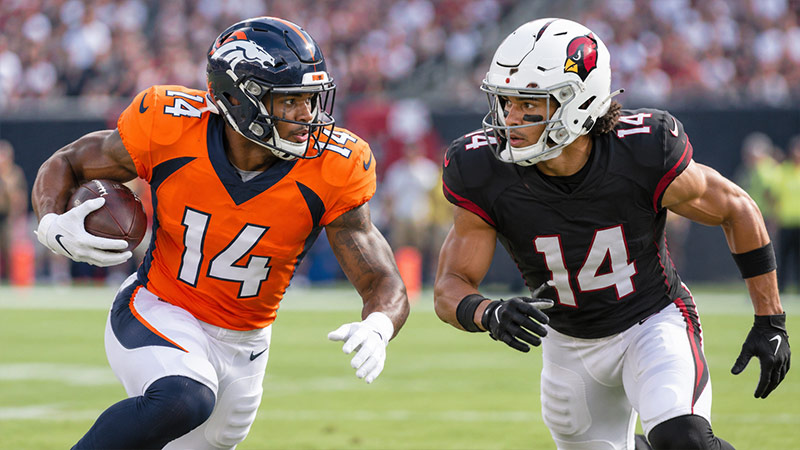
Michael Wilson is the preferred fantasy football choice over Courtland Sutton entering Week 6 of the 2026 season, especially in PPR leagues.
Wilson’s stronger receiving production gives him the better current case, while Sutton needs a more convincing improvement in involvement before earning the same lineup confidence.
Through five games, Wilson has recorded 29 receptions for 288 yards and one touchdown. Sutton has 11 receptions for 104 yards and one touchdown over the same number of appearances. Those totals establish a meaningful difference in their early-season contributions.
However, choosing between these receivers involves more than looking at their names or comparing their latest fantasy scores. Your scoring format, lineup needs, and the quality of each player’s opportunities all matter.
Sutton has the longer record of productive NFL seasons. Wilson has the more appealing current production profile. Understanding how to weigh those two factors is the key to making the right decision.
Michael Wilson or Courtland Sutton: The Quick Answer
Start Wilson over Sutton when you need the stronger current receiving workload. That recommendation is clearest in full PPR, remains reasonable in half PPR, and becomes somewhat closer in standard scoring.
Here is the practical approach:
- Full PPR: Prefer Wilson because catches provide an additional scoring advantage.
- Half PPR: Lean Wilson because his receiving production offers the stronger starting point.
- Standard scoring: Still lean Wilson, but give greater weight to touchdown opportunities and the upcoming matchup.
- Rest of the season: Favor Wilson at present, while watching for meaningful changes in either player’s role.
- Dynasty: Lean Wilson when acquisition costs are similar, particularly for teams building beyond this season.
These are analytical judgments based on the available production, rather than guarantees about the next game. A late injury, quarterback change, or substantial shift in usage could alter the decision.
The most useful distinction is between what a player has accomplished previously and what he is positioned to contribute now. Past production matters, but current opportunity should carry more weight in a weekly lineup choice.
What Their 2025 Numbers Tell Us
Before examining the early 2026 gap, it helps to establish that these receivers entered the season with comparable recent production.
Wilson finished 2025 with 78 catches, 1,006 receiving yards, and seven touchdowns across 17 games. Sutton finished with 74 catches, 1,017 receiving yards, and seven touchdowns, also across 17 games.
Those results challenge the idea that Wilson must be treated as an unproven alternative to an established fantasy starter. His most recent full season produced almost the same receiving yardage and exactly the same touchdown total as Sutton’s.
Using conventional receiving scoring—one point per 10 yards, six per touchdown, and no bonuses or fumble deductions—their 2025 totals translate to:
| 2025 receiving production | Michael Wilson | Courtland Sutton |
|---|---|---|
| Receptions | 78 | 74 |
| Receiving yards | 1,006 | 1,017 |
| Receiving touchdowns | 7 | 7 |
| Standard receiving points | 142.6 | 143.7 |
| Half-PPR receiving points | 181.6 | 180.7 |
| Full-PPR receiving points | 220.6 | 217.7 |
The fantasy totals above are calculations from the listed receiving statistics.
Sutton’s standard-scoring advantage was only 1.1 points over the entire season. Wilson’s full-PPR advantage was just 2.9 points. In practical terms, their receiving output was nearly level.
That matters because the current recommendation does not require dismissing Sutton’s ability. It simply recognizes that Wilson already had a comparable statistical foundation before establishing the stronger start in 2026.
Why Wilson Has the Current Advantage
His receiving volume creates more ways to score
A receiver can produce fantasy points through receptions, yardage, and touchdowns. When his involvement supports all three, he has multiple paths to a useful afternoon.
Wilson’s early-season catch total gives him an advantage that becomes especially valuable in reception-based formats. A catch does not need to gain 30 yards to help your lineup in PPR. Several ordinary completions can build a respectable score.
That does not make every target equally valuable. A difficult sideline throw and an uncontested completion underneath present different chances of success. Nevertheless, consistent involvement gives a receiver more opportunities to overcome an unsuccessful play.
For fantasy managers, this is often more useful than relying on one decisive touchdown. You want a player who can contribute even when the offense fails to finish a drive.
His advantage is not simply a touchdown difference
Touchdown results can distort a comparison over a short stretch. A receiver who scores twice on three catches may appear more dependable than his actual involvement suggests.
In this comparison, both players have one receiving touchdown through five games. Wilson’s production advantage therefore comes from catches and yardage, rather than a temporary lead in scoring plays.
That distinction strengthens his case. It suggests that his advantage has been built through more receiving activity.
Touchdowns still matter, especially in standard leagues. But when evaluating which receiver has offered the stronger foundation, production outside the end zone deserves close attention.
Arizona’s receiving situation has changed
Arizona announced a trade sending Marvin Harrison Jr. to Houston on October 12, with the transaction still pending a physical in that report. The reporting also identified Wilson as having moved ahead of Harrison as Arizona’s leading wide receiver.
My interpretation is that this development supports confidence in Wilson’s importance to the passing game. It does not automatically create a major increase in targets, particularly because Harrison had contributed relatively little before the deal.
That is an essential distinction. Managers should avoid adding a departed teammate’s hypothetical workload directly to another receiver’s projection.
Instead, watch how Arizona actually distributes its passes after the change. Wilson’s existing involvement is the strongest part of his case; any additional opportunity would be a further benefit.
Why Sutton Still Deserves Consideration
His recent track record remains relevant
Sutton recorded 1,081 receiving yards and eight touchdowns in 2024, then followed with another 1,000-yard season in 2025. He also scored 10 receiving touchdowns in 2023.
That history gives managers a legitimate reason to keep monitoring him. A slow start does not erase multiple productive seasons or prove that a receiver cannot rebound.
However, historical production should help explain a player’s possible outcomes. It should not give him an automatic place in your starting lineup.
The useful question is whether Sutton is beginning to receive the opportunities that supported those earlier results. If the answer becomes yes, the comparison can tighten quickly.
Touchdown opportunity can change a weekly decision
A receiver does not need a large catch total to deliver a strong standard-scoring performance. Two scoring receptions can outweigh a substantial yardage difference.
For Sutton to become the preferred weekly option, managers should look for repeatable opportunities near the end zone. Those could include targets inside the 10-yard line, designed scoring plays, or a broader increase in passing-game involvement.
A touchdown by itself provides less reassurance. It tells you what happened on one play; it does not necessarily tell you how the next game will unfold.
The stronger rebound signal would combine production with increased opportunity. More routes, more targets, and useful scoring-area involvement would provide a better reason to reconsider the current preference.
A favorable matchup can narrow the gap
Season-long trends are a starting point. Weekly circumstances can change the order.
Sutton could become more appealing if his upcoming opponent struggles against the routes he is being asked to run, Denver’s passing conditions are favorable, and his recent involvement improves.
Wilson could become less appealing if he enters the game limited, faces a significant quarterback disruption, or encounters a matchup that sharply reduces his expected opportunities.
Those conditions need evidence. A defense’s reputation or a single poor performance should not outweigh a substantial difference in receiver involvement.
Michael Wilson or Courtland Sutton in PPR?
Wilson is the stronger PPR choice under current conditions.
Full PPR awards one point per reception, making consistent catches particularly valuable. A six-catch performance gives a receiver six points before yardage and touchdowns are counted.
Consider these hypothetical stat lines:
- Receiver A: Six catches for 60 yards, no touchdown.
- Receiver B: Three catches for 70 yards, no touchdown.
Receiver A scores 12 PPR points. Receiver B scores 10.
The second player gains more yards, but the first produces the better fantasy result. That is why reception expectations should influence close decisions.
Wilson’s stronger early catch production supports the PPR recommendation. Still, do not confuse a better expected floor with a guaranteed minimum score. Any receiver can disappoint if his team struggles or the game develops unexpectedly.
The goal is to select the more defensible opportunity profile before kickoff.
Floor vs. Ceiling: Which Receiver Fits Your Lineup?
Fantasy managers often describe one player as safe and another as explosive. Those labels can become misleading when they are based mainly on reputation.
A useful floor comes from repeatable opportunities. A useful ceiling comes from having enough valuable opportunities to produce an exceptional game.
If you need dependable points
Lean toward the receiver with the stronger expected involvement.
That includes routes on passing plays, targets across different situations, and a role that does not disappear when the team changes its approach.
Wilson’s current production makes him the preferred starting point here. However, no receiver offers complete protection from a low score.
If you need a comeback
Do not automatically switch to Sutton because he has a history of touchdown production.
A high-volume receiver can also deliver a major ceiling through catches and yardage. Wilson demonstrated substantial single-game upside with a 185-yard performance against San Francisco in November 2025.
The right question is which player has the better chance to reach the score your lineup needs. Choosing the more volatile option only helps when his favorable outcomes are sufficiently strong and reasonably likely.
If your matchup looks close
Use the same evidence-based process. Projected fantasy margins change throughout the week and can be inaccurate.
A small difference in your platform’s matchup forecast should rarely override a clear advantage in player involvement.
How to Evaluate Their Upcoming Matchups
A useful matchup review goes beyond points allowed to wide receivers.
That statistic can be affected by which teams a defense has faced, injuries, game pace, and whether opponents needed to throw.
Focus on the following factors.
Passing volume
How many attempts is each offense reasonably likely to generate?
A receiver with a healthy share of a low-volume passing attack may receive fewer targets than expected. Conversely, a pass-heavy game can create enough opportunities for multiple receivers to contribute.
Protection and quarterback availability
A receiver’s outlook depends partly on whether his quarterback has time to execute the offense.
Pressure can interrupt deeper routes, force quick checkdowns, or end drives. Quarterback limitations can also change the types of passes a team attempts.
Coverage fit
Look for relevant coverage tendencies rather than assuming every receiver faces the same difficulty.
A defense may handle boundary routes effectively while allowing production elsewhere. Individual assignments also change with formations, motion, and defensive adjustments.
Weather
Strong wind can matter because it affects passing accuracy and the practicality of deeper throws.
Rain alone should not automatically trigger a benching. Evaluate the severity of conditions and how they are likely to affect each offense.
Expected game development
A trailing team may pass more, but extra attempts are not guaranteed to be productive.
Sustained drives and catchable targets are more useful than desperation throws made under constant pressure.
Michael Wilson or Courtland Sutton for the Rest of the Season?
Wilson is the preferred rest-of-season option based on the evidence available entering Week 6.
That judgment combines his comparable 2025 receiving production with his stronger start to 2026. It also recognizes that his importance within Arizona’s receiving group appears established.
Rest-of-season rankings should remain flexible, though. The most useful developments to monitor are changes in role, rather than every fluctuation in fantasy points.
For Wilson, watch whether his targets remain consistent and whether his yardage opportunities improve.
For Sutton, watch whether Denver begins involving him more often across consecutive games.
One productive afternoon can justify another look. A sustained improvement in opportunity provides a stronger reason to change the ranking.
Which Receiver Is Better in Dynasty?
At similar trade prices, Wilson is my dynasty preference.
Dynasty decisions include future roster value as well as immediate scoring. A player who can contribute now while offering a longer potential window is especially useful.
Wilson entered the league in 2023, while Sutton entered in 2018. That difference in career stage supports Wilson’s appeal for managers looking beyond the current season.
However, price can outweigh a general ranking.
Sutton may be worthwhile for a contender if his acquisition cost becomes modest. Wilson may be less attractive if another manager demands compensation that assumes years of elite production.
A rebuilding team should prioritize future flexibility. A contender should weigh likely points against the assets required to acquire them.
Mistakes to Avoid in This Comparison
Starting Sutton automatically because of familiarity
A recognizable veteran can feel safer than a younger alternative.
That feeling should be tested against current involvement. Experience helps explain a player’s capabilities, but it does not create targets.
Treating Wilson’s latest quiet game as a complete reset
Every receiver experiences disappointing weeks.
Investigate whether the result came from reduced opportunity, poor offensive execution, or normal variation. Those explanations carry different implications for the next game.
Chasing the previous touchdown
Touchdowns can make a limited performance appear more encouraging than it was.
Evaluate the plays that led to the score and the receiver’s broader workload.
Applying one ranking to every format
Full PPR, half PPR, standard, dynasty, and salary-based contests reward different considerations.
A player can be the preferred season-long starter while being poor value at an expensive contest salary.
Ignoring lineup flexibility
If one receiver plays later, preserve alternatives where possible.
For example, placing a later-starting player in a flex position can leave more replacement options than placing him in a receiver-only slot. Check your platform’s eligibility and lineup rules before making that adjustment.
The Final Call
Choose Michael Wilson over Courtland Sutton under current conditions, with the clearest preference in full PPR.
Their 2025 receiving totals were remarkably similar, while Wilson has established the stronger production profile early in 2026.
Sutton remains worth monitoring because his recent career includes multiple productive seasons. To regain the advantage, he needs opportunities that support a rebound.
Before locking your lineup, check availability, scoring settings, recent involvement, and any meaningful change in the upcoming matchup. If those checks leave the comparison unchanged, put Wilson in your starting lineup.






