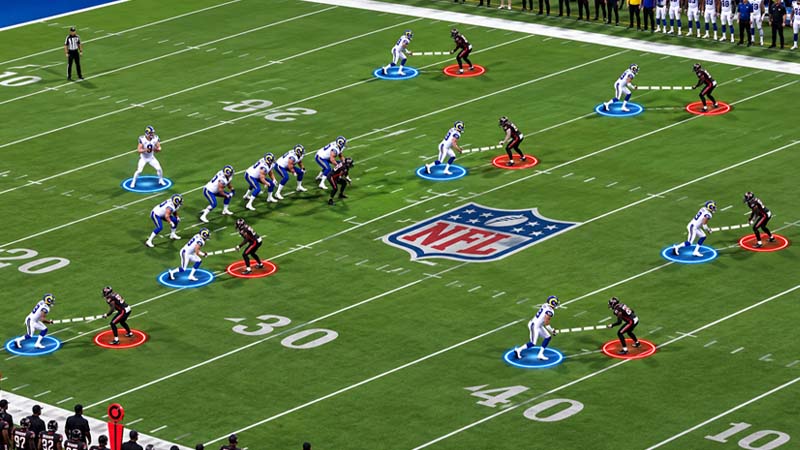
In the modern era of high-octane offensive schemes and increasingly athletic receiving corps, the defensive counter-response has undergone a significant evolution.
At the heart of this tactical tug-of-war lies a fundamental defensive philosophy: man-to-man coverage.
Unlike zone-based systems that prioritize the protection of specific geographical areas on the field, man coverage shifts the focus entirely toward neutralizing individual offensive threats.
It is a strategy of direct accountability, where the defensive outcome of a play often rests on the success of isolated, one-on-one physical battles.
The Foundational Philosophy of Man-to-Man Coverage
Man coverage is defined as a defensive system where each pass defender is assigned a specific offensive receiver to guard rather than a designated zone. This shift in priority creates a “defender’s shadow” effect.
The primary objective is for the defender to follow their assigned player relentlessly across the field, regardless of the route’s complexity or the receiver’s ultimate destination.
The goal of this “direct matchup” is three-fold:
- Disruption: To physically interrupt the timing of the receiver’s route.
- Prevention: To deny the window for a successful catch.
- Pressure: To force the quarterback into an incompletion by removing his primary and secondary options.
In a professional environment, this strategy is employed to remove the “grey areas” often found in zone coverage, where receivers can settle into the seams between defenders.
By locking a defender onto a target, the defense effectively attempts to turn an 11-on-11 game into a series of five distinct, individual contests.
The Structural Hierarchy: Variations of the Man Scheme
Not all man coverage is created equal. The degree of risk and the level of safety support define the specific “flavor” of man-to-man utilized by defensive coordinators.
These structures are categorized by their “Cover” designations, which dictate the positioning and responsibilities of the deep safeties.
1. Cover 0: The High-Stakes Gamble
Cover 0 represents the most aggressive form of man-to-man defense. In this structure, there is zero deep safety help.
Every available defender is either locked in a one-on-one matchup or is part of a heavy blitz package directed at the quarterback.
- The Intent: The goal is to create such an overwhelming pass rush that the quarterback is forced to throw the ball before the receivers can complete their routes.
- The Risk: Without any safety “over the top,” if a single defender loses their individual matchup, there is no one left to prevent a touchdown. It is the ultimate “hit or miss” defensive call.
2. Cover 1: The Single-High Security
Cover 1 is perhaps the most common iteration of man defense in professional football. It maintains the man-to-man assignments for the cornerbacks and underneath defenders but utilizes one “free” safety to roam the deep middle of the field.
- The Intent: The deep safety acts as a center fielder, tracking the quarterback’s eyes and providing support on deep vertical routes.
- The Advantage: This allows the underneath defenders to play more aggressively and “trail” their receivers, knowing they have a safety net behind them if they are beaten deep.
3. 2-Man (Cover 5): The Double-Deep Shell
2-Man coverage offers the maximum level of safety support while maintaining man-to-man principles underneath. In this scheme, two deep safeties split the field, each responsible for half of the deep zone.
- The Intent: The safeties provide “top-down” support, allowing the cornerbacks to play in a “trail technique.” In this technique, the cornerback stays slightly behind and inside the receiver, effectively sandwiching the offensive player between the defender and the safety support.
- The Advantage: This is an ideal scheme for neutralizing explosive deep threats while still forcing the quarterback to make difficult, contested throws into tight windows.
Strategic Advantages: Why Organizations Invest in Man Systems
The decision to implement a man-heavy defensive system is rarely arbitrary. For many elite organizations, the benefits of “locking down” an opponent outweigh the inherent risks of one-on-one failures.
1. Tightening the Throwing Windows
One of the primary advantages of man coverage is its ability to shrink the field. In zone coverage, a quarterback can often find “soft spots” where no defender is present. In man coverage, a defender is—by design—always in the immediate vicinity of the target.
This forces the quarterback to be perfect with his ball placement, as even a slight overthrow or underthrow can result in a pass deflection or interception.
2. Simplification of Defensive Assignments
While the physical demands of man-to-man are immense, the mental load can be lower than in complex zone-matching systems.
Instead of reading the movement of multiple receivers and “passing off” targets to teammates, a defender’s job is simplified to a single objective: “Follow that man”.
This clarity can lead to faster reaction times and fewer communication breakdowns in high-pressure situations.
3. Enabling the Pass Rush
There is a symbiotic relationship between man coverage and a team’s pass rush. Because man coverage tends to disrupt the immediate timing of a route, it forces the quarterback to hold the ball a fraction of a second longer.
This additional time is often all a defensive line needs to secure a sack. Furthermore, the simplicity of man assignments allows coordinators to utilize more players in exotic blitz packages, knowing that the primary receivers are already accounted for.
The Personnel Requirement: The Elite Athlete Threshold
The most significant “con” of man coverage is its extreme dependence on elite athletic talent. To successfully run a man-to-man system, a team must possess cornerbacks who can match the speed, agility, and size of the world’s best receivers.
In a man-to-man scheme, the defender is often forced to react to the receiver’s movements without the benefit of looking at the quarterback. This requires:
- Exceptional Lateral Agility: To mirror the sudden breaks and “cuts” of a route.
- Recovery Speed: To close the gap if a receiver momentarily gains a step.
- Mental Fortitude: Defenders must have a “short memory,” as they are frequently isolated and their mistakes are highly visible.
Without a roster of elite athletes, a man-to-man system becomes a liability. A single mismatch on the field—such as a slower linebacker forced to guard a fast running back in space—can be exploited by an intelligent quarterback for the duration of a game.
Vulnerabilities and Offensive Counter-Measures
Despite its strengths, man coverage has distinct weaknesses that offensive coordinators are trained to exploit. Understanding these vulnerabilities is essential for any defensive strategist.
1. The “Rub” and “Pick” Route
Because defenders in man coverage are focused entirely on their assigned receiver, they often lose awareness of other players on the field. Offenses exploit this by running “rub” or “pick” routes, where two receivers cross paths very closely.
The goal is to cause the two defenders to collide or be forced to take a long path around each other, creating a split second of separation for the receiver.
2. The Risk of the One-on-One Battle
The most glaring weakness of the system is its lack of redundancy. In zone defense, if one player makes a mistake, there is usually another defender nearby to mitigate the damage.
In man coverage, if a defender is “beaten” by their man, the coverage structure effectively collapses in that sector of the field.
This can lead to explosive plays and “home run” touchdowns, particularly in Cover 0 or Cover 1 looks where help is limited or non-existent.
3. Mobility of the Quarterback
Man coverage can also be vulnerable to mobile quarterbacks. When every defender has their back turned to the line of scrimmage while following a receiver, the quarterback may find massive lanes to run the ball himself.
Defenses often have to “spy” the quarterback with a linebacker to prevent this, which can remove one player from the coverage or pass rush.
Conclusion
The implementation of man-to-man defense is a high-reward strategic choice that requires a specific blend of elite personnel and aggressive play-calling.
By prioritizing direct matchups and shadowing receivers across the field, a defense can effectively disrupt the rhythm of even the most sophisticated passing attacks.
However, the margin for error is razor-thin. The vulnerability to rub routes and the catastrophic potential of a lost one-on-one battle mean that man coverage is as much a test of a team’s athletic recruitment as it is of their coaching.
In the final analysis, man-to-man defense remains the ultimate expression of competitive football: a series of isolated, high-stakes duels where the better athlete and the more disciplined technician usually emerge victorious.