In the modern landscape of professional football, the management of a roster is as much an exercise in elite financial engineering as it is in athletic evaluation.
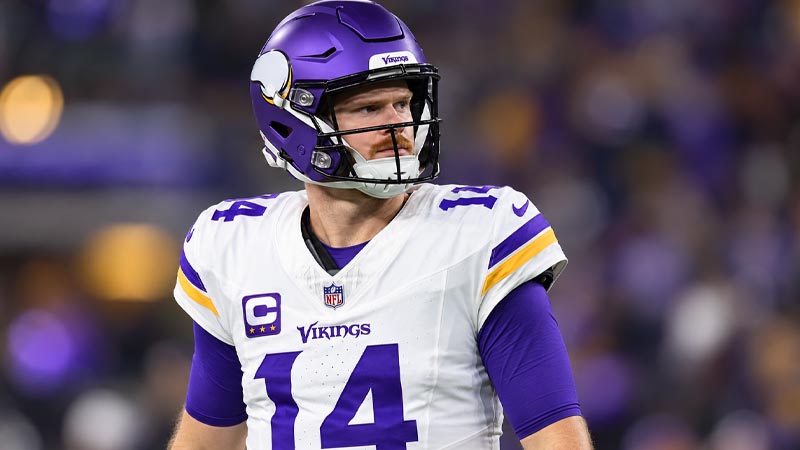
The recent decision by the Minnesota Vikings to part ways with veteran quarterback Sam Darnold following a highly successful regular season serves as a premier case study in organizational discipline and long-term capital allocation.
While a 14-win campaign typically solidifies a veteran’s position, the Vikings’ leadership chose a different path—one defined by the “Rookie Contract Window” and a commitment to high-ceiling draft investments.
The Paradox of the 14-Win Season
On the surface, moving on from a quarterback who orchestrated 14 victories in a single season appears counterintuitive. In most professional contexts, such a high level of output would result in a significant contract extension and a “franchise tag” designation.
However, elite-level management requires looking past surface-level win-loss records to evaluate the sustainability of performance under pressure.
While Darnold provided the Vikings with consistent production during the bulk of the schedule, the internal evaluation from the front office revealed significant hesitations regarding his performance in high-stakes environments.
Data from the late-season stretch and the playoff rounds indicated a struggle to maintain efficiency when the defensive complexity increased, and the margin for error narrowed.
For a franchise aiming not just for playoff appearances but for a championship, the “ceiling” of a veteran like Darnold was weighed against the potential of a younger, more dynamic prospect.
The organizational consensus was clear: the regular season success, while impressive, did not sufficiently mitigate the risks associated with a long-term, high-dollar commitment to a veteran who had yet to prove he could overcome the league’s elite defenses in January.
The Financial Thesis: Capitalizing on the Rookie Window
The most compelling driver of this transition was the pursuit of salary cap flexibility. In the current NFL economy, the “Rookie Quarterback Window” is the most valuable competitive advantage a team can possess.
By starting a player on a first-round rookie scale contract, such as 2024 pick J.J. McCarthy, a team can reallocate 15% to 20% of its total cap space toward other critical positions.
Strategic Reallocation of Funds
When a team commits $40 million to $50 million annually to a veteran quarterback, it inevitably necessitates talent drains in other areas—often the offensive line or the secondary. By choosing McCarthy over a lucrative extension for Darnold, the Vikings preserved the financial liquidity required to:
- Retain Elite Skill Talent: Ensuring that generational players like Justin Jefferson remain in a Vikings uniform by having the cap room to meet their market value.
- Bolster the Defensive Front: Investing in a pass rush that can mask deficiencies in the back end of the defense.
- Build Roster Depth: Protecting the team against the inevitable injuries that occur during a 17-game season.
The organization prioritized a cost-controlled deal for their 2024 first-round pick, viewing McCarthy as a foundational asset that allows for a more balanced and high-quality roster across all 53 spots.
The J.J. McCarthy Investment: A Commitment to Development
The selection of J.J. McCarthy in the first round of the 2024 draft was not merely a tactical move; it was a philosophical statement about the future of the franchise.
The organization’s primary focus shifted toward the long-term development of a young quarterback who fits the specific creative and athletic profile demanded by the modern game.
Internal decision-makers viewed McCarthy as a “high-draft-pick investment” that required immediate reps and a clear path to leadership.
Keeping a veteran like Darnold on a multi-year deal would have created an atmospheric “quarterback controversy,” potentially slowing McCarthy’s maturation process.
By allowing Darnold to seek opportunities elsewhere, the Vikings cleared the deck for McCarthy to take ownership of the locker room and the playbook without the shadow of an established veteran looming over his every mistake.
The Market Disconnect: Security vs. Flexibility
The final factor in Darnold’s departure was a fundamental disconnect in contract expectations. Professional athletes at the quarterback position seek long-term security, especially after a career-best 14-win season.
Darnold entered the free-agent market looking for a multi-year commitment that reflected his recent success.
The Vikings, conversely, were only willing to offer a limited commitment. This “bridge” mentality did not align with Darnold’s career goals or his market value.
Consequently, he found the longer-term security he desired with the Seattle Seahawks, a move that allowed the Vikings to exit the veteran quarterback market without the burden of a “dead cap” hit in future years.
This exit was a clean break that served both parties: Darnold secured his financial future and a starting opportunity in a new system, while the Vikings maintained their trajectory toward a McCarthy-led future.
Why the Move Aligns with Best Practices?
From a strategic standpoint, the Vikings are following a blueprint that has yielded high returns for other successful franchises. The “reset” at quarterback allows a team to stay young, stay fast, and stay under the cap.
- Risk Mitigation: By not overpaying for a 14-win veteran who struggled in the playoffs, the Vikings avoided the “mediocrity trap”—being good enough to win games but not good enough to win titles, all while having no money to improve.
- Asset Maximization: Draft picks are the most valuable currency in the league. To draft a quarterback in the first round and not play him is a sub-optimal use of that currency.
- Cultural Alignment: Transitioning to a rookie allows the coaching staff to “grow” the quarterback within their specific culture, rather than trying to break the habits of a veteran who has played in multiple systems.
Conclusion: The Calculated Risk of Tomorrow
The departure of Sam Darnold marks the end of a successful, albeit brief, chapter in Minnesota football. By prioritizing financial flexibility and the development of J.J. McCarthy, the Vikings have chosen a path of high-upside volatility over veteran stability.
It is a move that reflects a deep understanding of the modern NFL’s economic realities: to win a championship, you must either have an elite veteran or a high-performing rookie who allows you to build an elite roster around him.
The Vikings have placed their bet on the latter. While the 14 wins of the previous season will be remembered fondly, the organization is firmly looking toward the potential of the McCarthy era, betting that the cap space saved and the talent drafted will eventually lead them further than a veteran could.