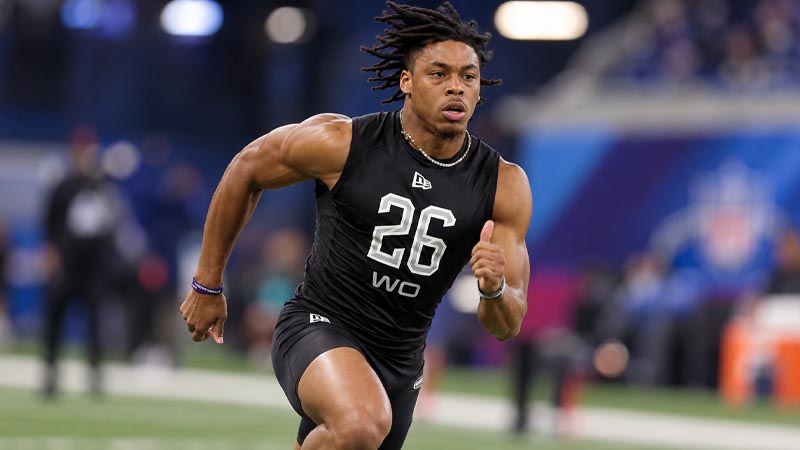
In the world of elite athletic evaluation, few metrics carry as much weight as the 40-yard dash.
For professional evaluators and organizations, this single sprint is often the deciding factor between a prospect being labeled a “specialist” or a “complete” athlete.
When Justin Jefferson arrived at the 2020 NFL Scouting Combine, the stakes were remarkably high.
Despite his staggering production at LSU, a narrative had emerged that he lacked the vertical speed to succeed outside the slot in the professional ranks.
The Moment of Validation: Indianapolis 2020
The atmosphere in Indianapolis during the Combine is one of clinical precision. Every movement is tracked, and every millisecond counts toward a player’s future earning potential. For Jefferson, the 40-yard dash was not just a drill; it was a rebuttal.
Official Performance Metrics
| Metric | Detail |
|---|---|
| Official 40-Yard Dash Time | 4.43 Seconds |
| Position | Wide Receiver |
| College | LSU |
| Event Year | 2020 |
| Drafting Team | Minnesota Vikings |
This 4.43-second mark was a pivotal data point. It signaled to every front office in the league that Jefferson possessed the “long speed” necessary to threaten NFL secondaries deep, effectively shattering the “slot-only” label that had followed him during his final season in Baton Rouge.
Deconstructing the 4.43: Why It Mattered for the Minnesota Vikings
To understand the weight of this number, one must look at the context of the 2020 wide receiver class. This was a group touted as one of the deepest in a generation, featuring names like CeeDee Lamb, Jerry Jeudy, and Henry Ruggs III.
- The Threshold for Excellence: In modern scouting, a sub-4.45 time is generally considered the “Gold Standard” for a WR1 (Wide Receiver 1). By hitting 4.43, Jefferson placed himself in the top tier of athletes in his class.
- The LSU Narrative: At LSU, Jefferson was often used in the slot because of his elite catch radius and contested-catch ability. Critics misinterpreted this usage as a lack of speed. The 4.43 time proved his role was a coaching choice, not a physical limitation.
- The Vikings’ Evaluation: For a team like the Minnesota Vikings, who were looking to replace the explosive production of Stefon Diggs, the 4.43 time provided the mathematical certainty needed to utilize a first-round pick on Jefferson.
Technical Analysis of the Sprint
The 40-yard dash is a three-phase event: the start (acceleration), the transition, and the top-end speed phase.
- The Explosive Start: Jefferson’s initial ten yards (the “10-yard split”) showed a level of explosion that allowed him to get off the line of scrimmage against press coverage.
- Maintaining Velocity: His 4.43 time suggests he did not “plateau” mid-sprint. He maintained a consistent stride length, which translates directly to the “smooth” route running he is now known for in the professional ranks.
- The Finish: By maintaining his form through the 40-yard mark, he demonstrated the stamina and mechanics that have allowed him to outrun defensive backs even in the fourth quarter of games.
Comparative Analysis: The 2020 Receiver Landscape
While the 4.43 time is impressive in a vacuum, its true value is revealed when compared to the expectations of that draft cycle.
- Projected Speed: Many analysts expected Jefferson to run in the 4.50 to 4.55 range.
- Actual Performance: His 4.43 official time exceeded those projections by nearly a full tenth of a second.
- The Result: This performance moved him from a “safe” late-first-round pick to a “must-have” blue-chip prospect.
The Long-Term Impact on Professional Success
The 4.43-second dash was the foundation. Since entering the league with the Minnesota Vikings, Jefferson has used that speed to set numerous records.
However, speed alone does not make a player elite. Jefferson’s success is a combination of that baseline athleticism and technical mastery.
Key Components of the Jefferson Formula:
- Route Geometry: Using his 4.43 speed to “sell” deep routes before breaking off into intermediate patterns.
- Vertical Threat: Forcing safeties to play deeper, which opens up the entire offense for the Vikings.
- Stature and Speed: Running a 4.43 at his height (approximately 6’1″) is more difficult and valuable than a smaller player running the same time.
Strategic Takeaways for Organizations
The lesson from Justin Jefferson’s 2020 Combine performance is one of data over narrative.
- Trust the Metrics: When a player has high college production, a strong Combine time acts as the final “green light” for investment.
- The Value of 4.43: This specific time is often the “sweet spot” where speed meets size. It provides enough velocity to beat defenders without sacrificing the muscle mass needed for durability.
- Positional Versatility: The speed displayed in Indianapolis allowed the Vikings to move Jefferson across the formation, from the slot to the outside, creating mismatches that have defined his career.
Conclusion: The Speed of a Standard-Setter
Justin Jefferson’s 4.43-second 40-yard dash at the 2020 NFL Scouting Combine was the moment the football world realized they were looking at a future superstar.
It was more than just a number on a stopwatch; it was the empirical proof that a “productive college player” possessed the “elite professional traits” required to dominate at the highest level.
Today, as Jefferson continues to rewrite the record books for the Minnesota Vikings, that sprint in Indianapolis remains the definitive starting point of his journey toward becoming the face of the wide receiver position in the modern era.