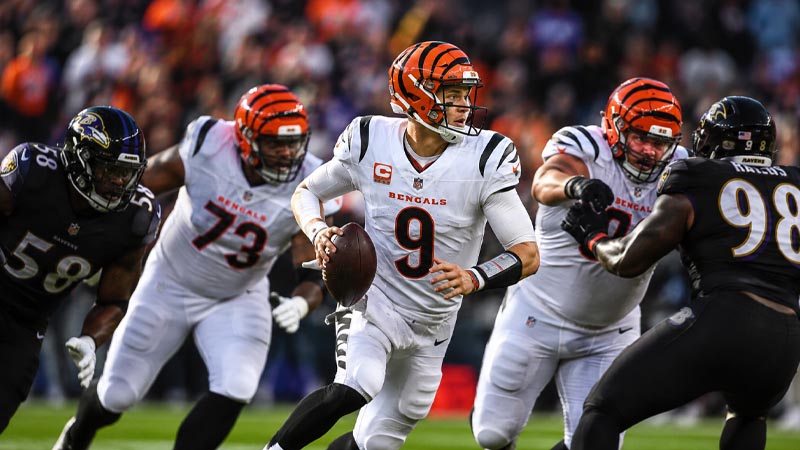
In today’s NFL, explosive plays often separate championship contenders from average offenses. Defined as receptions of 20-plus yards and rushes of 10-plus yards, these gains quickly change field position, increase scoring opportunities, and disrupt defensive schemes.
The Cincinnati Bengals demonstrated this during their AFC Championship-winning 2021 season, ranking sixth in the league in explosive plays before reaching Super Bowl LVI.
Their vertical passing attack helped them overcome defensive pressure and score efficiently. Since that Super Bowl appearance, however, Cincinnati’s big-play production has declined.
Rebuilding this explosive element is essential for revitalizing the offense, forcing defenses away from conservative coverage strategies, and giving the Bengals a realistic path toward another Super Bowl run.
Deconstructing the Definition: The Threshold of Explosive Efficiency
To understand why explosive plays carry such a high correlation with winning, we must look at the specific thresholds of these gains.
By separating these plays into two distinct categories—passing plays of 20+ yards and running plays of 10+ yards—we can analyze how they impact the structural integrity of an opposing defense:
The Passing Threshold (20+ Yards)
A 20-yard completion is a devastating blow to a defensive unit because it typically requires the quarterback to throw past the intermediate level of defense, challenging the safety help and the cornerbacks’ vertical recovery speed.
When an offense can attack this deep third of the field, it stretches the defense vertically, creating massive voids between the linebacker level and the defensive backfield.
This vertical stretch forces the safeties to play with deeper depth, which in turn clears out the intermediate lanes for dig routes, crossers, and curl concepts.
The Rushing Threshold (10+ Yards)
A 10-yard run is highly disruptive because it represents a clean break through the line of scrimmage and the immediate engagement of the second and third levels of the defense.
When a running back gains 10 or more yards, it indicates that the offensive line has successfully created a push, sealed the edge, or isolated a linebacker, forcing safeties to fill run fits aggressively.
This aggressive safety play directly compromises the deep passing lanes, setting up the ultimate synergy between the ground game and the vertical attack.
When these two thresholds are met with high frequency, the offensive system achieves self-actualization. Opponents can no longer play aggressive, single-high safety looks without risking immediate downfield damage, nor can they sit in soft, two-high split-safety shells without being systematically dismantled by an efficient ground game.
Tracking the Decline: A Multi-Year Statistical Regression
The trajectory of the Bengals’ offensive production over the last several seasons reveals a direct correlation between their declining explosive play rate and their struggle to maintain a dominant foothold in the AFC.
The peak of their offensive potency coincided with their highest big-play ranking; since then, the drop-off has been stark.
According to comprehensive research tracking offensive efficiency, the Bengals’ rank in generating 20+ yard offensive gains has experienced a sustained downward trend:
- 2021 Season (Super Bowl LVI Run): Ranked 6th in the NFL
- 2022 Season: Dropped to 17th in the NFL
- 2023 Season: Dropped further to 27th in the NFL
- 2024 Season: Recovered slightly to 21st in the NFL
- Subsequent Campaigns: Hovered around 20th in the NFL
Bengals Explosive Play Ranking (20+ Yard Gains) By Season:
===========================================================
2021 (Super Bowl Run)  | [######] 6th
2022                   | [#################] 17th
2023                   | [###########################] 27th
2024                   | [#####################] 21st
Subsequent             | [####################] 20th
===========================================================
(Lower rank number indicates a more explosive, highly efficient offense)
This multi-year regression highlights a fundamental shift in how opponents defend Cincinnati. In 2021, the league was caught off guard by the rapid maturation of the Bengals’ deep-passing game.
In the years that followed, defensive coordinators adjusted, implementing deep-coverage structures designed specifically to keep the ball in front of them and eliminate the quick-strike touchdowns that had defined Cincinnati’s identity.
As the big plays dried up, the offense was forced to work harder for every yard, resulting in longer, more grueling drives that were highly susceptible to a single mistake, penalty, or negative play.
The Defensive Blueprint: How Opponents Stifled Cincinnati’s Star Power
To understand why the big plays disappeared, we must examine how defenses attacked the Bengals’ elite receiving duo of Ja’Marr Chase and Tee Higgins.
Heavy Double-Teams and Bracket Coverage
Defenses moved away from single-high looks, frequently bracket-covering Chase on third downs while providing safety help over Higgins. This limited deep Go routes and posts that once produced explosive gains.
Physical, Press-Inside Coverages
Cornerbacks used aggressive press coverage and inside leverage to disrupt Chase and Higgins at the line. The physical approach delayed their releases, giving pass rushers additional time to pressure Joe Burrow and forcing quicker throws underneath.
Anti-Pass “Shell” Coverages
Defenses increasingly deployed split-safety shells such as Cover 2, Cover 4, and Cover 6. With seven or eight defenders in coverage, these schemes congested deep areas and forced Cincinnati into a patient underneath attack, increasing the chances of sacks, penalties, or stalled drives.
The Downward Spiral of First-Down Inefficiency
The loss of explosive plays directly weakened how the Bengals operated on early downs, especially first down.
When an offense can consistently threaten defenses deep, defenders must respect the entire field. Without that vertical threat, defenses can compress the formation and make first-down execution much harder.
First-Down Efficiency Comparison:
Positive EPA on First Down   -->  Short 2nd/3rd downs, unpredictable play-calling,
                                  higher drive success rate.
Negative EPA on First Down   -->  2nd/3rd & long, predictable pass situations,
                                  stalled drives, higher punt rate.
Cincinnati’s offensive struggles were reflected in a negative first-down EPA profile. EPA measures the value a play adds relative to scoring expectations. Poor first-down results create difficult down-and-distance situations.
On second- and third-and-long, defenses can ignore the run, drop linebackers deeper, unleash edge rushers, and focus on pressuring the quarterback, making sustained offensive success increasingly difficult.
The Schematic Remedy: Under-Center Play-Action vs. Shotgun Predictability
To break their predictable offensive cycle and restore the vertical passing attack, Cincinnati needs a significant schematic adjustment, particularly in its play-action game.
The Bengals have traditionally relied heavily on Shotgun Formations, allowing Joe Burrow to operate from a comfortable alignment. However, the data shows a major efficiency gap:
- Shotgun Formations: Produce an 11.1% explosive play rate.
- Under-Center Play-Action: Produces an impressive 19.4% explosive play rate.
That represents more than a 74% increase in explosive-play potential.
Why Under-Center Play-Action is Structurally Superior
- Manipulating Linebacker Eye Discipline: Burrow’s back to the defense during the handoff fake hides the football, encouraging linebackers to take false steps toward the line.
- Creating Deep Vertical Windows: Those false steps open space behind linebackers for deep posts, digs, and crossing routes.
- Slowing the Pass Rush: The run action forces edge defenders to hesitate, giving Burrow additional time for deeper concepts to develop.
Increasing under-center play-action would help Cincinnati create explosive plays while reducing dependence on receivers winning isolated perimeter matchups.
The Cycle Reset: Forcing Defenses Out of Anti-Pass Shells
Once Cincinnati threatens vertically through under-center play-action or seam routes, defenses can no longer comfortably sit in two-high shells or overload coverage.
- Defenses Abandon the Underneath Box: Safeties retreat deeper, while linebackers drop to protect intermediate zones after surrendering explosive gains.
- The Underneath Game Opens Up: Deeper coverage creates space for Burrow to attack with quick slants, hitches, tight ends, and running backs.
- The Running Game Clicks into Rhythm: Light boxes give Cincinnati favorable blocking numbers, helping the rushing attack become more efficient.
The Virtuous Cycle of Offensive Efficiency:
================================================================================
[Explosive Plays Established]
       │
       ▼
[Defenses Retreat into Deeper Coverage]
       │
       ▼
[Underneath Passing Lanes Open Up]
       │
       ▼
[Defensive Front Lightens]
       │
       ▼
[Running Game Clicks into Rhythm]
       │
       ▼
[Play-Action Becomes Even More Deadly]
================================================================================
By hitting those crucial big plays early in a matchup, Cincinnati resets the entire defensive cycle, turning a predictable, sluggish game script into an unpredictable, highly dynamic offensive output.
The Defensive Anchor: Run Defense and Front Seven Reinforcements
An NFL offense cannot thrive without complementary defense. When the Bengals struggled to stop the run, opponents controlled the clock, limited Joe Burrow’s opportunities, and increased pressure on Cincinnati’s offense.
Knowing they needed to score on nearly every possession often led to forced throws, rushed decisions, and an overly aggressive, one-dimensional attack.
To solve this problem, Cincinnati made substantial investments in their front seven, bringing in premier run-stopping defensive linemen:
- Dexter Lawrence II: A dominant, space-eating nose tackle capable of resetting the line of scrimmage, absorbing double-teams, and completely shutting down interior running lanes.
- Jonathan Allen: A highly physical, technically sound defensive tackle who excels at penetrating the B-gaps, disrupting zone-blocking schemes, and shedding blocks to make plays in the backfield.
Front Seven Structural Impact:
==============================================================================
Adding Lawrence II & Allen  -->  Shuts down opposing ground games.
                                 -->  Forces opponents into 3rd-and-long.
                                 -->  Keeps opponent scoring low.
                                 -->  Removes pressure on Burrow to score
                                      34+ points every week.
==============================================================================
By adding these key pieces to the defensive front seven, the Bengals can consistently stop the run on early downs. This keeps opposing offenses behind the chains, limits their time of possession, and reduces the overall scoring burden on the Bengals’ offense.
Burrow and the offensive coaching staff no longer have to play with a sense of desperation; they can remain patient, execute their under-center run fakes, and strike vertically when the optimal defensive coverage presents itself.
The Foundation: The Health and Execution of Joe Burrow
While schematic shifts, run-stopping acquisitions, and play-action rates are vital components of this strategic blueprint, the entire vertical evolution rests upon a singular, non-negotiable prerequisite: the physical health and elite execution of quarterback Joe Burrow.
A fully healthy Joe Burrow is the absolute baseline for executing this offensive transformation. His unique skillset is what transforms schematic design into championship reality:
Elite Deep-Ball Touch and Placement
Under-center play-action requires the quarterback to make deep throws downfield with high anticipation. Because his back is temporarily turned to the defense, he must snap his head around, rapidly process the safety rotations, and deliver the ball to a spot before his receiver has fully broken open. A healthy Burrow possesses the elite processing speed and arm elasticity to make these high-anticipation throws with perfect touch, dropping the ball over the defender’s shoulder into the receiver’s bucket.
Pocket Navigation and Lower-Body Health
To hit deep vertical routes, the quarterback must often hang in the pocket for an extra beat while the double moves and deep crossing concepts develop downfield. This requires superb lower-body strength and calf/ankle mobility to climb the pocket, escape edge rushers, and reset his platform. When Burrow is healthy and possesses full lower-body mobility, he can navigate congested pockets with ease, keeping his eyes downfield and delivering strikes even under physical duress.
Command of the Perimeter Weapons
With Ja’Marr Chase and Tee Higgins on the outside, a healthy and mentally sharp Burrow knows exactly how to manipulate single-high or split-safety coverages with his eyes. He can look a safety off to one side of the field before turning and launching a deep pass to the opposite boundary, giving his elite perimeter playmakers a clean, one-on-one opportunity to make a play on the ball.
Without a healthy quarterback under center, the playbook naturally shrinks, defenses compress, and the explosive capability of the entire unit is severely capped. Keeping Burrow healthy and protected is the ultimate key that unlocks the door to a Super Bowl return.
The Blueprint for a Championship Return
The path back to Super Bowl contention for the Cincinnati Bengals does not require a complete roster overhaul, but it does demand a deliberate, strategic evolution.
By recognizing that explosive plays are the primary engine of offensive success, the coaching staff can design a system that maximizes their elite assets.
The Championship Path
- Keep Joe Burrow healthy and under center
- Use Lawrence II and Allen to anchor the defense
- Emphasize high-efficiency under-center play-action
- Target a 19.4% big-play rate
- Force defenses out of double-teams and soft shells
- Return to the elite Tier-1 Super Bowl hunt
By marrying the run-stopping power of their defensive front with a highly deceptive, under-center play-action passing scheme, the Bengals can systematically dismantle the passive coverages that have stifled them in recent years.
With a healthy Joe Burrow orchestrating a revived vertical attack, Cincinnati has the exact strategic blueprint required to reclaim their explosive identity, dominate the AFC, and capture the ultimate prize.