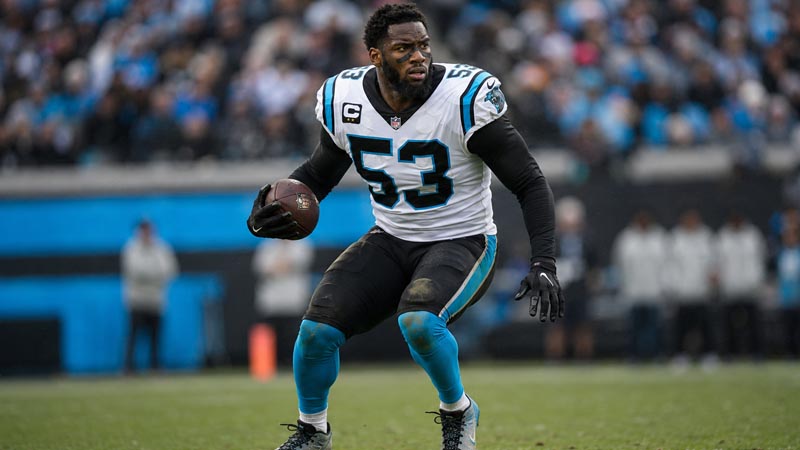
Few NFL franchises are more closely tied to defensive dominance than the New York Giants. From Lawrence Taylor and Harry Carson to Michael Strahan, Osi Umenyiora, Justin Tuck, and Jason Pierre-Paul, the Giants have built their identity around powerful defensive fronts and elite pass rushers.
Today, that tradition is increasingly represented by Brian Burns. After a standout campaign, Burns has established himself as one of the league’s premier edge defenders while filling a significant leadership role on the Giants’ defense.
His combination of production, versatility, preparation, and leadership has transformed him from a high-profile acquisition into a central figure in New York. This analysis examines Burns’ impact, defensive role, leadership, and contract value.
The 2025 Breakout: A Season of Elite Production
To understand why Burns is widely recognized as the centerpiece of this defensive unit, one must first look at the sheer numbers from his remarkable campaign. In professional sports, compensation and reputation must ultimately be justified by on-field impact.
During the season, Burns delivered an elite performance that silenced critics and elevated his standing among the league’s defensive hierarchy.
Statistical Domination on the Edge
Burns registered a career-best 16.5 sacks, a figure that placed him among the absolute elite in pass-rushing efficiency.
This milestone was not merely a collection of coverage sacks or fortunate bounces; it was the product of a high-motor, disruptive style of play that consistently forced opposing offenses to alter their protection schemes.
His ability to win individual matchups on the edge provided a constant source of pressure that disrupted quarterback timing, forced quick decisions, and created opportunities for his teammates.
His performance did not go unnoticed by the wider football community. Burns was honored as a second-team All-Pro, a prestigious designation that confirms his status as a consensus top-tier defender in the sport.
| Performance Indicator | Statistical Value / Status | Strategic Organizational Impact |
|---|---|---|
| Pass Rush Production | 16.5 Sacks (Career-Best) | Primary metric of pocket disruption; forces opposing offenses to commit extra blockers. |
| National Recognition | Second-Team All-Pro | Establishes league-wide prestige, validates franchise investment, and boosts locker room confidence. |
| Contract Structure | 5-Year, $141 Million | Marks him as the foundational franchise cornerstone for long-term roster planning. |
| Defensive Coordinator | Dennard Wilson | Serves as the strategic centerpiece for a modern, aggressive defensive scheme. |
| Leadership Status | Primary Defensive Tone-Setter | Fills the emotional and vocal void left by recent roster departures. |
3. Leadership by Necessity: Filling the Roster Void
An elite player becomes a franchise cornerstone through more than statistics. Leadership, resilience, and the ability to inspire teammates are equally important.
For the Giants, recent defensive departures created a leadership void, leaving the unit without several veteran voices.
Burns stepped into that gap, setting the standard for preparation, intensity, and accountability. His presence has helped restore focus and competitiveness to the defensive front, establishing him as one of the team’s most important leaders.
The Qualities of Modern Defensive Leadership
- Setting the Physical Standard: Burns is widely regarded as a high-motor player. His relentless pursuit of the ball, whether rushing the passer or chasing down a running back from the backside, serves as a non-verbal cue to the rest of the defense that half-hearted efforts are unacceptable.
- Vocal Coordination in the Front Seven: Following roster departures, Burns became a primary communicator. Helping younger players align correctly, identifying pre-snap offensive adjustments, and maintaining huddle discipline are crucial tasks that he embraced.
- Emotional Resilience Under Pressure: In the high-stress environment of professional sports, maintaining composure during adversity is what separates good players from true leaders. Burns’s steady demeanor has anchored a young unit through challenging stretches of play.
- Mentorship of Young Pass Rushers: By sharing his technical knowledge of pass-rush angles, hand placement, and film study habits, Burns has accelerated the development of younger defensive linemen on the roster.
By embracing these responsibilities, Burns has proven that his value extends far beyond the sack column. He has become the emotional heartbeat of the defense, a player whom coaches can rely on to enforce standard operating procedures and maintain high morale in the locker room.
4. Tactical Integration: Dennard Wilson’s Defensive Blueprint
The appointment of defensive coordinator Dennard Wilson signaled a structural shift in how the Giants approach defensive game planning. Modern defenses must be highly adaptable, capable of shifting between pressure packages and disguised coverages to confuse elite quarterbacks.
For Wilson’s system to operate effectively, it requires a highly versatile, disruptive athlete on the edge who can demand constant attention from the offensive line. Burns has filled this role, serving as the central piece around whom the defensive coordinator builds his entire strategic scheme.
                     [Opposing Offensive Line]
                     /           |           \
                    /            |            \
          [Double Team]    [Slide Protection]  [Chip Block by TE/RB]
                    \            |            /
                     \           |           /
                      v          v          v
                       [Brian Burns: Edge Anchor]
                                 |
         -------------------------------------------------
        |                                                 |
        v                                                 v
[Single Matchups for Interior]                  [Unorthodox Blitz Paths]
   - Open B-gaps for tackles                       - Linebacker pressure loops
   - One-on-one rush opportunities                 - Safety blitz opportunities
How the Scheme Leverages Burns’s Skill Set?
- The Gravity Effect on Offensive Protections: Because Burns is such a lethal threat off the edge, opposing offensive coordinators must consistently slide their pass protection in his direction or assign a tight end or running back to assist the tackle. This “gravity” frees up interior defensive linemen and blitzing linebackers, allowing them to exploit single-coverage matchups.
- Atypical Blitz Paths and Creeping Pressures: Under Wilson’s guidance, Burns is not merely aligned as a traditional defensive end. His spatial awareness allows him to be moved along the defensive front, rushing from interior gaps or dropping into shallow zone coverages to disguise the actual pressure path.
- Exceptional Run Deflection and Edge Setting: While pass rushing receives the majority of public attention, a true defensive anchor must be effective against the run. Burns’s athleticism allows him to set a hard edge, forcing outside runs back into the teeth of the defense and preventing opposing offenses from establishing a balanced attack.
- Optimizing Third-Down Packages: On critical passing downs, Wilson’s scheme utilizes Burns’s speed to force quick releases. Even when Burns does not secure a sack, his pressure rate forces off-balance throws that increase the likelihood of pass deflections and interceptions by the secondary.
This synergy between player capability and coaching strategy is what elevates a defense from average to elite. Wilson’s willingness to build his entire system around Burns’s strengths has allowed the defender to maximize his impact and truly act as the anchor of the unit.
The $141 Million Question: Evaluating the Business Strategy
In the modern landscape of professional sports, roster construction is a complex exercise in resource allocation and salary cap management.
When the Giants committed to a lucrative five-year, $141 million contract for Burns, it was a clear statement of organizational intent. High-value contracts naturally bring immense public scrutiny and high expectations.
To evaluate whether this investment represents sound business strategy, one must analyze the market value of elite edge defenders and the specific return on investment (ROI) that Burns provides to the franchise.
Evaluating the Market for Premier Edge Rushers
In professional football, elite edge rushers are among the most valuable players after quarterbacks because of their ability to disrupt opposing passing games. That makes Burns’ contract a major investment with clear expectations.
- Value Generation: A $28+ million annual salary demands consistent game-changing production, leadership, and impact.
- Cap Efficiency: Burns’ long-term deal provides cost certainty at a premium position while protecting against future salary-cap inflation.
- Strategic Roster Construction: An elite defensive anchor allows the Giants to build around him with younger players on affordable rookie contracts.
With 16.5 sacks and a growing leadership role, Burns has shown he can justify the investment by creating game-changing pressure and making the defense better around him.
Historical Context: How Burns Compares to Giants Legends
To appreciate Brian Burns’s impact, it helps to compare his trajectory with New York’s legendary pass rushers. The Giants have long valued defensive dominance, and Burns is building his own place in that tradition.
- Lawrence Taylor Era: Taylor transformed the linebacker position with explosive speed and aggression. Burns plays a different role but shares that ability to create constant pressure and influence protections.
- Michael Strahan Era: Strahan combined elite run defense with exceptional pass rushing. Burns’s 16.5 sacks in 2025 highlight a similarly dominant single-season impact.
- 2007/2011 Championship Rotation: Those teams featured Strahan, Umenyiora, Tuck, and Pierre-Paul. Unlike that deep rotation, Burns carries a larger share of today’s pass-rushing responsibility.
By sustaining this level, Burns is establishing his own Giants legacy and becoming a modern symbol of Big Blue’s defensive excellence.
Conclusion
The evolution of professional football has made elite edge defenders more valuable than ever. For the New York Giants, Brian Burns represents the next chapter in their proud defensive tradition.
His impressive 16.5-sack season showcased the athleticism, consistency, and relentless motor needed to dominate opposing offenses.
Beyond his production, Burns has emerged as an important locker-room leader during a period of roster transition.
Dennard Wilson’s defensive scheme has helped maximize his strengths, while the Giants’ long-term investment reflects his importance.
Burns is no longer simply a major acquisition; he has become a defensive cornerstone and a central figure in the Giants’ championship aspirations.