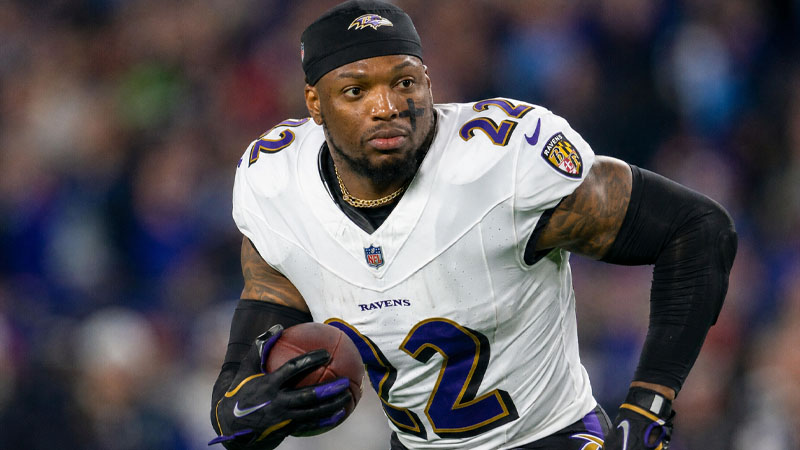
The trajectory of elite athletic talent often hinges on a single decision: the alignment between an individual’s raw physical traits and the developmental philosophy of a collegiate institution.
For those analyzing the modern history of football, few combinations have proven as physically devastating or historically significant as the pairing of running back Derrick Henry and the University of Alabama.
When examining the question of where Derrick Henry attended college, the answer represents more than a simple geographical location.
It marks the starting point of an era that redefined the boundaries of what a modern running back could achieve, culminating in a historic junior campaign and establishing a physical and tactical foundation that continues to yield elite results in the professional ranks a decade later.
The Recruiting Profile: Transitioning from Yulee to Tuscaloosa
To understand the magnitude of his collegiate choice, one must first examine the physical profile of the athlete who emerged from Yulee High School in Florida.
Born on January 4, 1994, he possessed a physical stature that immediately challenged traditional positional classifications.
Typically, prospects of his dimensions are converted to defensive positions, such as edge rushers or off-ball linebackers.
However, his commitment to play college football at the University of Alabama from 2013 to 2015 ensured that his unique physical advantages would be preserved and optimized in a highly physical offensive system.
The table below outlines the core baseline metrics of his entry profile and collegiate destination:
| Parameter | Metric / Detail | Tactical Implications |
|---|---|---|
| Full Name | Derrick Henry | The central figure of a historic era in collegiate rushing performance. |
| Collegiate Institution | University of Alabama | Provided a run-heavy, physical environment perfectly suited to maximize his traits. |
| Tenure | 2013 – 2015 | A three-year developmental arc resulting in historic individual and team accolades. |
| Physical Stature (Height) | 6’3″ | Offered an unusually high center of gravity for a runner, offset by elite stride length. |
| Physical Stature (Weight) | 252 lbs | Delivered a level of mass and kinetic impact that wore down opposing defensive fronts. |
| High School Origin | Yulee (FL) | The geographic origin where his developmental foundation was first established. |
| Birthdate | January 4, 1994 | His developmental timeline aligned with a highly competitive era of SEC football. |
The Biomechanics of Power: Analyzing the Physical Profile
An athletic frame measuring 6 feet 3 inches and weighing 252 pounds is highly anomalous for the running back position.
In traditional football theory, running backs are preferred to be shorter and more compact, allowing them to maintain a low center of gravity and slip through narrow running lanes.
At the University of Alabama, the coaching and training staff recognized that his size was not a limitation, but an unprecedented competitive advantage.
The Power of Mass and Momentum
The physical reality of a 252-pound athlete running at full velocity introduces a severe challenge to defensive structures.
When a defender attempts to make a tackle, they must absorb the kinetic energy of a runner who carries the weight of a traditional linebacker but possesses the speed of an elite perimeter player.
During his college career from 2013 to 2015, this mass allowed Alabama to execute a highly physical style of play.
Opposing defenses could often match the physical intensity of his runs in the first and second quarters, but as the game entered the late third and fourth quarters, the cumulative physical toll of tackling a 252-pound runner led to defensive fatigue and explosive, long-distance runs.
Stride Length and Second-Level Acceleration
While his height of 6’3″ initially presents a larger target for defenders in the backfield, it also provides him with an extraordinarily long stride.
Once he clears the defensive line and reaches the second level of the defense, his stride length allows him to cover ground at a rate that deceives pursuing defenders.
At the University of Alabama, the offensive scheme was designed to create clear pathways to the line of scrimmage, allowing him to build momentum before meeting contact.
Once he reached top speed, his physical profile made him nearly impossible to bring down with arm tackles, forcing opposing secondary players to risk injury to stop his forward progress.
The Historic 2015 Campaign: A Pinnacle of Collegiate Football
While his early years at the University of Alabama from 2013 to 2014 established his role within the offensive rotation, his junior season in 2015 stands as one of the most statistically dominant and historically decorated individual campaigns in the history of college football.
  Derrick Henry's Historic 2015 Junior Season Achievements:

  [ 1,986 Rushing Yards ]  --> Set the All-Time SEC Single-Season Record
            │
            ├─► [ Won the Heisman Trophy ] ────► Elite Individual Honor
            │
            └─► [ Won National Championship ] ──► Ultimate Team Success
The SEC Rushing Record
The Southeastern Conference (SEC) is universally regarded as one of the most physically demanding and defense-heavy environments in collegiate athletics. To achieve consistent rushing success in this conference requires both elite talent and immense physical durability.
During his junior year in 2015, he rewrote the record books by compiling 1,986 rushing yards. This milestone set the SEC single-season rushing record, surpassing previous marks set by some of the most legendary names in football history.
The achievement of 1,986 yards in a single year was not merely a product of high volume, but a testament to his ability to remain highly productive against defensive units designed specifically to stop the Alabama run game.
The Confluence of Individual and Team Glory
True greatness in collegiate athletics is achieved when individual milestones directly contribute to collective team success.
In 2015, his historic rushing output served as the engine for the entire Alabama team. His performances led to a series of critical victories, culminating in two major achievements:
- The Heisman Trophy: He was awarded college football’s most prestigious individual accolade, recognizing him as the outstanding player in the nation for the 2015 season.
- The National Championship: His individual efforts were validated on the grandest stage as he led the Crimson Tide to a national title, cementing the 2015 Alabama team’s place in college football history.
From Tuscaloosa to the Professional Ranks: A Study in Durability
A recurring concern among football analysts is the “workload tax” associated with high-volume collegiate running backs.
Many players who experience heavy usage in college suffer from premature physical decline once they reach the professional level.
However, his tenure at the University of Alabama served as a highly effective conditioning phase, preparing his body for the extreme demands of professional football.
By the 2025 professional season, a full decade after his historic collegiate run, he continued to showcase elite physical durability and performance metrics that placed him at the very top of the sport.
The table below compares his historic 2015 collegiate peak with his highly productive 2025 professional campaign to illustrate his sustained excellence:
| Career Phase | Rushing Yards | Rushing Touchdowns / Key Milestones | National / League Ranking |
|---|---|---|---|
| Collegiate Junior Year (2015) | 1,986 yards | Heisman Trophy Winner & National Champion | Set the all-time SEC single-season record |
| Professional Season (2025) | 1,595 yards | 16 Touchdowns | 2nd in Rushing Yards (behind Cook’s 1,621) / 2nd in Rushing TDs (behind Taylor’s 18) |
Sustained Production
The data reveals an extraordinary level of career longevity. In the 2025 professional season, he recorded 1,595 rushing yards, finishing second in the entire league, just behind Cook (1,621 yards) and ahead of Taylor (1,585 yards).
Furthermore, his 16 rushing touchdowns in 2025 placed him second in the league, trailing only Taylor’s 18 touchdowns and surpassing Allen’s 14 touchdowns.
This high-level output a decade after his college career began is highly unusual for the running back position, where the average career span is exceptionally short.
It highlights the long-term value of the physical preparation, structural discipline, and running technique he developed during his three years at the University of Alabama.
Conclusion: The Blueprint for Modern Running Back Success
Ultimately, the question of where Derrick Henry attended college is answered not just by naming the University of Alabama, but by acknowledging the historic legacy he built there.
His three years in Tuscaloosa from 2013 to 2015 served as a masterclass in how to develop, utilize, and sustain an athletic anomaly.
By combining his raw, high-school traits from Yulee with Alabama’s elite developmental environment, he was able to rewrite the SEC record books, capture the sport’s highest individual and team honors, and build a physical foundation durable enough to support elite professional performance a decade later.
For sports analysts and franchise builders, his collegiate path remains the definitive blueprint for running back development and long-term athletic success.