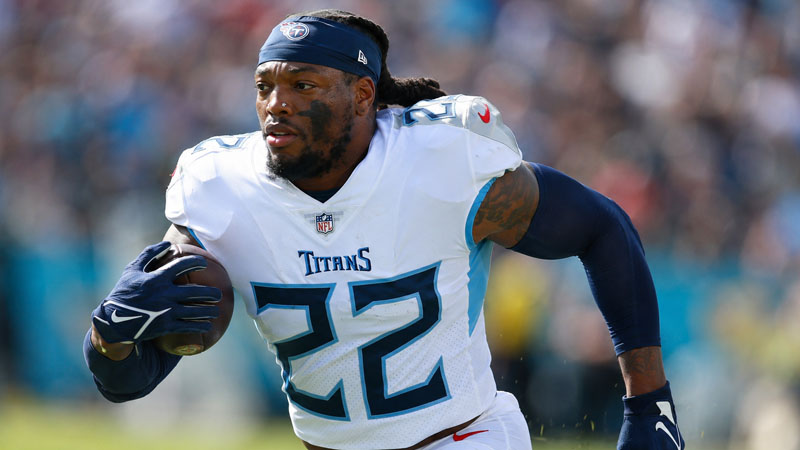
In the modern era of professional football, no position has been as systematically devalued or subjected to as rigid a career expiration date as the running back.
The consensus among front offices, sports scientists, and analysts is that a running back’s efficiency begins a steep downward trajectory upon reaching 30 years of age, or once their career workload surpasses 1,500 rushing attempts.
Yet, Derrick Henry continues to stand as a monumental outlier to this rule. At 6’2″ and 252 pounds, Henry possesses a physical template that defies conventional football physics.
Drafted in 2016 in the second round (45th overall) by the Tennessee Titans, Henry has spent a decade absorbing and delivering contact, accumulating a massive volume of work while maintaining elite-level efficiency.
This comprehensive analysis evaluates the statistical trajectory of Henry’s career, examining his early development, his historic peak with the Tennessee Titans, his hyper-efficient transition to the Baltimore Ravens, and his unique secondary contributions in the passing game.
The Physical Template: Breaking the Wear-and-Tear Model
To understand why Henry has not succumbed to the traditional age cliff that has derailed the careers of prior elite running backs, one must first look at his physical profile.
Most modern running backs who carry a heavy volume of work are built low to the ground to maximize leverage. Henry, by contrast, is built like an elite edge rusher or modern linebacker.
This size—252 pounds—gives him a unique kinetic advantage. Rather than absorbing the brunt of defensive impacts, Henry inflicts punishment on defenders. As games progress into the third and fourth quarters, this physical attrition wears down opposing front sevens.
This is reflected in his career average of 4.9 yards per carry over ten seasons, a number that has actually risen during specific late-career campaigns.
Over his ten-year career, Henry has logged 2,662 rushing attempts. In historical contexts, exceeding 2,500 carries is almost universally accompanied by a severe drop in yards per carry, a rise in fumbles, and an inability to break long runs.
Henry’s statistical record demonstrates the exact opposite: a player whose efficiency has been sustained—and in some areas unlocked—in his thirties.
Decade of Dominance: Complete Career Rushing Statistics
To fully appreciate his journey, we must look at the complete, year-by-year rushing metrics that span his career from his rookie season in Tennessee in 2016 through his second season in Baltimore in 2025.
Derrick Henry Year-by-Year Rushing Performance (2016–2025)
| Year | Team | Games Played (GP) | Carries (CAR) | Rushing Yards (YDS) | Yards Per Carry (AVG) | Rushing Touchdowns (TD) | Longest Run (LNG) | First Downs (FD) | Fumbles (FUM) | Fumbles Lost (LST) |
|---|---|---|---|---|---|---|---|---|---|---|
| 2016 | TEN | 15 | 110 | 490 | 4.5 | 5 | 22 | 29 | 0 | 0 |
| 2017 | TEN | 16 | 176 | 744 | 4.2 | 5 | 75 | 39 | 1 | 0 |
| 2018 | TEN | 16 | 215 | 1,059 | 4.9 | 12 | 99 | 51 | 0 | 0 |
| 2019 | TEN | 15 | 303 | 1,540 | 5.1 | 16 | 74 | 73 | 5 | 3 |
| 2020 | TEN | 16 | 378 | 2,027 | 5.4 | 17 | 94 | 98 | 3 | 2 |
| 2021 | TEN | 8 | 219 | 937 | 4.3 | 10 | 76 | 49 | 1 | 0 |
| 2022 | TEN | 16 | 349 | 1,538 | 4.4 | 13 | 56 | 65 | 4 | 2 |
| 2023 | TEN | 17 | 280 | 1,167 | 4.2 | 12 | 69 | 63 | 0 | 0 |
| 2024 | BAL | 17 | 325 | 1,921 | 5.9 | 16 | 87 | 94 | 3 | 1 |
| 2025 | BAL | 17 | 307 | 1,595 | 5.2 | 16 | 59 | 79 | 4 | 3 |
| Total | – | 153 | 2,662 | 13,018 | 4.9 | 122 | 99 | 640 | 21 | 11 |
The Tennessee Era: Creating a Ground-and-Pound Identity
Henry’s career in Tennessee can be split into three distinct phases: integration (2016–2017), historical peak (2018–2020), and high-volume stabilization (2021–2023).
The Integration Phase (2016–2017)
In his first two seasons, Henry shared the backfield with veteran DeMarco Murray. During this period, Henry was utilized as a change-of-pace, power option.
Despite limited opportunities—averaging just 7.3 carries per game as a rookie and 11.0 in his second year—he displayed high-end efficiency. In 2017, he showcased his home-run ability with a 75-yard touchdown run, finishing the season with 744 rushing yards.
The Historic Peak (2018–2020)
The 2018 season marked Henry’s transition to the undisputed focal point of the Tennessee offense. He eclipsed the 1,000-yard mark for the first time, rushing for 1,059 yards and 12 touchdowns.
This season was highlighted by an NFL-record-tying 99-yard touchdown run against the Jacksonville Jaguars, demonstrating that despite his 252-pound frame, Henry possessed elite, breakaway speed once he reached the second level of a defense.
In 2019 and 2020, Henry put together one of the most dominant back-to-back rushing stretches in modern NFL history:
- 2019: Led the NFL with 1,540 rushing yards and 16 touchdowns on 303 carries, averaging 5.1 yards per carry.
- 2020: Became only the eighth player in NFL history to break the 2,000-yard rushing barrier. Henry carried the ball a career-high 378 times for 2,027 yards and 17 touchdowns. He averaged 5.4 yards per carry and accumulated 98 rushing first downs, single-handedly carrying Tennessee to an AFC South division title.
The High-Volume Stabilization (2021–2023)
By 2021, Henry was on pace for another historic season, rushing for 937 yards and 10 touchdowns in just 8 games before suffering a foot injury that sidelined him for the remainder of the regular season. Despite playing only half the year, his 937 yards would have led many backfields.
He returned in 2022 without showing any structural limitations, leading the league in rushing attempts with 349 carries for 1,538 yards and 13 touchdowns.
In his final year with the Titans in 2023, behind a transitioning offensive line, Henry still managed 1,167 yards and 12 touchdowns across 17 games.
The Baltimore Resurgence: The Impact of Scheme and Spacing
When Henry signed with the Baltimore Ravens before the 2024 season, critics questioned whether a 30-year-old power back could adapt to a highly fluid, spread-option offense.
The subsequent two seasons completely silenced those doubts, representing one of the most successful late-career reinventions in sports history.
In Baltimore, Henry was paired with a highly dynamic, dual-threat quarterback. This schematic pairing fundamentally altered how defensive coordinators had to defend the run.
In Tennessee, Henry regularly faced “stacked boxes” (eight or more defenders in the division near the line of scrimmage).
In Baltimore, the threat of the quarterback keeping the ball on read-option plays forced defensive ends and linebackers to freeze, creating wider interior running lanes for Henry.
The statistical impact of this change was immediate and historic:
Derrick Henry’s Baltimore Ravens Statistics (2024–2025)
| Metric | 2024 Season | 2025 Season | Two-Year Baltimore Total |
|---|---|---|---|
| Games Played | 17 | 17 | 34 |
| Rushing Attempts | 325 | 307 | 632 |
| Rushing Yards | 1,921 | 1,595 | 3,516 |
| Yards Per Carry | 5.9 | 5.2 | 5.56 |
| Rushing Touchdowns | 16 | 16 | 32 |
| Longest Run | 87 | 59 | 87 |
| Rushing First Downs | 94 | 79 | 173 |
In 2024, Henry rushed for 1,921 yards on 325 carries. His average of 5.9 yards per carry was a career-high, an extraordinary achievement for a running back in his ninth professional season.
He backed this up in 2025 by rushing for 1,595 yards (ranking second in the NFL) and 16 touchdowns (also ranking second in the NFL), maintaining an elite 5.2 yards per carry.
Over his two seasons in Baltimore, Henry accumulated 3,516 rushing yards and 32 rushing touchdowns, demonstrating that his running style was not only sustainable but actually more potent when integrated into a modern, multi-threat offensive system.
The Versatility Metrics: Receiving and Trick-Play Passing
A common narrative surrounding Henry throughout his career was that he was a one-dimensional, early-down runner who offered little value in the passing game.
While he was never a high-volume target like some of his contemporaries, an analytical breakdown of his receiving and passing data reveals highly efficient, clutch contributions that coordinators have leveraged to exploit defensive coverage.
Receiving Contribution
Henry’s receiving numbers show that while he is rarely used as a traditional slot or screen receiver, he is highly effective as a check-down option, using his speed in the open field to pick up yards after the catch.
Derrick Henry Year-by-Year Receiving Statistics (2016–2025)
| Year | Team | Games Played (GP) | Receptions (REC) | Targets (TGTS) | Receiving Yards (YDS) | Yards Per Reception (AVG) | Receiving Touchdowns (TD) | Longest Catch (LNG) | First Downs (FD) |
|---|---|---|---|---|---|---|---|---|---|
| 2016 | TEN | 15 | 13 | 15 | 137 | 10.5 | 0 | 29 | 6 |
| 2017 | TEN | 16 | 11 | 17 | 136 | 12.4 | 1 | 66 | 4 |
| 2018 | TEN | 16 | 15 | 18 | 99 | 6.6 | 0 | 21 | 4 |
| 2019 | TEN | 15 | 18 | 24 | 206 | 11.4 | 2 | 75 | 4 |
| 2020 | TEN | 16 | 19 | 31 | 114 | 6.0 | 0 | 53 | 4 |
| 2021 | TEN | 8 | 18 | 20 | 154 | 8.6 | 0 | 16 | 7 |
| 2022 | TEN | 16 | 33 | 41 | 398 | 12.1 | 0 | 69 | 11 |
| 2023 | TEN | 17 | 28 | 36 | 214 | 7.6 | 0 | 46 | 7 |
| 2024 | BAL | 17 | 19 | 22 | 193 | 10.2 | 2 | 27 | 11 |
| 2025 | BAL | 17 | 15 | 21 | 150 | 10.0 | 0 | 44 | 4 |
| Total | – | 153 | 189 | 245 | 1,801 | 9.5 | 5 | 75 | 62 |
Henry’s peak receiving year came in 2022, when he caught 33 passes on 41 targets for a career-high 398 yards. In Baltimore, he remained a highly efficient option, averaging 10.2 yards per reception in 2024 and 10.0 yards per reception in 2025.
His career total of 1,801 receiving yards and 5 receiving touchdowns provides a critical secondary element that keeps defenses from keying purely on his running paths.
The Passing Weapon
Perhaps the most overlooked element of Henry’s profile is his ability to throw the ball on trick plays.
Because of his massive frame and high-school background, teams have frequently run “Wildcat” or jump-pass designs in short-yardage and red-zone situations.
Derrick Henry Career Passing Statistics
| Total Games (GP) | Completions (CMP) | Attempts (ATT) | Completion % (CMP%) | Passing Yards (YDS) | Average Per Pass (AVG) | Passing Touchdowns (TD) | Interceptions (INT) | Longest Pass (LNG) | Passer Rating (RTG) |
|---|---|---|---|---|---|---|---|---|---|
| 153 | 7 | 10 | 70.0% | 37 | 3.7 | 4 | 0 | 12 | 115.4 |
While 10 pass attempts over a ten-year career may seem minor, the efficiency is astounding. Henry has completed 70% of his passes, with 4 of his 7 completions resulting in touchdowns. He has never thrown an interception, resulting in a career passer rating of 115.4.
His passing touchdowns occurred during high-leverage situations:
- 2021: 1-for-1, 5 yards, 1 touchdown.
- 2022: 2-for-2, 4 yards, 1 touchdown.
- 2023: 2-for-3, 14 yards, 2 touchdowns.
This threat forces goal-line defenses to hesitate when Henry takes a direct snap, as his ability to execute the jump-pass is statistically proven to be highly lethal.
Scoring Impact: A Touchdown Machine
Henry’s value is ultimately reflected in his ability to put points on the board. He has scored 127 total career touchdowns (122 rushing, 5 receiving) and has thrown for an additional 4 touchdowns.
Derrick Henry Career Scoring and Points Progression
| Year | Team | Games Played (GP) | Passing TDs Thrown | Rushing Touchdowns | Receiving Touchdowns | Total Scoring TDs | 2-Point Conversions | Total Points Scored |
|---|---|---|---|---|---|---|---|---|
| 2016 | TEN | 15 | 0 | 5 | 0 | 5 | 0 | 30 |
| 2017 | TEN | 16 | 0 | 5 | 1 | 6 | 0 | 36 |
| 2018 | TEN | 16 | 0 | 12 | 0 | 12 | 0 | 72 |
| 2019 | TEN | 15 | 0 | 16 | 2 | 18 | 0 | 108 |
| 2020 | TEN | 16 | 0 | 17 | 0 | 17 | 1 | 104 |
| 2021 | TEN | 8 | 1 | 10 | 0 | 10 | 1 | 62 |
| 2022 | TEN | 16 | 1 | 13 | 0 | 13 | 0 | 78 |
| 2023 | TEN | 17 | 2 | 12 | 0 | 12 | 0 | 72 |
| 2024 | BAL | 17 | 0 | 16 | 2 | 18 | 0 | 108 |
| 2025 | BAL | 17 | 0 | 16 | 0 | 16 | 0 | 96 |
| Total | – | 153 | 4 | 122 | 5 | 127 | 2 | 766 |
Henry’s scoring output demonstrates elite consistency. He has registered double-digit rushing touchdowns in eight consecutive seasons (2018–2025). Even in 2021, when he was limited to just 8 games, he managed to find the endzone 10 times on the ground.
His career total of 766 points scored ranks him among the most productive non-kickers in modern NFL history, reinforcing his status as a legendary red-zone weapon.
Comparative Analysis: Why Derrick Henry Defies the Running Back Decline
To truly understand how unique Henry’s statistics are, we must look at how typical modern running backs perform when hitting the milestone markers of age 30 and 2,500 career carries.
Historically, players like Shaun Alexander, LaDainian Tomlinson, and Adrian Peterson saw their yards-per-carry averages drop below 4.0 within a season of hitting these milestones. The combination of structural wear, loss of top-end speed, and defensive adjustments typically limits their utility to short-yardage situations.
By contrast, let’s look at Henry’s age 30 and 31 seasons (2024 and 2025):
- Carries: 632 total attempts.
- Rushing Yards: 3,516 yards.
- Efficiency: 5.56 yards per carry.
- Touchdowns: 32 rushing touchdowns.
Instead of declining, Henry’s efficiency actually increased compared to his final seasons in Tennessee, where he averaged 4.4 and 4.2 yards per carry in 2022 and 2023.
This is primarily driven by three analytical factors:
- Physical Resilience: Henry has never suffered a major, career-altering ligamentous knee injury (such as an ACL or MCL tear) that strips a running back of their lateral agility. His only major injury was a bone fracture in his foot in 2021, from which he made a full recovery.
- Schematic Migration: Transitioning to Baltimore allowed Henry to play in an offense that did not require him to construct yards entirely on his own. The presence of elite passing targets and a dual-threat quarterback spread the defense horizontally, allowing Henry to run vertically into open space.
- Draft Context and Early Workload Preservation: Drafted in the second round in 2016, Henry was not overworked early in his career. He did not record a 300-carry season until his fourth year in the league (2019). This delayed entry into the high-volume running role preserved his joints and muscle tissue during his early twenties, extending his physical prime into his early thirties.
Conclusion
Derrick Henry is more than just an elite running back; he is a structural anomaly that challenges the foundational principles of modern NFL roster construction.
At a time when teams are hesitant to offer multi-year contracts to running backs past the age of 26, Henry signed a late-career contract with Baltimore and immediately produced back-to-back seasons of elite, near-2,000-yard efficiency.
With 13,018 rushing yards, 127 total touchdowns, and a career average of 4.9 yards per carry, “King Henry” has proved that physical preparation, unique athletic traits, and smart schematic placement can successfully defeat the dreaded running back age cliff.
As he continues to build on his legendary career, he is not just chasing victories—he is rewriting the historical limits of what is possible at the position.