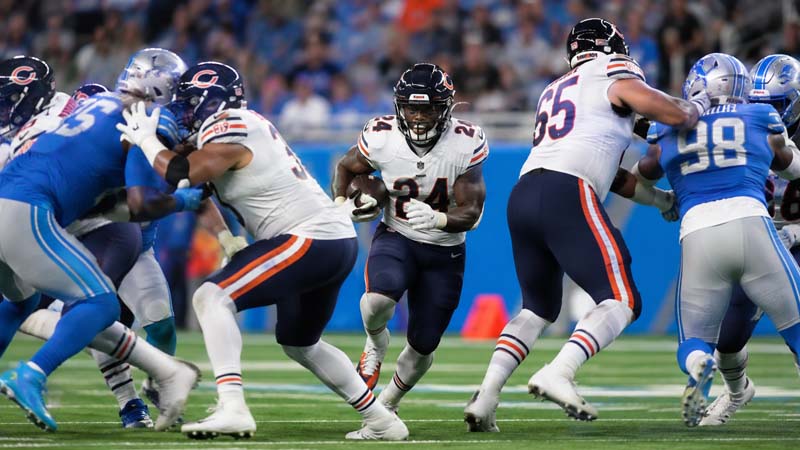
In the high-stakes landscape of modern football, where defensive schemes have become increasingly complex and athletes more specialized, one concept remains the bedrock of offensive success: the zone run. To the casual observer, a running play might look like a chaotic collision of bodies.
To the professional analyst, however, the zone run is a masterpiece of synchronized movement, geometry, and intuition.
The transition from traditional “man-to-man” blocking to a zone-based system represents one of the most significant shifts in the history of the sport.
It moved the game away from a contest of pure individual strength toward a collective, area-based philosophy that prioritizes spatial awareness and timing.
Understanding the mechanics of this play is essential for anyone looking to grasp how the modern ground game operates at the highest levels of the NFL and collegiate athletics.
The Philosophy of Area Responsibility
At its core, a zone run is defined by its departure from traditional assignments. In an “iso” or “power” scheme, every offensive lineman is tasked with blocking a specific defender.
If that defender moves, the lineman must follow. In a zone run, the offensive line blocks an area, or “zone,” rather than a specific jersey number.
This shift in philosophy simplifies the mental load for the offensive line while simultaneously complicating the math for the defense.
When the ball is snapped, every lineman steps in the same lateral direction in unison. This collective movement creates what coaches often refer to as a “moving wall”.
By moving together, the line exerts lateral pressure on the defensive front, forcing defenders to either hold their ground and get washed away or “flow” with the line, which inevitably opens up lanes elsewhere.
The beauty of the zone scheme lies in its adaptability. Because the linemen are responsible for a space, they are prepared to handle stunts, blitzes, and defensive shifts in real-time.
If a defender enters a lineman’s designated zone, he is blocked; if the defender moves out of that zone, the lineman moves on to the next threat.
The Mechanics of the Offensive Line
The success of a zone run is dictated by the first three steps of the offensive linemen. This is where the technical precision of the “moving wall” is established.
Coordinated Lateral Steps
The hallmark of the zone run is the initial “bucket step” or lateral reach step. All five linemen move as a single unit toward the play side. This synchronized movement is designed to do two things:
- Cut off penetration: By stepping laterally, the linemen prevent defenders from “shooting the gap” and disrupting the play in the backfield.
- Establish leverage: The goal is to get the lineman’s head across the defender’s frame, effectively “hooking” them and sealing them away from the intended path of the ball.
The Art of the Double Team and the “Climb”
One of the most sophisticated elements of zone blocking is the vertical movement of the line. Linemen frequently engage in double teams on defensive tackles.
However, these are not static blocks. As the “moving wall” shifts laterally, one of the linemen in the double team will keep an eye on the second level of the defense—usually a linebacker.
Once the defensive lineman is neutralized or moved off his spot, one of the offensive linemen will “spin off” or “climb” to the linebacker.
This ensures that the defense cannot simply fill the gaps with unblocked players from the secondary levels. The timing of this transition is the difference between a three-yard gain and a twenty-yard explosive play.
Variants of the Zone Scheme: Inside vs. Outside
While the underlying principles remain the same, the zone run is typically categorized into two primary variations: Inside Zone and Outside (or Wide) Zone. Each requires a different focus and a different style of execution.
The Inside Zone: Verticality and Power
In an Inside Zone scheme, the offensive line focuses on the interior gaps—the spaces between the center and the guards. The objective here is to create a North-South push.
- The Approach: The linemen are more aggressive with their vertical push, attempting to displace the defensive tackles backward.
- The Runner’s Goal: The running back aims for a tight path, looking to hit a crease and go straight upfield or make a quick vertical cut. It is a game of inches and power, relying on the line to create a small “bubble” of space in the heart of the defense.
The Outside (Wide) Zone: Stretching the Perimeter
The Outside Zone is an exercise in lateral stress. The offensive line moves aggressively toward the sideline, aiming to “stretch” the defense horizontally.
- The Approach: The goal is to reach the edge of the formation. Linemen are less concerned with pushing defenders backward and more focused on running them toward the sideline.
- The Runner’s Goal: The runner attacks the edge of the defense. This forces the linebackers to sprint laterally to maintain their gap integrity. As the defense stretches, natural seams begin to open up between the defenders. The runner must then decide whether to “bounce” the play to the far outside, “punch” through a widening gap, or “cut back” against the momentum of the pursuit.
The Running Back’s Role: Vision and Decision-Making
If the offensive line provides the engine, the running back provides the steering. In a zone scheme, the runner cannot be a “track” runner—meaning they cannot simply run to a predetermined spot and hope for the best. Instead, they must possess elite patience and vision.
The runner’s job begins by tracking the flow of the defenders. As the line moves laterally, the back is watching the “keys”—usually the movements of the defensive ends and inside linebackers. The back is looking for the “crease,” the specific moment when a defender over-commits or a lineman wins a leverage battle.
The Three Pillars of Choice: Bang, Bend, or Bounce
Professional coaching clarifies the runner’s decision-making process into three distinct options:
- Bang: If the offensive line creates a clear vertical crease in the intended path, the runner “bangs” it straight ahead, maximizing the yardage by getting upfield immediately.
- Bend: If the defense flows too aggressively toward the play side, a massive gap often opens up on the “backside” of the play. The runner will “bend” or cut back against the grain, often finding themselves in open space with only a safety to beat.
- Bounce: If the interior is clogged but the linemen have successfully sealed the edge, the runner will “bounce” the play to the extreme outside, using their speed to outrun the defense to the corner.
This “read-and-react” requirement is why the zone run is so difficult to stop. Even if a defense plays the initial front perfectly, a single linebacker taking a bad step can lead to a cut-back lane that the runner is trained to exploit.
Conclusion: The Future of the Ground Attack
The zone run is more than just a play; it is a tactical philosophy that has redefined the expectations for offensive players. It demands that linemen be as agile as they are strong and that running backs be as cerebral as they are explosive.
By leveraging the “moving wall” and the “bang, bend, or bounce” decision-making process, offenses can stay ahead of the curve, forcing defenses to defend every blade of grass from sideline to sideline.
Whether it is the quick-hitting Inside Zone or the defense-stretching Wide Zone, this scheme remains the most effective way to control the clock, move the chains, and dictate the physical tone of a football game.
As the sport continues to evolve, the zone run will undoubtedly remain the gold standard for ground-game efficiency.