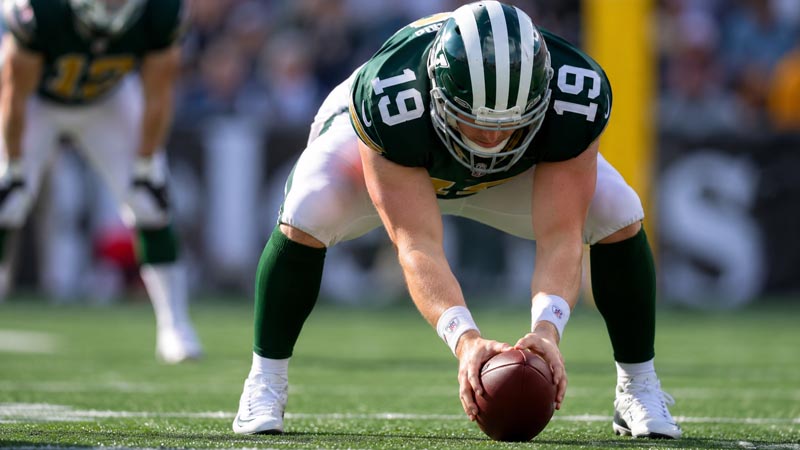
In modern professional football, quarterbacks, receivers, and pass rushers receive most of the attention, but the long snapper plays a crucial role away from the spotlight.
Responsible for delivering precise, consistent snaps during punts and field goals, the long snapper must combine accuracy, timing, athleticism, and mental toughness.
A single mistake can lead to blocked kicks, turnovers, or game-changing touchdowns, while flawless execution often goes unnoticed.
Despite limited playing time, long snappers are highly specialized athletes whose performance directly affects special teams.
Their success is measured not by fame or statistics, but by reliability, precision, and remaining invisible on game day.
The Micro-Mechanics of the Perfect Snap
At its core, the job of a long snapper sounds deceptively straightforward: deliver the football backward to a waiting teammate. However, the physical reality of this task is a marvel of kinetic chain efficiency and absolute precision.
Traditional offensive centers snap the ball to a quarterback who is either directly under center or positioned just a few yards back in a shotgun or pistol formation. The long snapper, however, must launch the ball over significantly greater distances:
- For Field Goals and Extra Points: The ball must travel exactly 7 to 8 yards backward, landing precisely in the hands or chest of the kneeling holder.
- For Punts: The ball must travel roughly 15 yards backward, arriving perfectly in the chest area of the punter.
The Speed Threshold: 0.75 Seconds
In the NFL, space and time are compressed to microscopic margins. On a punt play, an oncoming rush can overwhelm the protection scheme in a heartbeat.
Therefore, the industry standard for an elite punt snap is incredibly demanding: the ball must cover that 15-yard distance with a tight, aerodynamic spiral in under 0.75 seconds.
To achieve this speed, a long snapper cannot merely “hike” the ball; they must effectively throw a maximum-velocity pass upside down, looking backward through their own legs.
The movement requires the coordination of the entire body. The energy must transfer from the feet, up through the lower body, through the core, and out through the shoulders, arms, and wrists, culminating in a violent flick of the fingers to generate a high-RPM spiral.
The Physical Challenge of Unnatural Movement
This throwing motion is fundamentally unnatural. The human body is not structurally designed to generate high-velocity, pinpoint-accurate overhead-style throws while bent completely double, staring at the sky upside down.
Because of this physical anomaly, perfecting the motion requires years of highly specialized muscle memory development.
On field goal attempts, the challenge shifts from pure velocity to extreme target control. The snapper must deliver the ball with the exact number of rotations so that when the holder catches it, the laces are already facing away from the kicker.
If the snap is off by even a few inches, or if it arrives with the laces facing the wrong way, the kicker’s approach is compromised, and the entire play can fall apart.
The Dual Responsibility: Transitioning from Snapper to Protector
Many spectators assume that once the ball is snapped, the long snapper’s job is finished. In reality, the release of the ball is merely the opening second of a multi-phased physical battle.
Unlike quarterbacks, who are protected by strict safety rules after throwing a pass, the long snapper is instantly subjected to physical contact. Because they are legally part of the offensive line, they carry critical blocking and coverage responsibilities:
The Interior Line Battle
On field goal and extra-point attempts, the defense will routinely attempt to exploit the split-second vulnerability of the center of the line. When a long snapper delivers the ball, their head is down, their center of gravity is low, and their arms are extended backward.
Defenses will intentionally overload the middle gaps with multiple physical rushers, aiming to overpower the snapper before they can fully stand up, establish a base, and prepare for a collision.
To counter this, the long snapper must possess elite recovery mechanics. They must snap the ball and immediately snap their head back up, widen their stance, drop their hips, and bring their hands into a defensive blocking position.
Failure to execute this transition in a fraction of a second allows defenders a direct path to the backfield to block the kick.
Punt Coverage and Downfield Sprints
On punt plays, the physical demands change entirely. The long snapper cannot simply hold their ground; they must actively participate in downfield coverage. After delivering a 15-yard snap and briefly checking the interior rush, the snapper must burst into a full-field sprint.
Because they line up in the center of the formation, they often have an unobstructed path down the middle of the field, making them one of the primary “gunners” responsible for shedding blocks, tracking the returner, and making open-field tackles, or stopping the ball before it bounces into the end zone.
This requires a level of straight-line speed and open-field tackling ability that is highly unusual for traditional offensive linemen.
The Athletic Profile: Balance, Strength, and Psychological Steel
Elite long snappers are highly specialized athletes with physical and mental traits tailored specifically to this demanding role.
1. Core Balance and Body Control
The foundational athletic trait of a premier snapper is exceptional balance. Stating a play in a deep knee bend while looking backward requires a highly developed vestibular system and strong stabilizing muscles.
The athlete must generate maximum rearward force while maintaining their footing, ensuring they do not tumble backward or lose their balance when struck by a defender.
2. Power Distribution: Upper-Body Torque and Lower-Body Anchors
While arm and shoulder strength are vital for generating the velocity needed to cut through wind, rain, and snow, the real power engine is the lower body. The glutes, hamstrings, and quadriceps act as the physical anchor.
This lower-body stability allows the athlete to absorb head-on rushes from 300-pound defensive tackles immediately after releasing the ball.
| Athletic Trait | Technical Requirement | On-Field Outcome |
|---|---|---|
| Balance | Rapid shift from bent posture to upright stance | Prevents falling; enables immediate blocking |
| Upper-Body Strength | Explosive chest, shoulder, and wrist rotation | High-velocity, tight spiral snaps |
| Lower-Body Anchor | Deep core and leg power stabilization | Solid blocking base; resists defensive bull-rushes |
| Pinpoint Accuracy | Repeatable release point under pressure | Holder or punter captures ball without moving |
3. High-Pressure Psychological Profile
Perhaps the most overlooked element of the position is mental resilience. A quarterback can throw an interception in the first quarter and have three subsequent drives to redeem themselves.
A long snapper does not have the luxury of multiple downs to correct a mistake. They may only step onto the field five or six times a game, but every single repetition is a high-leverage moment.
The position demands a quiet, unflappable focus. The athlete must block out crowd noise, freezing weather conditions, and the immense pressure of game-defining moments (such as a game-winning field goal attempt with two seconds left on the clock) to deliver a perfectly rotated, perfectly placed ball.
The Historical Evolution of the Specialist
The rise of the dedicated long snapper is a fascinating case study in NFL roster optimization and tactical evolution.
The Pre-1970s Double Duty
For the first several decades of professional football history, specialized long snappers simply did not exist. Roster sizes were smaller, and versatility was highly prized.
The starting offensive center was expected to handle all snapping duties, whether they were launching a shotgun snap, hand-delivering the ball to a quarterback under center, or snapping for a punt or field goal on special teams.
Because these starting centers were optimized primarily for run and pass blocking against defensive tackles, their special teams snaps were often slower and less precise.
Coaches accepted a higher rate of bobbled snaps and blocked kicks as a natural cost of doing business.
George Allen’s Special Teams Revolution
The landscape of the NFL changed permanently in the early 1970s, spearheaded by legendary Washington head coach George Allen. Allen was a visionary who recognized that games were frequently won or lost on the margins of special teams play.
He realized that a dedicated specialist, trained exclusively to snap the ball with maximum velocity and accuracy, could give his team a decisive competitive advantage.
Allen made history by signing George Burman explicitly to serve as a designated long snapper. This tactical innovation raised the bar for special teams execution across the league.
Opposing coaches quickly realized they could no longer afford to use converted centers or backup tight ends for these high-stakes plays.
Over the subsequent decades, the position underwent complete standardization. Today, the evolution is absolute: every single one of the 32 NFL franchises carries a dedicated long snapper on their active 53-man roster.
The Economics and Honors of Modern Snapping
While long snappers may not receive the astronomical contracts of quarterbacks or left tackles, they enjoy highly respectable, stable professional careers with impressive compensation structures.
NFL Salaries and Contract Milestones
The baseline economics of the position reflect the high value NFL front offices place on operational consistency:
- Average Salary: The average professional long snapper earns just over $1 million annually.
- The 2024 Salary Range: Salaries for active NFL snappers in 2024 range from $795,000 up to $1.553 million.
- Historic Contracts: In September 2023, the Indianapolis Colts solidified the financial ceiling of the position by signing veteran Luke Rhodes to a historic four-year contract extension worth $6.465 million, making it the richest deal ever recorded for the position.
- Top Earners: New England Patriots veteran Joe Cardona stood as the highest-paid active long snapper in the league for the 2024 season, with a salary of just over $1.5 million.
For franchises, dedicating roughly 1% of their total salary cap to ensure perfect operation on field goals, extra points, and punts is considered a highly cost-effective insurance policy against disastrous special teams errors.
Draft Capital Trends
Because the talent pool is highly specific and teams often prefer experienced veterans, NFL front offices rarely use valuable draft selections on long snappers. However, there are notable historical exceptions:
- Todd Thomas (1981): Selected by the Kansas City Chiefs in the fifth round, Thomas was the first player drafted specifically for his snapping capabilities.
- Patrick Mannelly (1998): Drafted by the Chicago Bears, Mannelly went on to play an incredible 16 seasons in Chicago, establishing himself as a legend of the position and the namesake of college football’s premier long snapping award.
- Camaron Cheeseman (2021): Selected in the sixth round by Washington, Cheeseman represents the most recent draft pick dedicated to the position, with no snappers selected in the subsequent three drafts.
The Path to Recognition and Accolades
Though historically overlooked, the football community has established formal avenues to recognize the contributions of these silent specialists:
- The Pro Bowl: In 2004, Kendall Gammons of the Kansas City Chiefs became the first recorded long snapper to earn a Pro Bowl selection. Since then, highly respected players like Tyler Ott, Rick Lovato, Brian Jennings, and Jon Dorenbos have joined the ranks of Pro Bowl alumni.
- The All-Pro Team: The ultimate validation of the position came in 2020, when the NFL officially added long snapper as an All-Pro position. Baltimore’s Morgan Cox made history as the first-ever first-team All-Pro long snapper. More recently, Ross Matiscik (Jacksonville Jaguars) and Andrew DePaola (Minnesota Vikings) have earned All-Pro honors.
- The College Level: The best collegiate snappers in the nation compete annually for the prestigious Patrick Mannelly Award, elevating the profile of the position for the next generation of athletes.
Conclusion: The Silent Guarantee
The story of the NFL long snapper is a testament to the beauty of operational perfection. In a sport defined by collision, chaos, and unpredictability, these athletes are asked to deliver absolute, unyielding consistency.
They step onto the field, bend down, stare backward, and deliver a silent guarantee of a perfect snap, over and over again.
While children playing youth football may not dream of growing up to be long snappers, the professional ranks have made it clear: you cannot win championships without them.
They are the ultimate team players—sacrificing personal glory for the collective success of the unit, and finding their greatest professional satisfaction in a job so well executed that nobody even noticed they were there.