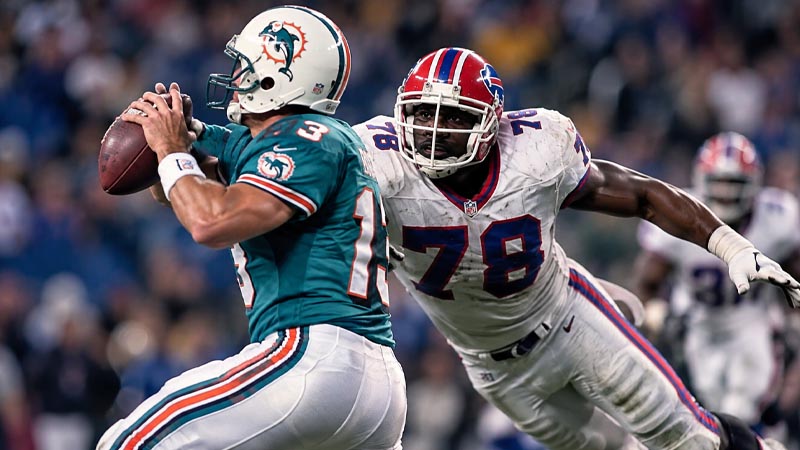
In the modern landscape of professional football, defensive architecture has undergone a massive paradigm shift.
As offensive schemes have evolved to favor high-tempo, spread passing concepts, the value of traditional, specialized defensive positions has changed.
To counter this offensive explosion, defenses have had to cultivate a highly versatile, explosive category of defender: the Edge Rusher.
Once considered a luxury or an occasional tactical adjustment, the edge rusher is now the undisputed cornerstone of the modern defensive front.
This analysis delivers an in-depth, professional evaluation of the edge rusher role, detailing their dual responsibilities, tactical scheme alignments, historical pioneers, mechanical toolboxes, and the physical blueprints required to dominate at the highest level.
Defining the “Edge” Role
To understand this position, one must first recognize that “Edge Rusher” (often simply referred to as “EDGE”) is an umbrella term rather than a single, fixed position on an official roster. It describes a functional role: a defensive player who lines up on the outermost boundaries of the line of scrimmage, positioned to the outside of the final offensive player—typically an offensive tackle or a tight end.
The primary mandate of an edge rusher is twofold:
- Disrupt the Passing Game: Explode past blockers to hit, hurry, or sack the quarterback.
- Contain the Running Game: Secure the perimeter by forcing outside running plays back inward toward the interior defensive core.
Depending on a franchise’s defensive philosophy, this hybrid role is typically filled by either a traditional Defensive End (DE) or a stand-up Outside Linebacker (OLB). The designation is fluid; a premier player in this role must possess the positional flexibility to adapt to various alignments, occasionally sliding inside to exploit interior mismatches during exotic pass-rushing packages.
Tactical Alignment: The 4-3 Base vs. The 3-4 Base
The physical alignment and specific technique of an edge rusher are dictated by the team’s base defensive scheme. The NFL primarily utilizes two defensive foundations: the 4-3 front and the 3-4 front.
                     4-3 DEFENSIVE BASE FRONT
      OLB              ILB              OLB      <-- Linebackers (Stand-up)
   DE(EDGE)     DT              DT     DE(EDGE)  <-- Defensive Line (3/4-Point Stance)
------------------- LINE OF SCRIMMAGE -------------------
   [OT]        [OG]    [C]     [OG]    [OT]      <-- Offensive Line


                     3-4 DEFENSIVE BASE FRONT
OLB(EDGE)                               OLB(EDGE) <-- Linebackers (2-Point Stance)
        DE             NT             DE         <-- Defensive Line (3/4-Point Stance)
------------------- LINE OF SCRIMMAGE -------------------
   [OT]        [OG]    [C]     [OG]    [OT]      <-- Offensive Line
1. The 4-3 Defense: The Hand-in-the-Dirt Specialist
In a traditional 4-3 scheme—which features four down linemen and three linebackers—the edge rusher role is occupied by the Defensive Ends (DE).
- Stance: These players typically line up in a three-point stance (one hand touching the ground) or a four-point stance (both hands touching the ground).
- Physical Profile: Defensive ends in a 4-3 are generally larger and heavier than linebackers, though they remain smaller and more agile than interior defensive tackles. This size is essential because they are tasked with absorbing direct blocks from offensive tackles on every single snap.
- Responsibilities: Because they are positioned on the line, their primary path is direct and linear. They rarely drop into pass coverage, focusing almost exclusively on setting a physical boundary against the run and executing pass rushes.
2. The 3-4 Defense: The Stand-up Hybrid
In a 3-4 defensive scheme—consisting of three down linemen and four linebackers—the edge rusher responsibilities transition to the Outside Linebackers (OLB).
- Stance: These defenders typically operate from a two-point stance (standing upright in an athletic position). Standing allows them to survey the entire offensive formation and keeps their intentions hidden.
- Physical Profile: Outside linebackers in a 3-4 are highly athletic hybrids who combine the size of a smaller defensive end with the speed and spatial awareness of a linebacker.
- Responsibilities: The 3-4 edge rusher has dual responsibilities. On any given play, they must be prepared to drop back into pass coverage to guard tight ends or running backs, hold the perimeter on running plays, or blitz the quarterback. By frequently creeping up to the line of scrimmage before the snap, they keep the offensive line guessing and act as a constant blitz threat.
Running Game Mechanics: The Art of “Setting the Edge”
While high-flying pass rushes dominate highlight reels, an edge rusher’s disciplined play against the run is what keeps them on the field. This duty is universally known in coaches’ meeting rooms as “setting the edge”.
When an offense calls an outside run play—such as a sweep, toss, or stretch—the ball carrier wants to bounce the run to the outside perimeter where they can use their speed in open space. The edge rusher’s absolute priority is to stop this outside progression.
To accomplish this, the defender must execute a series of physical keys:
- Maintain Outside Leverage: The edge rusher must line up and strike the blocker in a way that keeps their own body positioned outside of the blocker’s outermost shoulder.
- Shedding and Funneling: If the edge rusher cannot make the tackle directly, they must use physical hand techniques to hold their ground, squeeze the running lane, and force the ball carrier back toward the inside of the field. This funnels the runner directly into the waiting arms of the interior defensive tackles and inside linebackers.
- Disastrous Failures: If an edge rusher gets blocked too far inside, the edge is “cracked,” opening up a massive rushing lane along the sideline and leading to explosive plays for the offense.
Passing Game Mechanics: Isolating the Pocket
Passing plays are where the modern edge rusher truly dictates the terms of the game. Because they line up out wide, they isolate the offense’s outermost blockers—offensive tackles and tight ends—in one-on-one matchups in open space.
                     PASS-RUSH ISOLATION MAP
                        [Quarterback]
                             ^
                             |  (Deep Pocket)
                    [OT]     |     [OT]
                     ^       |      ^
       Speed Angle /         |       \ Inside Counter Lane
                  /          |        \
             [EDGE]                    [EDGE]
This isolation allows the defender to leverage superior speed and explosive agility against blockers who are typically much heavier.
Because offensive tackles must travel a significant distance outward to match a wide alignment, the edge rusher can manipulate the block, opening up direct rushing lanes to the quarterback or clearing paths for interior loopers in stunt concepts.
Additionally, the role requires elite pursuit capability. When a play breaks down, or if the offense executes a screen pass or a rollout, the edge rusher must rely on pure closing speed to hunt down running backs or scrambling quarterbacks from behind.
The Technical Pass-Rushing Toolbox
To survive the hand-to-hand combat along the line of scrimmage, elite defenders rely on a deeply cultivated arsenal of physical moves.
The battle is won through hand placement, leverage, and lateral quickness. Three classic techniques form the foundation of every professional rusher’s toolbox:
1. The Speed Rush
The most direct path to the quarterback is simply outrunning the blocker around the corner.
- Execution: The defender relies on an explosive first step to gain immediate upfield verticality. As they reach the depth of the pocket, they dip their inside shoulder, bend around the offensive tackle, and use their hands to push the blocker’s hands away, closing the distance to the quarterback.
2. The Rip Move
The rip is designed to exploit a blocker who has overextended their arms or attempted to punch too early.
- Execution: The defender rushes at the “half-man” (attacking one-half of the blocker’s body to avoid a chest-to-chest confrontation). They dip their body, drive their inside arm in an upward uppercut motion underneath the blocker’s extended shoulder, and forcefully lift the blocker’s arm out of the way, creating an open lane to bend around the corner.
3. The Swim Move (The Arm Over)
A finesse technique that uses the blocker’s forward momentum against them.
- Execution: The rusher first uses a quick hand jab or head fake to make the blocker commit their weight forward. Once the blocker lunges, the defender uses one hand to slap down the blocker’s hands, disengaging the block, and sweeps their opposite arm over the blocker’s shoulder in a swimming motion to glide past them into the backfield.
The Physical Blueprint: Arm Length and Athletic Profile
NFL front offices spend millions of dollars scouting the precise physical traits required to sustain high-level performance in the trenches.
While height and weight are important, the secret metric that separates average prospects from elite edge rushers is arm length.
- The 33-Inch Threshold: In the NFL, scouts typically view 33 inches as the baseline minimum arm length for a premier edge rusher.
- The Physics of Arm Length: Long arms function as physical levers. When a 300-plus-pound offensive lineman lunges forward to block, an edge rusher with long arms can make contact first, striking the chest plate of the lineman and keeping the blocker’s massive hands off their own body. This allows the defender to control the point of attack, shed blocks quickly, and maintain the separation needed to execute pass-rush moves.
- First-Step Explosiveness: Outstanding speed out of their stance is paramount. The faster a defender can close the gap, the more stress they put on the tackle’s footwork.
- Football IQ: Elite edge rushers must possess the cognitive speed to read a tackle’s stance, anticipate the play design, and counter the blocker’s leverage within a split second of the snap.
Historical Pioneers: Crafting the Modern Position
The modern edge rusher role is not an overnight invention; it is the result of decades of defensive innovation, spearheaded by two of the most disruptive players in football history.
1. Deacon Jones: The Father of the “Sack”
In the 1960s and 1970s, Hall of Fame defensive end Deacon Jones revolutionized defensive line play while starring for the Los Angeles Rams.
- At 6-foot-4 and 274 pounds, Jones possessed rare speed that allowed him to chase down ball carriers from behind.
- The Rams originally struggled to find a single, natural position for Jones, ultimately placing him at defensive end to leverage his rare pass-rushing ability.
- Jones is famously credited with inventing the word “sack” to describe tackling a quarterback behind the line of scrimmage (previously called a “tackled for a loss”). He popularized the term after a pregame speech by coach George Allen, who motivated his team by saying they were going to dump the opponent’s quarterback “into a sack”.
2. Lawrence Taylor: The Ultimate Blueprint
In the 1980s, New York Giants linebacker Lawrence Taylor altered the strategic landscape of the NFL forever.
- Taylor lined up all over the field, frequently setting up as a stand-up edge defender outside the last man on the line.
- His unmatched explosiveness, physical violence, and relentless pursuit disrupted offensive game plans, forced offenses to invent maximum protection schemes, and redefined the value of the blindside tackle.
- Taylor is universally recognized as the pioneer who bridged the gap between linebacker and defensive end, effectively creating the modern edge rusher position.
Battle Gear: The High-Contact Equipment Suite
Because edge rushers engage in high-impact collisions on every play, their choice of gear is vital for safety, leverage, and performance.
- Padded Lineman Gloves: Because the initial point of contact with an offensive lineman is hand-to-hand, thick, durable gloves are non-negotiable. Elite rushers wear heavy-duty gloves featuring extra padding across the knuckles and palms to protect their hands during heavy strikes.
- Mid- to High-Cut Cleats: Operating along the perimeter requires extreme ankle stability. To support a player weighing over 250 pounds who must plant their foot at extreme angles to sprint downfield, mid- or high-cut cleats are utilized to provide optimal ankle support without sacrificing essential flexibility.
- Compression Baselayers: To maximize range of motion while managing body temperature, players wear advanced, sweat-wicking compression layers beneath their armor. This gear is engineered to stretch in every direction, preventing bunching and helping players move dynamically in cold or hot weather.
Beyond the Sack: Evaluating Modern Defensive Value
Traditionally, the quality of a pass rusher was evaluated strictly by basic box-score metrics: sacks and tackles for loss. While these numbers remain valuable, modern defensive analytics have revealed that raw sack totals only tell a fraction of the story.
True evaluation now focuses on consistency and disruption. Key metrics include:
- Quarterback Pressures and Hurries: How often a defender forces the quarterback to throw the ball before they are ready, disrupting the offensive timing and leading to turnovers.
- Pass-Rush Win Rate: How quickly a defender beats their blocker (typically measured as beating the block in under 2.5 seconds). A defender who consistently wins their matchup within this window creates massive structural problems for the offense, even if the quarterback manages to release a quick pass before a sack can occur.
Conclusion: The Premium Position
The NFL is a passing league, and the most effective way to slow down a high-powered passing attack is to disrupt the quarterback’s timing from the outside.
By combining the speed of a linebacker with the physical power of a defensive lineman, the edge rusher has become the ultimate equalizer on defense.
Whether they are setting a physical perimeter against a run or executing a technically flawless swim move on third down, the edge rusher’s ability to dominate the boundary is what decides championships in today’s game.