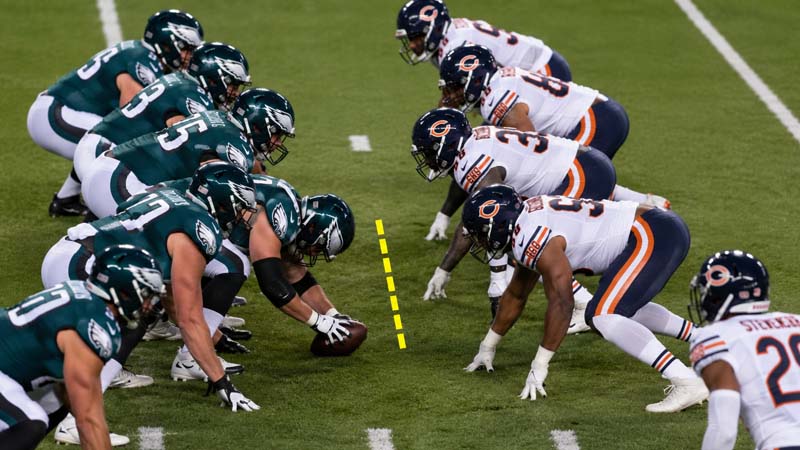
In the high-stakes environment of professional football, the moments immediately preceding the snap of the ball are filled with intense psychological warfare.
Linemen on both sides of the ball stand coiled like springs, waiting for the slightest cue to launch themselves forward. When a player jumps too early, a whistle blows, a yellow flag flies, and the referee delivers a ruling that can alter the momentum of an entire drive.
To the casual observer, almost any pre-snap jump by the defense is labeled as “offside”. However, official rulebooks make precise distinctions between different pre-snap infractions.
Among these, the Neutral Zone Infraction (NZI) is one of the most common, yet frequently misunderstood, penalties in the game.
Understanding the technical mechanics of this rule, how it differs from neighboring infractions, and how it governs player behavior is essential for anyone looking to truly master the tactical nuances of football.
Defining the Neutral Zone: The Invisible Gridiron Boundary
To understand why a neutral zone infraction occurs, one must first understand the physical territory where the infraction takes place.
The neutral zone is an invisible, temporary boundary established by the officials before every single play from scrimmage.
Under official rules, this zone is defined as the invisible area stretching between the two tips of the football before the snap. Consequently, the physical width of the neutral zone is exactly equal to the length of the football itself.
This small, highly contested space acts as a buffer between the offensive team and the defensive team:
- The forward tip of the football represents the defensive line of scrimmage.
- The rear tip of the football represents the offensive line of scrimmage.
Until the ball is legally snapped, no player from either team is permitted to enter or occupy this zone, with a few highly specific exceptions regarding how players align themselves before the play begins.
Because the entire offensive and defensive lines are packed tightly together, a margin of mere inches separates a legal pre-snap stance from a five-yard penalty.
The Mechanics of a Neutral Zone Infraction (NZI)
A neutral zone infraction is a specific 5-yard penalty assessed against the defensive team.
It occurs when a defender illegally enters the neutral zone before the ball is snapped and triggers one of two specific scenarios.
The Flinch Trigger
The most common scenario for a neutral zone infraction involves a chain reaction of player movement:
- The Trigger: A defensive player prematurely jumps, lunges, or reaches into the neutral zone prior to the ball being hiked.
- The Reaction: This sudden, aggressive movement by the defender occurs in proximity to an offensive player. Seeing the defender enter the neutral zone, an offensive lineman or nearby offensive player flinches or reacts defensively. This movement by the offensive player would normally constitute a false start.
- The Ruling: Because the defensive player’s illegal entry into the neutral zone directly caused the offensive player to react, the referees do not penalize the offense. Instead, they penalize the defense for causing the reaction. The play is blown dead immediately by the officials, representing a dead-ball foul.
This rule exists to protect the offense from being unfairly penalized for natural self-preservation instincts.
If a defender leaps across the line directly at an offensive tackle, the tackle’s instinct is to flinch or block to protect themselves. The neutral zone infraction rule ensures the initiating team bears the penalty.
The Unimpeded Path Trigger
A neutral zone infraction can also be called without any reaction from the offensive line. If a defensive player jumps across the line of scrimmage before the snap and has an unimpeded path to the backfield, the officials will blow the play dead immediately and assess a neutral zone infraction against the defense.
In this scenario, the play is stopped for safety and competitive fairness. Allowing a defender to run completely unchecked into the backfield before the ball is even snapped would create an incredibly dangerous situation for the quarterback and disrupt the entire structure of the play.
The Pre-Snap Trio: Neutral Zone Infraction vs. Offside vs. Encroachment
Part of the confusion surrounding pre-snap penalties stems from the fact that three distinct infractions—Neutral Zone Infraction, Offside, and Encroachment—all deal with players illegally crossing the line of scrimmage.
While all three result in a 5-yard penalty, their triggers and administrative mechanics differ significantly.
| Penalty Type | Initiating Team | Key Trigger | Play Status (Live vs. Dead) |
|---|---|---|---|
| Neutral Zone Infraction | Defense | Defender enters neutral zone, causing nearby offensive player to flinch OR has an unimpeded path to backfield. | Dead Ball (Play is blown dead immediately). |
| Offside | Defense (typically) | Defender is past the line of scrimmage at the exact moment the ball is snapped, without causing a pre-snap reaction. | Live Ball (Play continues; penalty can be declined). |
| Encroachment | Defense | Defender enters neutral zone and makes direct physical contact with an offensive player or the ball before the snap. | Dead Ball (Play is blown dead immediately). |
Deep Dive: Offside
A defensive player is ruled offside when they are positioned beyond the line of scrimmage at the exact moment the ball is snapped. The critical distinction between offside and a neutral zone infraction is the timing and the reaction of the offense.
If a defender jumps early into the neutral zone but does not cause an offensive player to flinch, and does not have an unimpeded path to the quarterback, they have technically committed a pre-snap violation.
However, if they cannot get back to their side of the line before the ball is snapped, they are offside at the moment of the snap.
Because no pre-snap reaction occurred, the officials do not blow the whistle. This remains a live-ball penalty. The offense is allowed to run the play, creating what is commonly referred to as a “free play.”
If the offense completes a deep pass or scores a touchdown, they can decline the offside penalty and take the result of the play. If the play results in an interception or an incomplete pass, the offense can accept the 5-yard penalty and replay the down.
Deep Dive: Encroachment
Encroachment is a strictly defined dead-ball foul. It occurs when a defender crosses the line of scrimmage and makes direct physical contact with an offensive player or the football before the snap actually occurs.
Unlike a neutral zone infraction, which relies on the offensive player flinching in response to defensive movement, encroachment is triggered solely by physical contact. The moment contact is made, the play is dead, the whistle is blown, and the defense is penalized 5 yards.
The Safety Exception: Unabated to the Quarterback
There is a specific variation of offside known as offside, unabated to the quarterback. While standard offside is a live-ball foul, this variation is treated as a dead-ball foul.
If a defender jumps across the line of scrimmage so early or so cleanly that they have a completely free, uninterrupted run at the quarterback, the officials will refuse to let the play proceed.
To prevent the quarterback from absorbing a highly dangerous, unexpected hit, the referees will blow the whistle immediately, kill the play, and assess a 5-yard penalty against the defense.
Why There is “No Such Thing as a Defensive False Start”
A common question among those learning the complexities of the sport is why a defender who jumps early is not called for a “false start”.
Under official rules, there is no such thing as a defensive false start. The false start penalty is strictly reserved for the offensive team.
The reasoning for this asymmetry lies in the design of the game. The offense has a structural advantage: they know the snap count, and they dictate exactly when the play will begin. Because of this, offensive players are held to an incredibly strict standard of pre-snap discipline.
Once the offensive line is set, any sudden movement that simulates the start of the play is immediately penalized as a false start, and the play is blown dead.
The defense, on the other hand, must react entirely to the offense. Defensive players are allowed to shift, jump, wave their arms, and move around laterally behind their line of scrimmage before the snap without penalty.
A defensive player can even jump across the line of scrimmage into the neutral zone—provided they manage to jump back to their side of the line before the ball is snapped, without touching an opponent and without causing an offensive player to flinch.
If they fail to jump back in time, they are called for offside. If their jump causes an offensive player to react, they are called for a neutral zone infraction. But they can never be called for a false start.
The Offense and the Neutral Zone: Rules, Rights, and Restrictions
Given how strictly the defense is monitored around the neutral zone, one might wonder: can the offense commit a neutral zone infraction or encroach upon this space?
In professional football, the answer is no. The offense cannot commit a neutral zone infraction or encroachment.
This is because, by rule, offensive players are legally permitted to be in the neutral zone before the snap. When the offensive line lines up, their heads and shoulders naturally break the plane of the rear portion of the neutral zone as they get into their three-point stances.
Because of this legal presence, an offensive player cannot “infract” or “encroach” on the zone in the manner a defender does. Instead, the rules govern offensive pre-snap mistakes through a different set of penalties:
False Start
If an offensive player makes any abrupt, premature movement before the snap, it is ruled a false start.
This is a dead-ball foul that immediately halts the play and penalizes the offense 5 yards. Even if a defender was moving nearby, if the defender did not enter the neutral zone, any reaction by the offense is penalized as a false start.
Lining Up in the Neutral Zone (Offensive Offside)
The only way an offensive player can commit an infraction related to the neutral zone is by lining up incorrectly at the snap.
If any offensive player (other than the center, who must legally grip the ball) has any part of their body inside or beyond the neutral zone at the exact moment the ball is snapped, they will be called for offside. This is technically ruled as “lining up in the neutral zone”.
The Center’s Unique Status
The offensive center occupies a unique role on the field. Because the center must physically handle, grip, and snap the football, their hands and arms are legally permitted to rest inside the neutral zone before and during the snap. No other player on the field enjoys this privilege.
Other Pre-Snap Offensive Infractions
For a complete understanding of how the pre-snap phase is governed, it is helpful to outline the other common rules that apply to the offense before the ball is put into play:
- Illegal Formation: Under professional rules, the offense must have exactly seven players lined up directly on the line of scrimmage at the snap. Everyone else must be positioned in the backfield. Furthermore, eligible receivers cannot have ineligible offensive linemen lined up outside of them on the line. Failure to meet these alignment criteria results in a 5-yard penalty.
- Illegal Motion: Only one offensive player is permitted to be in motion at the time of the snap, and they must be moving parallel to or away from the line of scrimmage. If a player is moving forward toward the line of scrimmage when the ball is snapped, or if a lineman moves after being set, it is an illegal motion penalty.
- Illegal Shift: Once the offense breaks their huddle, all eleven players must come to a complete, coordinated stop and remain completely still (“set”) for at least one full second before the ball is snapped. If players shift positions and fail to reset for a full second, or if multiple players are in motion simultaneously at the snap, an illegal shift is called.
Just like false starts, all of these offensive pre-snap errors are 5-yard penalties that stop the play immediately.
Rules Differences: Professional vs. College Football (NCAA)
While the rules governing the neutral zone are highly standardized, there are notable differences when transitioning from professional rules to college football (NCAA) rules.
In college football, the concept of offensive encroachment actually exists. Under NCAA rules, once the offensive linemen have assumed their pre-snap positions on the line of scrimmage, they are not permitted to make sudden movements, nor can any offensive player make contact with a defender or enter the neutral zone illegally.
Furthermore, college football rules are generally much stricter regarding defensive players entering the neutral zone.
While a professional defender is sometimes allowed to jump into the neutral zone and quickly jump back (assuming they do not cause a reaction, touch anyone, or have an unimpeded path), college rules often blow the play dead the moment a defender crosses the plane of the neutral zone, regardless of whether a flinch occurred.
The Fan’s Guide to Colloquialisms: Is It All Just “Offsides”?
To the average fan, trying to distinguish between a neutral zone infraction, encroachment, and offside during a fast-paced game can feel overwhelming.
Indeed, even professional television commentators, sports journalists, and highly educated fans frequently use the term “offsides” as a broad, generic catch-all for any penalty involving a player crossing the line of scrimmage early.
If you are watching a game with friends or discussing a play online, no one is going to correct you if you refer to a neutral zone infraction as “offsides”.
Because the penalties are functionally very similar—resulting in a 5-yard march backward for the defense—the colloquial blending of these terms is widely accepted in football culture.
However, recognizing the technical differences allows you to appreciate the chess match of the game on a deeper level.
When you see a referee blow a play dead instantly, you know it was either encroachment (physical contact), a neutral zone infraction (causing a flinch or having an unimpeded path), or a false start (offensive movement).
When you see the refs let the play continue despite a defender jumping early, you can instantly recognize it as a standard offside, meaning the quarterback has a risk-free “free play” to throw a deep pass downfield.
Conclusion: Mastering the Pre-Snap Chess Match
The line of scrimmage is a boundary of immense tension, where games can be won or lost before a single yard is gained.
While a 5-yard penalty for a neutral zone infraction might seem minor in isolation, these infractions often occur at critical junctures—such as third-and-short situations where a 5-yard jump gives the offense an automatic first down.
By understanding the precise mechanics of the neutral zone, how a defender’s entry triggers an infraction, and the distinct differences between the pre-snap trio, fans can move past colloquial catch-alls and view the game with the analytical eye of a coach or strategist.
The next time you see a yellow flag fly before the snap, you will know exactly why the whistle blew and which player truly caused the infraction.