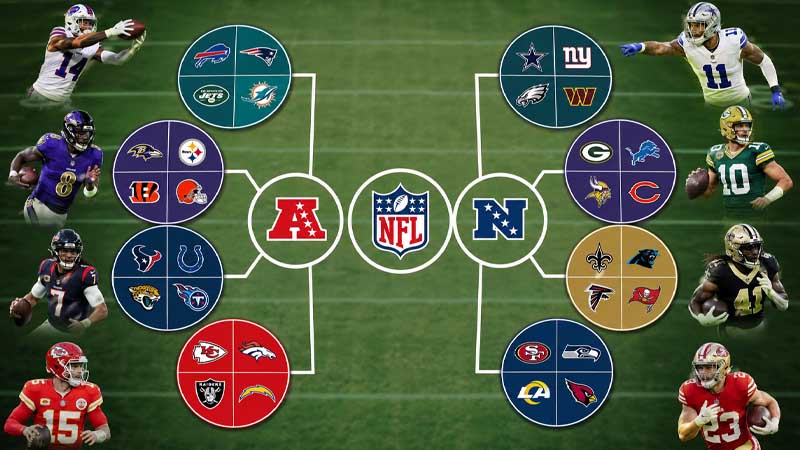
The National Football League represents the pinnacle of professional sports management, utilizing a highly calibrated organizational structure that balances competitive parity, commercial viability, and logistical efficiency.
For stakeholders ranging from casual observers to organizational analysts, understanding the mechanics of this system is essential to grasping how the league maintains its dominance in the global entertainment market.
The NFL is structured as a single entity composed of 32 teams, organized into a hierarchical framework designed to foster intense regional competition while ensuring a streamlined path to its championship game, the Super Bowl.
This analysis explores the architecture of the league’s conference and division system, examining how geographic considerations, historical legacy, and scheduling algorithms converge to create the most successful sports product in North America.
The Macro Structure: A Tale of Two Conferences
At the highest level of its organizational chart, the league is bifurcated into two distinct bodies: the American Football Conference (AFC) and the National Football Conference (NFC).
This 16-16 split is the foundational element of the league’s competitive balance, ensuring that exactly half of the teams are competing for the representative title of their respective conference.
While the two conferences operate under the unified governance of the league office, they serve as the primary filters for the postseason.
This binary system is not merely a naming convention; it is a structural necessity that allows the league to manage a vast number of teams across a continent-sized footprint.
By dividing 32 teams into two equal groups of 16, the league creates two parallel journeys that only intersect at the end of the season.
The Divisional Matrix: The 4x4x2 Architecture
Beneath the conference level lies the most granular and impactful layer of the league’s organization: the divisions.
Each conference is meticulously divided into four regional divisions: the East, North, South, and West.
This creates a perfectly symmetrical grid of eight divisions across the entire league, with each division containing exactly four teams.
This “four-by-four” symmetry is the engine of the league’s scheduling and playoff systems.
By maintaining a uniform number of teams in every division, the league ensures that every franchise faces a statistically similar path to the postseason. The divisional breakdown is as follows:
- AFC East, North, South, and West (16 teams total)
- NFC East, North, South, and West (16 teams total)
This rigid adherence to a four-team structure prevents the “power imbalances” seen in other professional leagues where divisions might have varying sizes, thereby ensuring that the mathematical probability of winning a division remains constant for every franchise at the start of the year.
The Logic of Placement: Geography vs. Historical Legacy
The methodology for assigning teams to specific divisions is a complex exercise in balancing operational costs with brand equity.
The league’s primary objective in divisional placement is Geographic Grouping. By clustering teams based on their physical location, the league achieves several key strategic goals:
- Minimized Travel Burdens: Reducing the flight miles and time zone shifts for athletes is essential for maintaining high-level performance and player safety.
- Operational Efficiency: Lower travel requirements translate to reduced overhead costs for team operations.
- Sustainability: Less travel contributes to a smaller carbon footprint for the league’s weekly logistics.
However, the organization also recognizes that the value of the sport is often tied to long-standing emotional narratives.
Therefore, the league allows for occasional historical exceptions where teams are kept in divisions that might not be the most geographically logical but are essential for maintaining “traditional rivalries”.
The Competitive Engine: Scheduling and the Divisional Cycle
The division is not just a grouping on a map; it is the primary driver of a team’s annual schedule.
To foster local engagement and high-stakes competition, the league mandates that each team plays the other three members of its division twice a year—once at their home stadium and once away.
These six divisional games represent more than a third of the regular-season schedule. This scheduling logic creates several benefits:
- Guaranteed High-Stakes Matchups: Because divisional games have the most direct impact on playoff standings, they are often the most-watched games of the season.
- Familiarity and Rivalry: Playing the same opponents twice every year breeds a level of competitive animosity and tactical familiarity that is unique to the NFL structure.
- Regional Dominance: The “home and away” format ensures that no team has an unfair advantage due to stadium conditions or local climate when competing for their divisional crown.
The Meritocracy of the Postseason: Playoff Qualification
The ultimate goal of the divisional structure is to provide a clear, merit-based pathway to the championship.
The league incentivizes divisional performance above all else by offering a significant reward: Winning a division guarantees a postseason playoff spot.
This rule ensures that:
- Regional Representation: Every part of the country (East, North, South, and West) has a mathematical chance to be represented in the playoffs.
- End-of-Season Drama: Even if a team has a statistically average record compared to the rest of the conference, if they are the best within their specific four-team pod, they earn the right to compete for the Super Bowl.
- Inventory Value: Every divisional game late in the season carries “play-in” implications, which maximizes the value of media rights for broadcasters.
The Impact of Division Symmetry on Parity
From a strategic management perspective, the NFL’s 4-team division structure is a key factor in its “Any Given Sunday” philosophy.
In larger divisions (such as those with 5 or 6 teams found in other sports), the “mathematical noise” increases, making it harder for struggling franchises to rebuild quickly.
In a 4-team pod, a single successful draft cycle or free-agency period can move a team from the bottom of the division to the top.
This structural parity is the primary reason for the league’s high turnover rate in playoff participants year-over-year.
By rewarding division winners with a playoff berth, the league ensures that its postseason is constantly refreshed with new storylines and regional representatives, preventing the “dynasty fatigue” that can sometimes hamper other professional leagues.
Conclusion: The Strategic Advantage of Order
The organization of NFL divisions is a deliberate blend of logistics and legacy. By grouping 32 teams into two conferences and eight regional divisions, the league has created a product that is easy for fans to follow, efficient for teams to navigate, and highly lucrative for media partners.
Whether it is the mandatory six-game divisional cycle or the guaranteed playoff pathway for division winners, every element of the NFL’s architecture is designed to maximize competition and maintain the league’s status as a premier global brand.