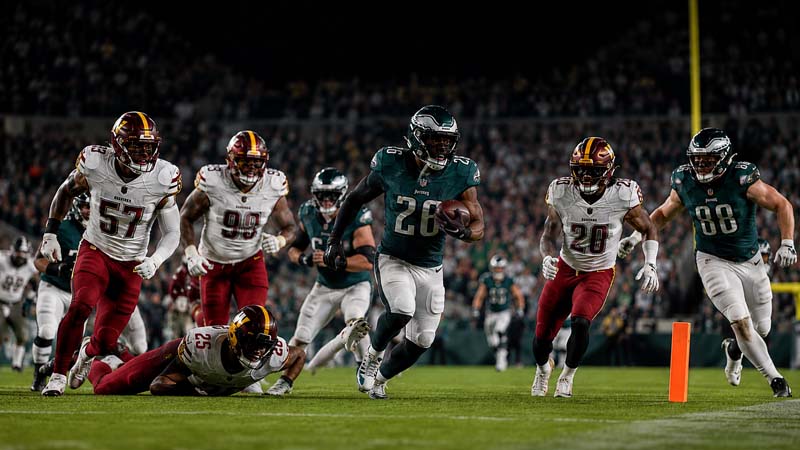
For anyone stepping into the world of American football, watching a game can initially feel like decoding a complex language.
The rapid whistles, the sudden halts, the hand signals from referees, and the strategic huddles can seem overwhelming to the uninitiated.
However, beneath the layered strategies and physical intensity lies a beautifully structured game governed by a clear, logical set of foundational rules.
Understanding these mechanics transforms the viewing experience. Instead of seeing a chaotic scramble on the grass, you will begin to appreciate the chess match taking place in real-time.
Whether you are preparing to watch your very first game or looking to solidify your understanding of why certain plays unfold the way they do, this guide will walk you through the essential rules of play, the mechanics of scoring, how possession changes, and the most common infractions that can alter the course of a drive.
Advancing the Ball and the Downs System
To appreciate the flow of a football game, one must first understand the spatial goal of the sport. The entire game is built around a simple, continuous battle for territory.
The Playing Field and the Ultimate Objective
The field of play is a rectangular area spanning exactly 100 yards, flanked on both ends by scoring zones known as the end zones.
The fundamental goal for the team on offense is to score the most points by successfully advancing an oval ball down this 100-yard field and into the opponent’s end zone.
The movement of the ball is highly structured. The offense can advance the ball using two primary methods:
- Running: A player physically carries the ball in their hands, sprinting forward through openings created by their teammates while attempting to avoid defenders.
- Passing: A player throws a forward pass through the air to an eligible teammate who catches it before it hits the ground.
The Mechanics of the Downs System
The rhythm of a football game is entirely dictated by “downs.” You can think of downs as a series of limited opportunities or attempts.
When a team takes possession of the ball, they are not allowed to simply run plays indefinitely until they score. Instead, the offensive team is granted exactly four chances, called “downs,” to gain a minimum of 10 yards.
The progression of this system works as follows:
- First Down: This is the starting point of a new sequence. The offense begins with “1st and 10,” meaning it is their first attempt, and they must gain 10 yards from the current spot of the ball.
- Second Down: If the first play gains, for example, 4 yards, the next play becomes “2nd and 6.” The offense now has three more attempts to cover the remaining 6 yards.
- Third Down: If the second play gains another 3 yards, the situation becomes “3rd and 3.” The pressure increases as they have only two attempts left to cross the original 10-yard threshold.
- Fourth Down: If the third play fails to gain the necessary yardage, the offense faces a critical decision point on fourth down. They must choose whether to attempt to gain the remaining yardage, kick a field goal, or surrender the ball strategically to keep the opponent as far from their own end zone as possible.
The moment the offensive team successfully covers 10 yards or more within their four attempts, the count immediately resets.
The referee marks the spot, and the offense is awarded a brand-new “first down,” granting them another four attempts to gain another 10 yards. This continuous cycle of resetting the downs is how teams march down the 100-yard field toward their scoring objective.
The Scoring System: How Points are Put on the Board
While advancing the ball is the method, scoring is the ultimate goal. Points can be accumulated in several distinct ways, reflecting different levels of achievement and risk on the field.
The table below outlines the specific scoring methods, their point values, and the conditions under which they are awarded:
| Scoring Method | Point Value | Core Condition for Earning Points |
|---|---|---|
| Touchdown | 6 Points | Awarded when a player successfully carries or catches the ball inside the opponent’s end zone. |
| Extra Point | 1 Point | A kick through the opponent’s goalposts, attempted immediately following a touchdown. |
| Two-Point Conversion | 2 Points | A single run or pass play executed from close range, attempted immediately following a touchdown. |
| Field Goal | 3 Points | A kick through the opponent’s goalposts, usually attempted on fourth down when the offense is too far for a touchdown but close enough to kick. |
| Safety | 2 Points | Awarded to the defensive team if they manage to tackle an offensive ball-carrier inside their own end zone. |
Understanding the Strategy Behind Each Score
Let us examine the tactical decisions surrounding these scoring mechanics:
- The Touchdown (6 Points): This is the premier achievement in American football. To earn a touchdown, a player must establish control of the ball by either carrying it across the goal line or catching a pass while securely inside the boundaries of the opponent’s end zone. Because it is worth 6 points, it represents the primary target of every offensive strategy.
- The Post-Touchdown Choice (1 or 2 Points): A touchdown is never a standalone event; it immediately triggers a secondary scoring opportunity. The scoring team must make a strategic decision:
- The Extra Point (1 Point): This is the safer, more traditional option. The team lines up and attempts to kick the ball through the upright goalposts.
- The Two-Point Conversion (2 Points): This is a high-risk, high-reward alternative. Instead of kicking, the team attempts a single running or passing play to get the ball into the end zone from a short distance. This is typically utilized later in games when a team desperately needs to catch up or secure a specific point margin.
- The Field Goal (3 Points): Not every offensive drive ends in a touchdown. When an offense moves the ball deep into opponent territory but hits a wall and faces a fourth down, they must evaluate their field position. If they are within kicking range, they will often send out their kicker to attempt a field goal. A successful kick through the upright goalposts yields 3 points, turning a halted drive into a scoring possession.
- The Safety (2 Points): The safety is a unique and rare score because it is awarded directly to the defense. If the offense is backed up near their own goal line, and the defensive team manages to swarm and tackle the offensive ball-carrier inside their own end zone, the defense is awarded 2 points. This rare event not only rewards the defense with points but also represents a massive shift in momentum.
How Plays End and Possession Changes?
A football game is a dynamic cycle of changing possession. Understanding how a single play ends and how the ball changes hands is vital to following the action.
How a Play Ends: Down by Contact
A play does not simply continue indefinitely until players get tired. Every individual play has a distinct ending. The most common way a play concludes is when a player is ruled “down by contact”.
According to the rules, a play officially ends and the runner is declared down when two conditions are met:
- A defensive player makes physical contact with the runner.
- Any part of the runner’s body—other than their hands or feet—touches the ground.
If a runner slips and falls without being touched by a defender, or if they are touched but remain on their feet, the play continues. The combination of defender contact and the runner’s knee, elbow, hip, or torso hitting the turf is what officially whistles the play dead.
Turnovers: Instant Possession Shifts
In football, the defense is not merely trying to stop the offense from gaining yards; they are actively seeking to steal possession of the ball. When the defense successfully takes the ball away, it is called a turnover. There are two primary ways the defense can force an instant change in possession mid-play:
- Interceptions: When the offense attempts to advance the ball through the air, they risk the ultimate defensive theft. If a defensive player catches a forward pass that was intended for an offensive receiver, they instantly gain possession for their team. The defender who caught the ball can immediately run in the opposite direction, attempting to score, while the previous offense must suddenly transition into defenders.
- Fumbles: Unlike an interception, which occurs in the air, a fumble happens on the ground. If an offensive player who has possession of the ball drops it while running or before the play is whistled dead, the ball becomes “live”. It is a mad scramble on the field: players from either the offense or the defense can recover the loose ball. If the defense recovers it, possession instantly switches; if the offense recovers it, they retain possession but must deal with the loss of yards and the continuation of their downs.
The Strategic Punt: Surrendering Safely
There are times when the offense must accept that their drive has stalled. This typically happens on fourth down.
If the offense is on their fourth attempt, has failed to reach the 10-yard marker, and is positioned too far from the opponent’s goalposts to realistically attempt a 3-point field goal, they face a dangerous scenario.
If they try to run a play to gain the remaining yards and fail, the opponent will take possession of the ball at that exact spot, giving them excellent field position.
To prevent this, teams employ the punt. The offense lines up on fourth down and kicks the ball far downfield to the opposing team. While this act willingly surrenders possession of the ball, it does so safely.
By kicking the ball deep into the opponent’s territory, the kicking team forces the opposing offense to start their own drive much further away from the scoring zone, protecting their own defense.
The Rules of Engagement: Common NFL Penalties
To maintain order and competitive fairness amidst high-impact physicality, officials enforce a strict rulebook. When a rule is broken, a yellow penalty flag is thrown onto the field, halting play and resulting in a penalty.
While there are dozens of technical rules, four common infractions make up the vast majority of calls during a typical game. Understanding these penalties will help you make sense of the sudden pauses and restarts in play.
1. Offside and False Starts (Pre-Snap Infractions)
Before a play begins, both teams must line up on opposite sides of an imaginary line that runs across the width of the field, known as the line of scrimmage. No player is allowed to cross this boundary or move prematurely until the ball is put into play (snapped).
- Offside: This is a defensive infraction. It occurs when a defensive player moves across the line of scrimmage before the snap of the ball, entering the offensive territory prematurely.
- False Start: This is an offensive infraction. It occurs when an offensive player makes a sudden, premature movement before the ball is snapped. Because the offense knows exactly when the play will start, they are held to a strict standard; any flinch or jump prior to the snap immediately halts the play and penalizes the offense.
2. Physical Boundaries: Holding and Pass Interference
Once the ball is snapped and the play is active, physical contact is heavily regulated to ensure fairness and safety.
- Holding: While blocking is a fundamental part of football, players are not allowed to grab and restrain their opponents. Holding occurs when a player illegally grabs, pulls, or restricts an opponent who does not have possession of the ball. This is most frequently called on offensive linemen trying to protect their passer or block for their runner, but it can be called on any player on the field.
- Pass Interference: When a forward pass is thrown high into the air, both the offensive receiver and the defensive player have an equal right to try and catch the ball. Pass interference occurs when a player illegally hinders or physically restricts an eligible receiver (or defender) from making a fair attempt to catch the forward pass. This includes pushing, grabbing, or tackling the opponent before the ball arrives.
Conclusion: Watching the Game with New Eyes
Every snap of a football is a story of strategy, physics, and execution. Now that you understand the fundamental goals of the game, you can watch the drama unfold with a deeper appreciation of the choices coaches and players make on every single play:
- You will recognize the critical nature of third downs, where teams must decide how aggressively to chase that 10-yard reset.
- You will appreciate the risk-reward calculation of going for a two-point conversion instead of a safe extra point.
- You will understand why a defender scrambling for a loose ball after a fumble is one of the most exciting moments in sports.
Armed with these core rules, you are no longer just an observer—you are a knowledgeable fan ready to enjoy the complex chess match of the gridiron. Grab some snacks, find a comfortable seat, and enjoy the next game with complete confidence!