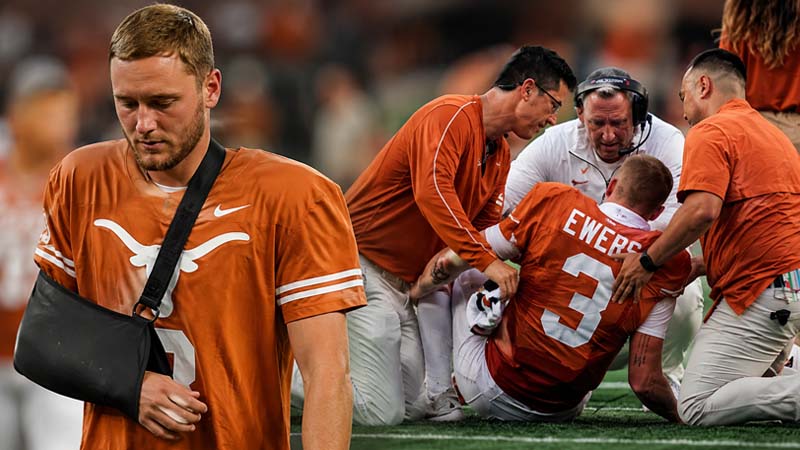
The trajectory of a professional quarterback is determined as much by physical durability as it is by arm talent. For Miami Dolphins quarterback Quinn Ewers, this balance has become the central focus of analysts, franchise executives, and fantasy managers alike.
Standing 6’2″ and weighing 211 pounds at 23.4 years of age, Ewers possesses the ideal physical frame of a modern pocket-passer. However, throughout his journey from elite collegiate prospect to the professional ranks, his medical history has been a subject of intense scrutiny.
To truly understand his outlook for the 2026 season and beyond, we must look past superficial headlines. A close evaluation of his historical injury ledger reveals a complex narrative. On one hand, he has sustained multiple shoulder, collarbone, abdominal, and lower-extremity setbacks.
On the other hand, the data highlights an underrated level of physical toughness, characterized by playing through severe structural issues that would sideline lesser athletes.
This deep-dive analysis decomposes his medical history, evaluates his current recovery status, and explores what the predictive modeling says about his long-term reliability in the National Football League.
The Preseason Setback: Inside the August 2026 Groin Injury
The latest chapter in Ewers’ physical ledger occurred early in the 2026 preseason. During an August 14, 2026 game against the Washington Commanders, Ewers sustained a groin injury early in the contest. The medical staff subsequently classified his recovery timeline as week-to-week, with an immediate expectation that he would be sidelined for at least one week of active preparation.
Groin Strain Recovery Profile:
|— Severity: Moderate / Week-to-Week
|— Primary Impact: Rotational torque, lower-body drive, lateral evasion
|— Expected Absence: Minimum 1 week (August 2026)
While a week-to-week groin strain is a common hurdle in August training camps, it presents unique challenges for a young quarterback.
The groin and pelvic region serve as the core foundation for a passer’s rotational torque, enabling the lower-body drive necessary to deliver deep throws with velocity. For Ewers, this temporary setback halts crucial reps as he seeks to build continuity within the Miami offense.
This injury is particularly frustrating given his career stage. After a 2025 regular season where he accumulated 622 passing yards, 19 rushing yards, 3 touchdowns, and 3 interceptions, the 2026 preseason was slated to be his primary developmental launching pad. Missing critical team periods, even for a week, complicates his immediate integration, though it does not necessarily derail his broader trajectory.
The Collegiate Ledger: Mapping the Physical Patterns at Texas
To contextualize his current professional health, we must examine the patterns established during his collegiate tenure with the Texas Longhorns. Between 2022 and 2024, Ewers’ collegiate campaigns were frequently interrupted by high-impact upper-body and core injuries.
The Left Clavicle Sprain and Separation (September 10, 2022)
During his freshman season at Texas, Ewers faced his first major physical test against Alabama. He absorbed a heavy hit from defender Dallas Turner, resulting in a left clavicle sprain and separation.
This high-impact injury forced him to miss three games. Because the injury occurred to his non-throwing shoulder, his long-term passing mechanics were preserved, but it established an early baseline for his recovery times under severe impact.
The Right Shoulder AC Joint Sprain (October 21, 2023)
In his sophomore season, Ewers suffered a right shoulder AC joint sprain during a game against Houston. Unlike the 2022 collarbone injury, this directly affected his throwing arm. Sidelined after a hard tackle, Ewers missed two games.
AC joint sprains can alter a passer’s release angle and velocity if not fully healed, but his subsequent performance showed a successful return to form without chronic mechanical degradation.
The Grade 2 Abdominal Muscle Strain (September 14, 2024)
Ewers’ junior year saw him suffer a Grade 2 abdominal muscle strain during a game against UTSA.
This oblique strain forced him to miss two consecutive games. Core muscle injuries are notoriously difficult for quarterbacks, as every throw requires rapid contraction of the abdominal wall.
The Professional Transition: Early NFL Physical Hurdles
Transitioning to the NFL introduces faster defensive lines and heavier hits. Ewers’ rookie and early professional experiences have shown that these physical demands remain highly relevant.
The Grade 1 Knee Strain (January 4, 2026)
At the tail end of his early professional career, Ewers sustained a Grade 1 knee strain. The injury occurred during the fourth quarter of the season finale against the New England Patriots.
Fortunately, being a Grade 1 strain, it was mild and did not require offseason surgical intervention. However, it marked his first documented professional lower-body joint injury.
Managing the Backfield Load
Ewers’ style of play is primarily that of a pocket passer, which is reflected in his limited rushing numbers. During his 2025 regular-season action, he recorded just 19 rushing yards alongside his 622 passing yards.
This limited mobility is a double-edged sword: while it reduces the number of hits he takes in the open field, his stationary posture in the pocket can make him vulnerable to heavy, blind-side hits from pass rushers.
Challenging the “Fragile” Narrative: Ewers’ Hidden Physical Toughness
A superficial glance at Ewers’ medical timeline might lead some commentators to label him as fragile.
However, a deeper look at the actual documented medical details reveals a player with a remarkably high pain tolerance who frequently plays through severe physical limitations.
The High-Ankle Sprain Resilience
On November 23, 2024, during his collegiate career, Ewers was hit during a scramble up the middle.
Head coach Steve Sarkisian described the play as a “hip-drop tackle, as they refer to it in the NFL”. The tackle resulted in a severe Grade 3 Pedal Ankle (high) Sprain.
Generally, a Grade 3 high-ankle sprain is a multi-week, if not multi-month, injury that severely limits lateral movement. Remarkably, Ewers did not miss a single game, playing through the structural instability and intense pain to lead his team down the stretch.
Playing Through Core Tears
Following his Grade 2 abdominal muscle strain against UTSA in September 2024, Ewers returned to the lineup after missing only two games.
However, subsequent medical reports revealed that he continued to play through the underlying abdominal issue for the remainder of the 2024 season.
Managing a torn oblique while throwing at an elite level requires immense physical resolve and specialized athletic management.
These instances prove that Ewers is not a player who easily surrenders to minor physical setbacks. When his team is in the hunt, he has repeatedly demonstrated a willingness to play through injuries that would sideline many of his peers.
Quantitative Durability Modeling: What the Projections Say for 2026
For analytical decision-makers and fantasy managers, quantitative modeling provides a clearer picture than narrative-driven speculation.
According to professional sports-health databases, Ewers’ projected outlook for the 2026 season is surprisingly optimistic.
| Quantitative Metric | Analytical Value | Strategic Significance |
|---|---|---|
| Overall Injury Risk | Very Low | Outperforms the baseline expectation for starting quarterbacks |
| Chance of Injury in 2026 | 22% | Suggests a nearly 4-in-5 chance of completing the season healthy |
| Chance of Injury per Game | 1.5% | Extremely low weekly exposure to catastrophic injury |
| Projected Games Missed (2026) | 0.80 | Expected to miss fewer than one full game due to physical setbacks |
| Durability Rating | 0.01 | A quantitative measure indicating minimal chronic wear-and-tear |
These numbers contrast sharply with the popular narrative surrounding Ewers. Despite his history of abdominal and shoulder issues, the mathematical models view his overall risk profile as Very Low.
A 22% chance of injury over an entire NFL season is exceptionally strong for a starting quarterback, and an expectation of missing just 0.80 games indicates that any potential setbacks are projected to be minor and short-lived.
Reconciling Current Status with Practice Reports
An interesting analytical detail is the reconciliation of his August 14 groin injury with his active status. Leading into upcoming game weeks, team practice reports have shown Ewers participating fully:
- Wednesday Practice: Full Participation
- Thursday Practice: Full Participation
- Friday Practice: Full Participation
- Game Status: Active (No Injury Status listed)
- Likelihood of Playing: High
This rapid return to full practice participation after his mid-August groin strain confirms the initial “week-to-week” diagnosis was handled with conservative precaution.
His ability to log full practices from Wednesday through Friday highlights a swift recovery and reinforces the “Very Low” overall injury risk designation calculated by predictive models.
Comprehensive Medical History Matrix
The following table provides a chronological summary of every documented physical setback Ewers has faced across his collegiate and professional careers.
| Date of Injury | Level / League | Injury Description | Primary Anatomy Affected | Games Missed | Play Context & Recovery Details |
|---|---|---|---|---|---|
| September 10, 2022 | Non-NFL | Clavicle Sprain / Separation | Left Shoulder | 3 | Absorbed a heavy hit from Alabama’s Dallas Turner during his freshman year. |
| October 21, 2023 | Non-NFL | A/C Joint Sprain | Right Shoulder (Throwing Arm) | 2 | Sustained after a hard tackle against Houston. |
| September 14, 2024 | Non-NFL | Abdomen Muscle / Oblique Strain (Grade 2) | Core / Oblique Muscle | 2 | Injured against UTSA; played through underlying core issues for the rest of the year. |
| November 23, 2024 | Non-NFL | Pedal Ankle Sprain (Grade 3 High Ankle) | Lower Extremity (Ankle Joint) | 0 | Sustained on a scramble via a hip-drop tackle. Played through the injury without missing time. |
| January 4, 2026 | NFL | Knee Strain (Grade 1) | Right Knee Joint | 0 (Season Finale) | Sustained during the fourth quarter against the New England Patriots. |
| August 14, 2026 | NFL | Groin Strain | Core / Lower Body | Preseason only | Sustained early in a preseason game against Washington. Returned to full practice by Week 1. |
Conclusion
Quinn Ewers presents a fascinating study in sports medicine and athletic projection. His medical history is undeniably active, with documented injuries stretching from his clavicle to his ankle.
Yet, the core takeaway from his physical journey is not fragility, but toughness. His ability to absorb high-impact contact and continue executing at an elite level—frequently playing through abdominal and ankle sprains—speaks to a player of high physical and mental resolve.
With predictive models projecting a modest 22% chance of injury and less than one expected missed game for the 2026 campaign, the data suggests that his physical history should not deter the Miami Dolphins or fantasy managers from viewing him as a highly viable asset.
If his core and throwing shoulder remain protected within Miami’s offensive system, Ewers has all the physical tools and personal grit required to establish himself as a highly reliable presence under center.