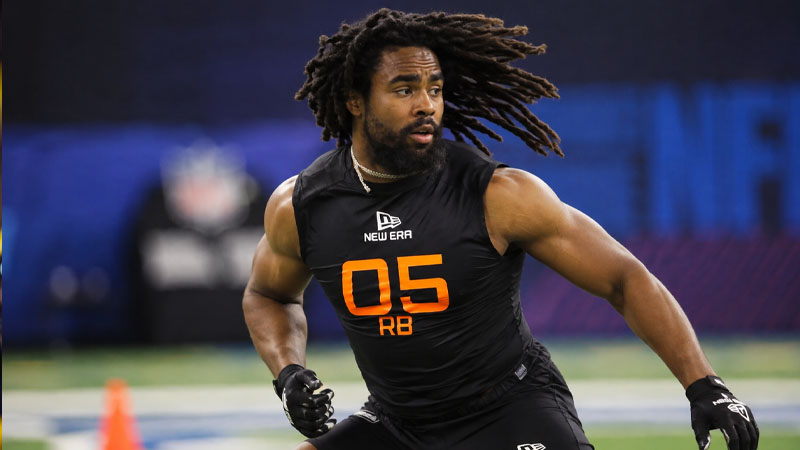
The NFL Scouting Combine serves as the ultimate laboratory for athletic evaluation, where years of collegiate production are distilled into a few hours of clinical measurement.
For Donovan Edwards, the 2025 event was more than a showcase; it was a verification of his physical ceiling.
Entering the draft cycle with a reputation for game-breaking speed at Michigan, Edwards faced the task of proving his acceleration and top-end velocity in a controlled environment.
The following analysis provides a granular look at his performance, the implications for his professional trajectory, and why his specific metrics align with the requirements of the modern NFL offense.
Quantitative Performance Metrics
To understand the value Edwards brings to an NFL backfield, we must first look at the official data captured during his session.
The 40-yard dash remains the gold standard for evaluating a prospect’s ability to stretch a defense and finish long runs.
| Metric | Measurement/Result |
|---|---|
| Official 40-Yard Dash Time | 4.44 Seconds |
| First Attempt | 4.45 Seconds |
| Second Attempt | 4.45 Seconds |
| Height | 5’11” |
| Weight | 205 lbs |
| Consistency Deviation | < 0.01 Seconds |
The data reveals a prospect with a highly stable physical floor. While many athletes fluctuate significantly between their two attempts, Edwards demonstrated a level of repeatable mechanics that suggests his speed is a permanent fixture of his athletic profile, rather than a statistical outlier.
The Mechanics of Resilience: Analyzing the Stumble
One of the most critical aspects of Edwards’ performance was not the official 4.44-second time itself, but the context of his first attempt. Despite a slight stumble at the start of his first run, he still managed to clock a 4.45-second time.
- Recovery Velocity: Recording a 4.45 while losing traction in the first ten yards indicates elite “recovery speed.” In a football context, this translates to a player who can maintain momentum even when contact or turf conditions disrupt their initial path.
- Mental Stability: Many prospects allow a poor start to compromise their entire performance. Edwards’ ability to return for a second attempt and deliver an identical 4.45—ultimately resulting in a 4.44 official time—shows a professional approach to high-stakes environments.
- The Sub-4.45 Club: In the modern era, a 205-pound back running in the 4.40 to 4.45 range is considered the “sweet spot” for three-down versatility.
Physical Dimensions and NFL Application
At 5’11” and 205 lbs, Edwards possesses a frame that provides a unique leverage advantage. This height-to-weight ratio is significant for several reasons:
- Center of Gravity: Standing at 5’11”, Edwards has the reach to be an effective pass-catcher while maintaining a low enough center of gravity to navigate tight interior rushing lanes.
- Speed-to-Power Conversion: A 4.44-second dash at 205 lbs suggests a high power-to-weight ratio. This allows him to sustain his speed even when carrying the additional weight of equipment and initiating contact with defenders.
- Durability and Mass: While speed-focused backs often fall under the 200-lb threshold, Edwards’ 205-lb frame suggests he has the requisite mass to handle the physical toll of a 17-game NFL season.
Strategic Implications for Draft Valuation
In the evaluation of running back prospects, scouts look for “differentiators.” Speed is the most common differentiator, but Edwards’ performance adds “verified consistency” to his portfolio.
- Home-Run Potential: A 4.44 official time confirms that Edwards can outrun NFL defensive backs in the open field. This shifts his scouting report from a “rotational piece” to a “big-play threat.”
- Special Teams Versatility: Players with this specific speed profile often find immediate value in the return game. His ability to accelerate quickly from a standstill—evidenced by his recovery from the stumble—is a trait highly valued by special teams coordinators.
- Draft Stock Stability: By meeting the expected speed thresholds, Edwards has mitigated the risk of a “draft day slide.” NFL teams are increasingly risk-averse; seeing a prospect deliver exactly what the film suggests provides a level of certainty that high-level organizations crave.
Comparative Evaluation: The 2025 Class Context
When placing Edwards’ 4.44-second time within the context of the 2025 class, it becomes clear he is among the upper echelon of athletes.
- The Speed Gap: Many “power” backs in this class struggled to break the 4.60-second mark. Edwards’ ability to run nearly two-tenths of a second faster while maintaining a 205-lb frame puts him in a rare tier of prospects.
- Consistency vs. Peak: While some athletes may have run a faster “peak” time, very few matched Edwards’ consistency of delivering sub-4.46 times on every attempt. This reliability is often a deciding factor for teams looking for “day-one starters.”
Technical Breakdown: The Components of 4.44
To achieve a 4.44-second 40-yard dash, several mechanical phases must align perfectly.
- The Initial Burst (0-10 Yards): This is where Edwards overcame his initial stumble. This phase is entirely about explosive power.
- The Transition Phase (10-20 Yards): In this window, the runner moves from a drive phase into a vertical posture. Edwards’ height of 5’11” allows for a longer stride length, which is advantageous in this middle section.
- Top-End Maintenance (20-40 Yards): This is where “track speed” takes over. Maintaining a 4.44 pace requires the athlete to resist deceleration. Edwards’ second 4.45 attempt confirms that his aerobic and anaerobic systems are optimized for late-run velocity.
Frequently Asked Questions
How does Donovan Edwards’ 40 time compare to other Michigan alumni?
While historical comparisons vary, his 4.44-second official time puts him among the fastest running backs to come out of the program in recent years, reinforcing the school’s reputation for producing NFL-ready athletes.
What was the most impressive part of his Combine performance?
While the 4.44-second time is the headline, the most impressive factor was his resilience. Recovering from a stumble to still clock a 4.45 on his first attempt is a feat few athletes can achieve.
Does his weight of 205 lbs limit his speed?
On the contrary, his performance proves that 205 lbs is an ideal weight for his frame. It provides the necessary bulk for NFL contact without sacrificing the 4.44-second speed that defines his game.
The Final Verdict: A Blueprint for Success
Donovan Edwards entered the 2025 NFL Combine with specific questions surrounding his elite-level speed and consistency.
By delivering an official 4.44-second 40-yard dash and showing remarkable stability across multiple attempts, he has answered those questions definitively.
For professional organizations, Edwards represents a high-floor, high-ceiling prospect. His measurements—5’11” and 205 lbs—are exactly what modern offensive coordinators look for in a versatile weapon.
Whether used as a traditional “between the tackles” runner or a vertical threat out of the backfield, his 4.44 speed is now a verified asset that will likely translate to a significant role at the next level.
In an industry where a hundredth of a second can equate to millions of dollars in draft value, Donovan Edwards’ performance was a masterclass in athletic precision and mental toughness.
He didn’t just run a fast time; he proved that his speed is a reliable, repeatable tool that is ready for the rigors of the NFL.