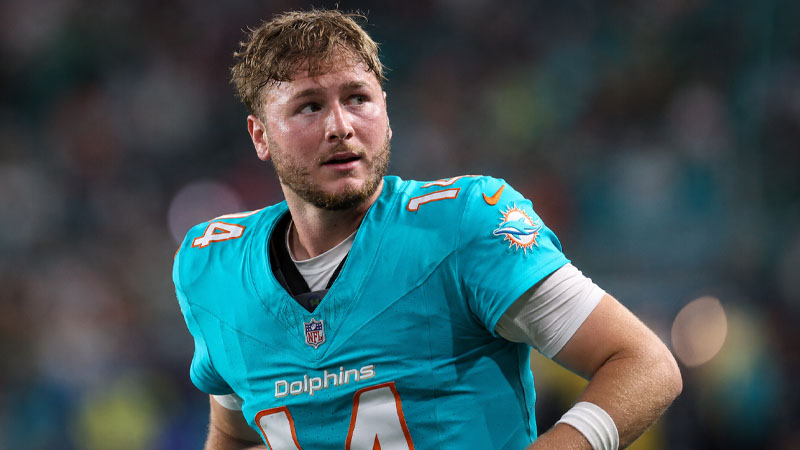
The intersection of collegiate hype and professional financial reality is a critical junction for any NFL franchise.
For the Miami Dolphins, the formalization of Quinn Ewers’ rookie contract represents more than just a depth chart addition; it is a calculated fiscal maneuver within the constraints of the NFL’s hard salary cap.
As teams increasingly look for “surplus value”—performance that exceeds the cost of the contract—the specifics of this deal provide a roadmap for how Miami intends to balance its books while maintaining a competitive roster.
In the modern era of professional football, the rookie wage scale has transformed high-potential prospects into the most valuable commodities in the league.
By locking in a player like Ewers to a fixed, four-year term, the Dolphins’ front office has secured a cost-controlled asset that allows for aggressive spending elsewhere on the roster.
Summary of Contractual Terms
The total valuation of the agreement sits at a structured $4,331,576, spread across a four-year duration.
This figure is representative of the slotted system dictated by the Collective Bargaining Agreement (CBA), which removes much of the negotiation volatility historically seen with top-tier prospects.
The following table outlines the primary financial pillars of the agreement:
| Contract Component | Value/Amount |
|---|---|
| Total Contract Value | $4,331,576 |
| Average Annual Value (AAV) | $1,082,894 |
| Total Guaranteed Money | $131,576 |
| Signing Bonus | $131,576 |
| Contract Length | 4 Years |
Annual Salary and Cap Management Roadmap
To understand the strategic utility of this contract, one must look at the “cap hit”—the actual amount that counts against the team’s total spending limit for a given year.
The Dolphins have backloaded the base salaries, which is standard practice to preserve immediate liquidity.
Year-by-Year Financial Obligations
- 2025 Fiscal Year: The inaugural season sees Ewers earning a base salary of $840,000. When factoring in the prorated portion of the signing bonus, the total impact on Miami’s salary cap is $872,894.
- 2026 Fiscal Year: In the second year, the base salary rises to $1,005,000, with a corresponding cap hit of $1,037,894.
- 2027 Fiscal Year: The third year crosses the million-dollar threshold for base pay at $1,120,000, resulting in a cap hit of $1,152,894.
- 2028 Fiscal Year: The final year of the rookie term peaks with a base salary of $1,235,000 and a total cap hit of $1,267,894.
This incremental growth is vital for long-term planning. It ensures that even in the final year of the deal, Ewers remains a relatively low-cost asset compared to the escalating market for veteran quarterbacks.
Strategic Analysis: Why the Numbers Matter
The “Guarantee” factor in this contract is particularly noteworthy. At $131,576, the total guaranteed money is tied specifically to the signing bonus. From a management perspective, this provides the Dolphins with significant flexibility.
Unlike veteran contracts that often feature high “dead money” (costs that must be paid even if the player is released), the risk profile here is remarkably low.
The Advantage of Cost-Controlled Talent
- Roster Flexibility: By keeping the quarterback room’s cap hit near the league minimum for a developmental player, the Dolphins can afford to retain high-priced playmakers at wide receiver and defensive end.
- Risk Mitigation: The low guaranteed sum means the team is not “pot-committed” to the contract if performance does not align with professional standards.
- Prorated Incentives: The signing bonus is typically paid upfront but spread across the length of the contract for cap purposes, which explains why the annual cap hit is consistently $32,894 higher than the base salary.
The Macro Environment: Comparing the Market
When analyzing Ewers’ $1,082,894 average annual salary, it is helpful to place it within the context of the broader NFL economy.
In a league where top-tier veteran quarterbacks are frequently commanding upwards of $50 million per year, having a player on the roster for approximately 2% of that cost is a massive competitive advantage.
Key Performance Indicators (KPIs) for the Deal
- Price-to-Performance Ratio: If Ewers develops into a viable starter or high-end backup, the Dolphins are essentially receiving millions of dollars in “free” production.
- Capital Allocation: This deal allows the front office to prioritize “win-now” veterans through free agency, as they aren’t bogged down by a massive rookie salary.
- Future Leverage: A four-year window gives the team ample time to evaluate Ewers’ ceiling before having to commit to a much larger, market-rate extension.
Institutional Insights: The Significance of the Signing Bonus
The signing bonus of $131,576 is the only portion of the contract that is fully protected. In professional football, “base salary” is often not guaranteed unless specifically negotiated. By tying the guarantees to the signing bonus, the Dolphins have followed a traditional conservative fiscal approach. This ensures the player receives immediate cash flow upon signing while the team maintains a clean exit strategy should it be required in the future.
Conclusion: A Masterclass in Fiscal Balance
The finalization of Quinn Ewers’ contract is a testament to the disciplined approach required to thrive in the NFL’s current economic climate.
By leveraging the rookie wage scale, the Miami Dolphins have acquired a high-upside asset with a total commitment of just over $4.33 million.
For fans and analysts, the numbers confirm a strategic reality: the Dolphins are positioning themselves for a window of sustained competitiveness.
The low cap hits of $872,894 in 2025 and $1,037,894 in 2026 provide the necessary breathing room to manage a star-studded roster without sacrificing future stability.
As the 2025 season approaches, the focus will shift from the ledger to the field. However, the foundation laid by this contract ensures that regardless of the outcome, the Dolphins have managed their risks and maximized their potential for a high return on investment.
Technical Breakdown: Annual Financial Commitments
| Year | Base Salary | Signing Bonus (Prorated) | Total Cap Hit |
|---|---|---|---|
| 2025 | $840,000 | $32,894 | $872,894 |
| 2026 | $1,005,000 | $32,894 | $1,037,894 |
| 2027 | $1,120,000 | $32,894 | $1,152,894 |
| 2028 | $1,235,000 | $32,894 | $1,267,894 |
Frequently Asked Questions
- What is the total value of Quinn Ewers’ contract? The contract is valued at a total of $4,331,576 over four years.
- How much of the contract is guaranteed? A total of $131,576 is guaranteed, all of which is tied to the player’s signing bonus.
- What is the average yearly salary? Ewers will earn an average of $1,082,894 per season.
- What is the highest cap hit during the deal? The contract peaks in 2028 with a cap hit of $1,267,894.