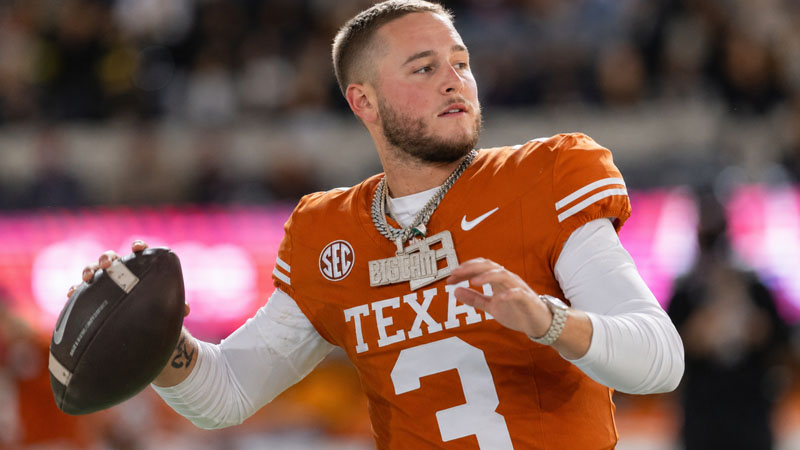
The trajectory of a highly touted athletic career is rarely a straight line, but few modern draft cycles have witnessed a slide as stark and analytical as that of former Texas quarterback Quinn Ewers.
Entering his final college seasons, public speculation and media pundits frequently projected him as a premium asset who could easily command a day-one or early day-two draft selection.
Yet, when the 2025 NFL Draft concluded, Ewers had fallen precipitously to the seventh round, ultimately selected with the 231st overall pick by the Miami Dolphins.
For football analysts and front offices, this dramatic slide represents a complex intersection of mechanical regression, chronic durability concerns, mental processing hurdles, and unique draft-room macroeconomic dynamics.
To understand why a player with his pedigree slipped to the final frame of the draft, one must look beyond generic talking points and dissect the specific on-field, medical, and psychological factors shaping NFL scouting reports.
This breakdown explores the multi-faceted reasons behind his draft-day slide and evaluates his professional outlook.
1. The Scouting Divide: Elite Drills vs. Game-Film Reality
One of the most persistent dichotomies in quarterback evaluation is the difference between performance in a controlled, non-contact environment and execution under the chaotic pressure of an active pass rush.
Throughout the pre-cycle, Ewers established himself as an exemplary performer during structured workouts and scripted throwing sessions.
Evaluators consistently noted his elite natural arm talent, defined by a remarkably quick release and an ability to effortlessly sling the football to all areas of the field during shorts-and-t-shirt drills.
His throwing motion in these optimized settings was clean, exhibiting the natural elasticity that originally made him a celebrated high school recruit.
However, once front offices transitioned from clean spring fields to raw game tape, a different narrative emerged. Scouts documented a profound drop-off in efficiency when Ewers was asked to operate outside of structured, single-read passing concepts:
- Short-to-Intermediate Mastery: When executing predetermined, quick-game throws—where he did not have to read defensive rotations or go through full-field progressions—Ewers was highly effective. His quick release allowed him to distribute the ball rapidly to playmakers in space.
- The Deep-Ball Collapse: Past the short-to-intermediate threshold, his efficiency plummeted. Evaluators noted severe limitations in his ability to drive the football outside the numbers and deep downfield. Rather than cutting through the air with velocity, his deep passes often lacked necessary “zip,” frequently appearing underthrown or floating.
This disparity created a significant division among front offices, with many concluding that his elite raw throwing traits did not consistently translate to actual game situations.
2. The Impact of Mechanics: Footwork Discrepancies and Coaching Whiplash
A quarterback’s upper-body release heavily depends on the stability of his lower-body platform. For Ewers, footwork inconsistencies served as a major root cause of his deep-ball inaccuracy.
Interestingly, his footwork was a point of notable debate. For instance, former NFL coach Jon Gruden publicly praised Ewers, stating that he possessed some of the best foundational footwork in the entire draft class.
Despite this praise, game film revealed a recurring pattern of lower-body instability, especially during high-leverage games or immediately following physical injuries.
This mechanical volatility was further exacerbated by conflicting developmental guidance. Over his career, Ewers underwent significant transitions in his dropback mechanics, switching from leading with his left foot to leading with his right foot during drops.
This adjustment disrupted his natural timing and rhythm, leading to highly erratic pocket footwork. Without an anchored base, he was forced to rely almost entirely on his upper body to drive the ball, increasing the physical strain on his throwing shoulder.
3. The Medical Evaluation: A Cumulative Concern Over Durability
In the modern NFL, availability is often valued just as highly as raw capability. For front offices considering Ewers in the early rounds, his extensive medical history presented an unacceptable risk profile.
Over his multi-year college career at Texas, Ewers missed significant time due to a wide array of physical setbacks, including injuries to his clavicle, shoulder, oblique, and ankle.
These recurring injuries did more than just sideline him; they actively degraded his on-field performance:
- Sapped Velocity: Ewers later revealed that a strained AC joint in his throwing arm severely restricted his shoulder’s natural range of motion, zapping his arm speed and causing a noticeable loss of velocity on deep throws.
- Statistical Regression: Operating at less than 100% capacity led to a noticeable decline in his efficiency and decision-making. In his final college campaign, Ewers threw more interceptions than in his previous two seasons combined.
NFL decision-makers worried that if collegiate defenders could routinely sideline Ewers, his frame and play style would struggle to survive the increased size and speed of NFL pass rushes.
4. Processing Under Pressure: Pocket Instincts and Blitz Responses
Beyond physical health and mechanics, playing quarterback in the NFL requires elite cognitive processing speed and spatial awareness. Scouting reports on Ewers highlighted critical limitations in his mental processing and pocket navigation under pressure.
One of the most difficult habits for a developmental quarterback to break is the tendency to lock onto a primary receiver pre-snap.
Evaluators noted that Ewers frequently decided where he was going with the football before the play developed, failing to scan the entire field.
When his primary target was covered, his processing speed slowed down, leaving him vulnerable to defensive packages.
Instead of stepping up into the pocket to buy time, Ewers frequently drifted backward or stood completely still, resulting in avoidable “self-sacks.”
When defensive coordinators dialed up heavy blitzes, his composure often eroded into jumpy and erratic play, raising severe doubts about his viability as an NFL starter.
5. The Longhorn System Critique: Evaluating Surrounding Talent
When evaluating college quarterbacks, NFL front offices must isolate individual talent from the quality of the surrounding system.
During his tenure at Texas, Ewers operated within an incredibly friendly environment under head coach Steve Sarkisian, supported by elite, NFL-caliber talent across both the offensive line and skill positions.
This abundance of talent proved to be a double-edged sword. While it allowed the team to achieve high-level collegiate success, it led NFL scouts to view Ewers as an unremarkable cog in a dominant machine rather than the driving force behind it. Critics argued his gaudy numbers were largely a product of his elite supporting cast making plays in space.
When comparing him to prospects who had to carry less-talented rosters, scouts concluded Ewers was a system-dependent passer lacking the individual dynamism to elevate an average roster.
6. Draft-Board Dynamics: The High-Profile Backup Penalty
While on-field and medical concerns explain why Ewers was not a day-one selection, his slide into the late seventh round was heavily influenced by the macroeconomic realities of the draft board and team-building psychology.
First, the quarterback market in the 2025 draft was historically cool, experiencing a dramatic slowdown where it took five full rounds just for six quarterbacks to be selected across the entire league. With fewer teams searching for immediate starters, the demand for developmental prospects plummeted.
Second, high-recognition college stars often face a unique penalty in late rounds. Front offices typically look to fill out depth charts with low-profile, highly compliant developmental backups.
Drafting a high-profile college star in late rounds can create unwanted media pressure and fan controversy if the established starter struggles. Many front offices preferred to bypass Ewers to avoid potential locker-room distractions.
7. The Miami Dolphins Landscape: Opportunity, System Fit, and QB2 Battles
Despite the disappointment of a seventh-round slide, the landing spot in Miami presents an intriguing developmental opportunity.
The Dolphins’ offensive scheme, designed by head coach Mike McDaniel, shares significant structural similarities with the concepts Ewers ran under Steve Sarkisian at Texas.
This conceptual familiarity should shorten his learning curve. Furthermore, Miami’s roster construction offers a realistic pathway to playing time given Tua Tagovailoa’s injury history.
However, Ewers faces immediate hurdles. His first challenge is a direct training camp battle against veteran Zach Wilson to secure the primary backup (QB2) role.
Moreover, early glimpses of Ewers in professional settings have highlighted ongoing growing pains; in limited action, he struggled mightily, completing just 1-of-7 passes for 27 yards, alongside a costly interception and a dismal 3.6 passer rating, serving as a stark reminder of the immense gap between collegiate system success and professional demands.
Strategic Outlook: Rebuilding the Prospect Pathway
Ultimately, Quinn Ewers’ draft slide serves as an instructive case study in the modern scouting landscape. It highlights the reality that high school recruiting stars and highly optimized collegiate environments do not guarantee early-round draft status.
NFL front offices are highly analytical, prioritizing medical durability, pocket poise, lower-body mechanical consistency, and full-field mental processing over raw, unstructured arm talent.
For Ewers, being selected 231st overall removes the crushing pressure of high draft expectations and places him in a low-risk, high-upside environment.
If he can remain healthy, stabilize his footwork, and master the mental demands of Mike McDaniel’s offense, he possesses the physical traits to eventually carve out a role as a reliable professional quarterback.
However, the margin for error in the NFL is razor-thin, and Ewers must quickly address his foundational developmental gaps if he hopes to transform his seventh-round draft slide into a story of professional resilience.