In professional football, linear speed is the ultimate strategic differentiator. It forces defensive coordinators to alter their coverage schemes, dictates safety positioning, and possesses the unique power to turn any routine play into an immediate touchdown.
Within the modern history of athletic evaluation, few names are as synonymous with pure, unadulterated vertical threat as Mecole Hardman.
By analyzing his raw numbers, timing data, and competitive performances, we can deconstruct the exact mechanics of elite human acceleration.
This deep dive examines the historical data from his showcase runs, breaks down the physics of his sprint splits, and analyzes how his competitive drive culminated in one of the fastest laser-timed match races ever recorded.
Deconstructing the 2019 Combine Showcase: Elite Consistency Under Pressure
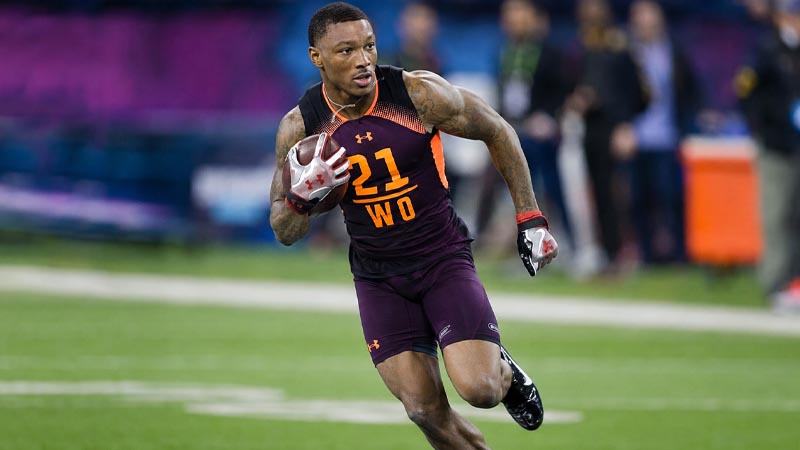
The annual scouting showcase in Indianapolis is the ultimate proving ground for collegiate prospects looking to transition to the professional ranks.
For speed specialists, the 40-yard dash is not merely a drill; it is a high-stakes auction where hundredths of a second can translate to millions of dollars in draft value.
When Mecole Hardman stepped onto the turf in 2019, expectations were high, but his performance cemented his status among the historic elite of the sport.
Hardman recorded an official, finalized 4.33-second 40-yard dash. To contextualize this achievement, a 4.33-second run placed him in the 94th percentile among all wide receivers evaluated historically.
Furthermore, his performance tied him for the third-fastest overall time recorded across all position groups at the entire 2019 event.
While the official time is what enters the record books, a closer look at his trial heats reveals a level of mechanical consistency that is arguably more impressive than the final number itself.
Under the immense pressure of the scouting environment, Hardman executed two preliminary heats with remarkable precision:
- First Attempt: 4.36 seconds
- Second Attempt: 4.34 seconds
- Official Finalized Time: 4.33 seconds
In professional track and short-distance sprinting, athletes typically experience a fatigue curve, where consecutive maximal-effort runs yield slightly slower times due to central nervous system fatigue and lactic acid accumulation.
Hardman, however, showed a reverse progression, getting progressively faster with each attempt.
This trajectory demonstrates exceptional aerobic recovery, a highly tuned neuromuscular system, and the ability to make rapid micro-adjustments to his starting stance and stride cycle under competitive conditions.
The Physics of Acceleration: Analyzing the Advanced Splits
To understand how speed translates to the football field, we must look beyond the final 40-yard time and analyze the incremental splits.
Linear speed is divided into three distinct phases: the start/drive phase (0 to 10 yards), the transition/acceleration phase (10 to 20 yards), and the maximum velocity phase (20 to 40 yards).
Hardman’s timing splits at the 2019 event provide a blueprint for elite acceleration:
- 10-Yard Split: 1.48 seconds
- 20-Yard Split: 2.57 seconds
The 10-Yard Split (The Drive Phase)
Clocking a 1.48-second 10-yard split is an extraordinary metric of raw power. In this initial phase, the runner must overcome inertia from a completely static, three-point stance.
This requires immense relative body strength, explosive hip extension, and a low projection angle. Hardman’s ability to clear the first 10 yards in under a second and a half indicates that his muscles can generate massive ground reaction forces instantly.
For coaches, this specific split is a critical metric: it represents “get-off” speed, or the ability to beat a defensive back’s press coverage at the line of scrimmage before they can even initiate contact.
The 20-Yard Split (The Transition Phase)
By reaching the 20-yard mark in 2.57 seconds, Hardman demonstrated a seamless transition from his initial drive phase into his maximum velocity mechanics.
During this 10-to-20-yard window, the torso gradually rises from its forward-lean angle into an upright posture, and the stride frequency increases.
Running this segment in just 1.09 seconds (the difference between his 10-yard and 20-yard splits) shows that his acceleration curve does not plateau early.
Instead, he continues to build momentum rapidly, entering his top-end speed phase with maximum kinetic energy.
The 4.22-Second Match Race: When Speed Meets Head-to-Head Competition
While the controlled, sterile environment of the scouting combine provides an excellent baseline for talent evaluators, direct competition often coaxes the absolute peak performance out of elite athletes.
This phenomenon was put to the test in May 2021 during a highly anticipated, simulated match race organized by Bleacher Report.
The event assembled a star-studded lineup of some of the fastest players in professional football, creating a high-pressure environment that mirrored the competitive tension of a real game. Hardman lined up directly against an incredibly fast field:
- Henry Ruggs III (celebrated for his vertical speed)
- Justin Jefferson (renowned for his elite route running and athletic range)
- Devin White (widely recognized as one of the most athletic, sideline-to-sideline linebackers in the sport)
Under the scrutiny of precise laser-timing equipment, Hardman rose to the occasion. He won the competition outright, clocking a spectacular 4.22-second 40-yard dash.
This 4.22-second run represents a significant improvement over his official combine time of 4.33 seconds.
While track surfaces, starting setups, and environmental factors can influence timing, the head-to-head competitive element undoubtedly pushed Hardman to access his absolute physical limit.
Winning a race against elite peers like Ruggs, Jefferson, and White solidified his reputation not just as a fast player, but as a dominant competitor capable of elevating his performance when the lights are brightest.
Strategic Implications: How Track Times Translate to Gridiron Dominance
Analyzing these times offers valuable lessons for sports scientists, coaches, and analytical minds.
A common critique of track speed is that it does not always translate to “football speed,” which requires wearing heavy protective pads, reacting to defensive movements, and changing directions. However, Hardman’s data points reveal why his speed is highly functional:
- Immediate Separation: A 1.48-second 10-yard split means that on vertical route concepts, defensive backs cannot afford to make a single physical or mental error at the snap. If a defender missteps or fails to jam Hardman at the line, the gap is closed instantly.
- Defensive Cushion Modification: Because defensive coordinators are acutely aware of his 4.33 combine speed and 4.22 competitive ceiling, they are forced to play with a deeper cushion. This fear of the deep ball opens up the underneath passing game, creating space for intermediate curls, slants, and comeback routes.
- Yards After Catch (YAC) Potential: When Hardman catches the ball in stride at the 15-to-20-yard depth, he is already at or near his peak velocity (well past his 2.57-second 20-yard split mark). At this stage, angle recovery becomes nearly impossible for pursuing defenders, converting short gains into massive, field-flipping plays.
Conclusion: The Velocity Standard
Mecole Hardman’s timing metrics—from his consistent combine heats of 4.36 and 4.34 to his official 4.33, and ultimately his blistering 4.22 match-race victory—demonstrate a rare combination of explosive power and competitive excellence.
By analyzing his split data, we gain a deeper appreciation for the fine margins that separate good athletes from truly elite speed threats. Hardman does not just run fast; his acceleration is engineered to dominate.