The modern professional football landscape is defined by a continuous negotiation between two competing organizational philosophies: the immediate pursuit of a championship window and the disciplined execution of a long-term financial and developmental reset.
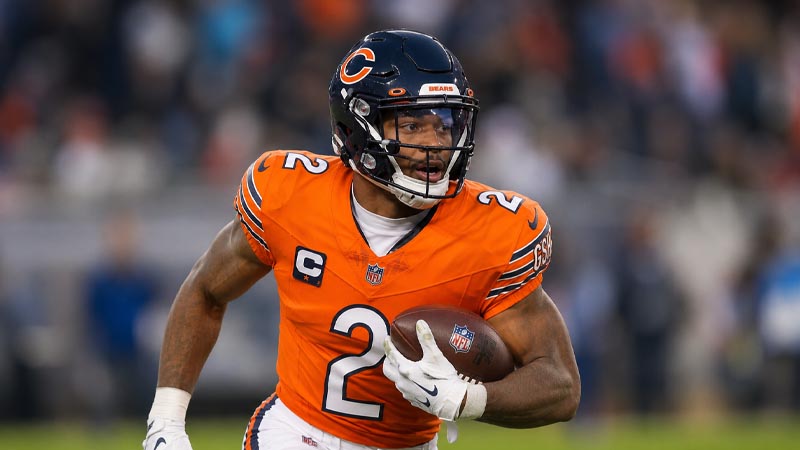
This structural tension has never been more visible than in the blockbuster trade that sent star wide receiver DJ Moore from the Chicago Bears to the Buffalo Bills.
For years, rumors had circulated regarding Moore’s future in Chicago. When the transaction finally materialized, it shook the foundations of both the NFC North and the AFC East, presenting a fascinating study in asset allocation, cap management, and schematic evolution.
This analysis deconstructs the deal from every angle, providing a comprehensive assessment of why both front offices made their moves, the financial realities of the trade, and how the acquisition alters the tactical landscape in Buffalo.
The Anatomy of the Transaction
To evaluate the impact of this trade, we must first establish the exact exchange of draft capital and player assets. The agreement is a clean, decisive realignment of resources:
- The Buffalo Bills acquire: Wide receiver DJ Moore and a 2026 fifth-round draft selection.
- The Chicago Bears acquire: A 2026 second-round draft selection.
At its core, the exchange highlights the different timelines of the two teams. Buffalo parted with premium draft capital (a second-round pick) to acquire an immediate, high-impact veteran to maximize their current competitive cycle.
Conversely, Chicago prioritized draft capital that aligns with their youthful trajectory, taking a future asset in exchange for a veteran player whose timeline no longer matched their rebuilding curve.
The Chicago Bears’ Perspective: Asset Realization and the Youth Movement
For Chicago, trading away a player of Moore’s caliber is a calculated maneuver centered on financial health and roster rejuvenation.
The decision was driven by two main factors: declining veteran production and a massive influx of elite, cost-controlled young talent.
The Financial Incentive: Clearing the Cap
From a balance-sheet perspective, keeping Moore at his projected cost was becoming unsustainable for a team undergoing a structural rebuild.
- The Cap Hit: Moore was scheduled to carry a massive $28.5 million cap hit for the 2026 season.
- The Cap Relief: By executing the trade, Chicago cleared $16.5 million in immediate cap space for 2026.
In the modern football economy, clearing $16.5 million in cap space provides a front office with immense operational flexibility. Those resources can be redeployed to bolster defensive depth, invest in the offensive line, or carry over space to future years when their young core enters their second contracts.
The Rise of the Next Generation
Roster construction is a game of opportunity cost. Keeping a highly paid veteran on the field inevitably takes away targets and developmental snaps from younger players.
The Bears’ front office recognized that their offensive future belongs to a dynamic, young receiving group, specifically Rome Odunze and Luther Burden III.
Moore’s statistical production had begun to dip, as he registered 50 receptions for 682 yards in 2025.
With Odunze and Burden III requiring more targets to accelerate their development, paying a premium salary of $28.5 million for declining veteran production was a luxury the Bears could no longer justify.
By moving Moore, Chicago cleared both the financial ledger and the depth chart, allowing their highly touted rookies to step into prominent roles as the primary targets in the passing game.
The Buffalo Bills’ Perspective: Securing the Definitive WR1
If Chicago’s strategy is defined by future flexibility, Buffalo’s strategy is defined by immediate urgency. The Bills have spent seasons searching for a true, elite boundary receiver capable of commanding defensive attention and opening up the entire passing offense.
In DJ Moore, they have acquired the definitive WR1 that quarterback Josh Allen has desperately needed.
The Price of Championship Ambition
To secure Moore, Buffalo was highly aggressive, not only giving up a valuable second-round pick but also taking on significant financial commitments:
- 2026 Commitment: Buffalo fully guaranteed Moore’s $23.5 million base salary for the 2026 season.
- 2028 Commitment: The Bills guaranteed $15.5 million of Moore’s base salary all the way out in 2028, signaling that they view him as a long-term foundation of their offense rather than a short-term rental.
This financial structure shows that Buffalo is fully committed to their championship window. They are willing to absorb high salary guarantees to ensure their franchise quarterback has an elite target during his peak physical year.
The Joe Brady Reunion: Schematic Familiarity and Tactical Continuity
A transition to a new franchise can often be hindered by the steep learning curve of a new offensive system. However, Moore bypasses much of this friction due to a crucial coaching connection in Buffalo.
The Carolina Connection
Buffalo’s head coach, Joe Brady, is in his first year leading the team. Brady and Moore have a rich history together, having worked closely during some of Moore’s most productive seasons with the Carolina Panthers, where Brady served as his offensive coordinator.
This reunion is a major advantage for both player and team. Brady understands Moore’s strengths, his preferred route stems, and how he handles defensive coverage adjustments.
Moore, in turn, is already familiar with Brady’s offensive terminology, pre-snap motion concepts, and structural expectations. This shared history removes the typical integration period, allowing Moore to play fast and confident from his very first snap in training camp.
Schematic Evolution: How Moore Unlocks Josh Allen’s Arm
The physical partnership between DJ Moore and Josh Allen represents a perfect marriage of talent and system design. Allen possesses one of the most powerful arms in professional football, but maximizing that arm requires receivers who can consistently win in the deep and intermediate areas of the field.
Shifting the Route Tree
In Chicago, Moore’s usage was sometimes constrained by passing game limitations. In Buffalo, the plan is entirely different. Team insiders have noted that the coaching staff intends to heavily shift Moore’s offensive usage toward deep- and intermediate-breaking routes.
This schematic adjustment is designed to maximize Moore’s elite field-stretching capability.
- Deep-Breaking Routes (Post, Go, Seam): By running vertical and deep-breaking patterns, Moore can use his speed to threaten safeties, forcing defenses to play with deeper coverages. This vertical stretch creates massive space underneath for tight ends and running backs.
- Intermediate-Breaking Routes (Digs, Out-Routes, Comebacks): Josh Allen excels at driving the football into tight windows at the intermediate level. Moore’s route-running precision allows him to separate at the break point, providing Allen with a highly reliable target on third downs and in critical passing situations.
Training Camp Integration and Physical Readiness
Any concerns about a veteran receiver transitioning to a new environment have been put to rest by Moore’s performance in training camp. Recent reports indicate that Moore is completely healthy and fully embedded in Buffalo’s practices.
Being healthy and present for the entirety of training camp is crucial. It allows Moore and Allen to build the non-verbal chemistry required to complete high-difficulty throws on the move.
When Allen flushes out of the pocket on scramble drills, knowing exactly where Moore will break is the difference between a spectacular first down and a costly turnover.
The early reports suggest that this connection is developing rapidly, laying a strong foundation for the upcoming campaign.
The Macro Impact: Roster Timelines and Future Projections
To truly appreciate this trade, we must look at how it repositions both franchises for the next three seasons.
The Chicago Bears: A Clean Slate for 2026 and Beyond
By trading Moore, Chicago has accepted the reality that they are building for a window that opens fully in 2026 and beyond.
- Draft Capital: The acquisition of a 2026 second-round pick gives them an incredibly valuable asset in a draft class that will be vital for filling out their young roster.
- Financial Freedom: Saving $16.5 million in cap space in 2026 gives them the resources to be major players in free agency. They can target experienced offensive linemen to protect their young quarterback or add defensive playmakers to complement their developing secondary.
- Unleashing the Youth: Most importantly, they have cleared the path for Rome Odunze and Luther Burden III to become the faces of the franchise. If these young receivers develop into elite options on rookie contracts, the Bears will have built one of the most efficient and dangerous roster structures in professional football.
The Buffalo Bills: Eliminating Excuses in the Championship Window
For Buffalo, this move is a declaration of intent. The AFC is a highly competitive conference, and elite quarterback play must be supported by elite pass-catching talent.
- The WR1 Solution: By guaranteeing $23.5 million for Moore in 2026, the Bills have resolved their biggest offensive weakness. They no longer have to rely on a committee of secondary options to move the chains.
- Maximizing Allen: They have paired Josh Allen with a receiver who fits his physical skill set perfectly, guided by a head coach who knows exactly how to put both of them in positions to succeed.
- The Long-Term Commitment: The $15.5 million guarantee for 2028 shows that this is not a short-term panic move. Buffalo has secured a high-end receiving weapon for the foreseeable future, ensuring their passing offense remains potent for years to come.
Conclusion: A Win-Win of Differing Timelines
The trade of DJ Moore is a rare example of a transaction where both teams successfully aligned their rosters with their long-term organizational goals.
The Chicago Bears gained valuable draft capital and cleared significant cap space to build a sustainable, young, and cost-controlled roster around Rome Odunze and Luther Burden III.
The Buffalo Bills secured an elite, healthy WR1 who is already familiar with their head coach’s offensive system, giving Josh Allen a dangerous field-stretching threat for their championship pursuit.
As Moore takes the field in Buffalo’s training camp, the trade stands as a fascinating example of how modern NFL franchises navigate the complex balance between immediate success and future planning.